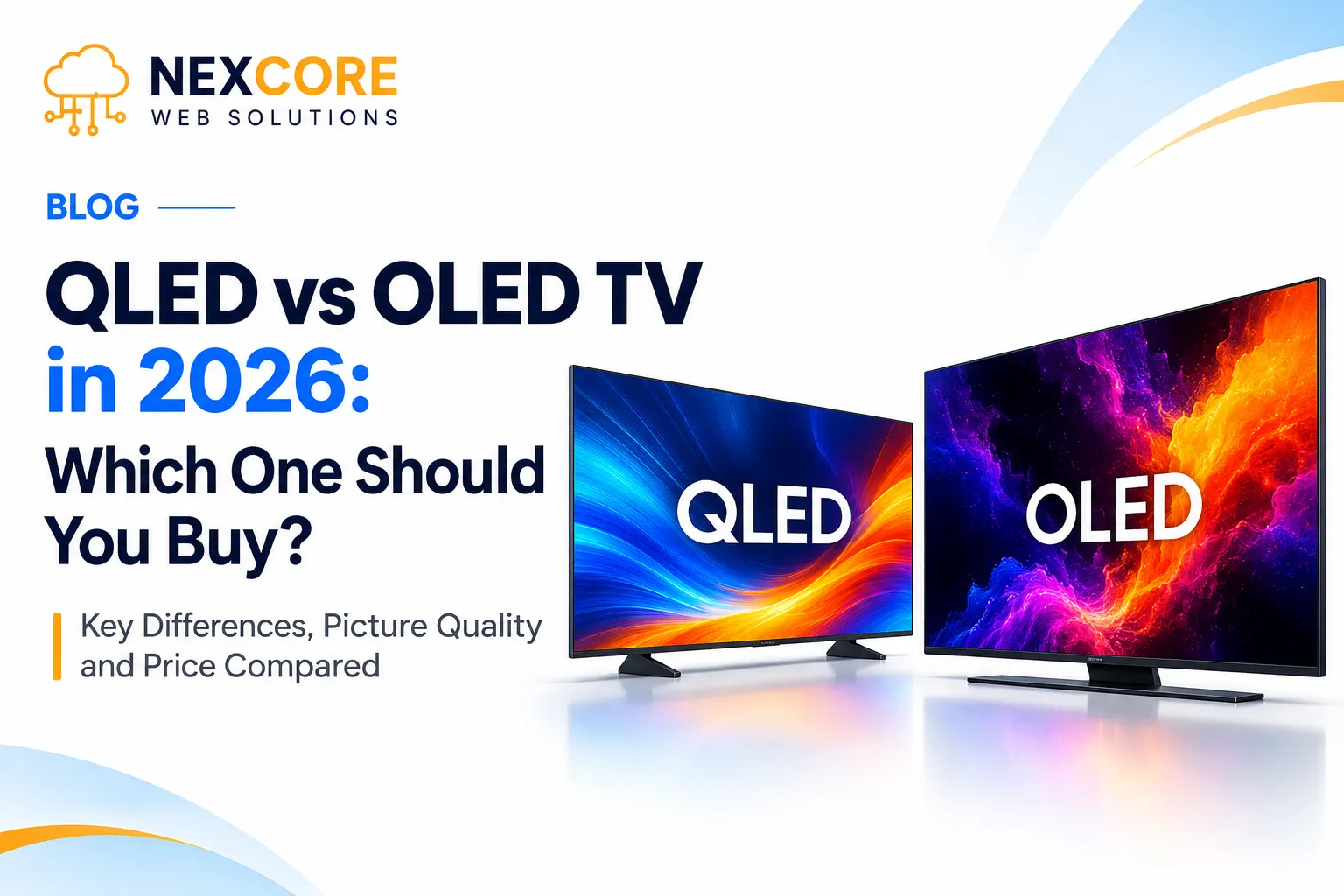
Choosing a new television in 2026 involves more than comparing screen sizes and smart features. QLED and OLED are two popular display technologies, but they produce images differently and offer distinct advantages. QLED televisions generally appeal to buyers who want high brightness, vibrant colours, and good value, while OLED models are known for deep blacks, excellent contrast, and precise picture control. The right choice depends on your room lighting, viewing habits, budget, and preferred screen size. Whether you watch movies, follow sports, play console games, or stream everyday entertainment, understanding these differences can help you avoid spending money on features you may not need.
What Is the Difference Between QLED and OLED?
Understanding QLED Technology
QLED stands for Quantum Dot Light Emitting Diode. It uses an LCD panel with a backlight and a quantum dot layer to improve colour reproduction and brightness. Because the television relies on a backlight, its pixels cannot individually switch off in the same way as OLED pixels. Some premium QLED televisions use Mini-LED backlighting with local dimming, which improves contrast by controlling smaller areas of the screen.
Understanding OLED Technology
OLED stands for Organic Light Emitting Diode. Each pixel produces its own light, so individual pixels can turn off completely when displaying black. This creates excellent contrast and helps dark scenes look more realistic. OLED televisions also provide wide viewing angles and fast pixel response, making them attractive for films, gaming, and premium home entertainment.
QLED vs OLED: Quick Comparison Table
| Feature | QLED TV | OLED TV |
|---|---|---|
| Display technology | LCD with quantum dots and backlight | Self-emissive pixels |
| Black levels | Good to excellent, depending on dimming | True black |
| Contrast | Depends on backlight control | Excellent pixel-level contrast |
| Brightness | Generally higher on many models | Strong, but varies by model |
| Colour quality | Bright and vibrant | Rich and accurate |
| Viewing angles | Usually narrower | Generally wider |
| Response time | Varies by panel | Typically very fast |
| Burn-in risk | No typical OLED-style burn-in | Possible with prolonged static content |
| Bright rooms | Often a strong choice | Model-dependent |
| Dark-room movies | Good, especially Mini-LED | Excellent |
| Price | Often more affordable | Usually more expensive |
| Best for | Bright rooms and value | Movies, contrast, and gaming |
Picture Quality: Which Technology Looks Better?
Brightness and Colour Performance
QLED televisions are often a strong choice for rooms with large windows or significant daylight. Their backlight systems can produce high brightness, helping pictures remain visible in challenging lighting conditions. Quantum dot technology also supports a wide colour range, making sports, animated films, and nature documentaries look colourful. However, actual brightness and colour accuracy depend on the television’s panel, processing, and picture settings.
OLED televisions produce impressive colours too, but their biggest advantage is contrast rather than maximum brightness. Since each pixel controls its own light, bright objects can appear against genuinely black backgrounds. This makes films and television shows with dramatic lighting particularly enjoyable. Premium OLED models can also deliver substantial brightness, so buyers should compare individual models rather than assume every QLED is brighter than every OLED.
Black Levels and Contrast
OLED has a clear technical advantage when displaying dark scenes. Individual pixels can switch off, preventing the backlight glow that can appear around bright objects on some LCD televisions. This is particularly useful when watching movies in a dark room. High-end QLED and Mini-LED models can reduce this issue through local dimming, but results vary with the number of dimming zones and processing quality.
Gaming Performance and Everyday Entertainment
Both technologies can provide excellent gaming experiences when the selected model includes suitable HDMI 2.1 features, variable refresh rate, and low input lag. OLED televisions are especially attractive for fast-paced games because their pixel response is extremely quick. This helps reduce motion blur during rapid camera movement. QLED and Mini-LED televisions can also deliver smooth gaming, particularly when they support high refresh rates and gaming-focused picture modes.
For everyday television viewing, the difference depends on the content and room conditions. QLED can be practical for daytime sports, news, and family entertainment because of its brightness. OLED is particularly appealing for cinematic streaming, gaming, and evening viewing. Always check the exact model’s refresh rate, HDMI ports, supported gaming formats, and input lag before purchasing.
Lifespan, Burn-In, and Maintenance
QLED televisions do not have the same organic-pixel burn-in concern associated with OLED technology. This makes them appealing for households that display news channels, sports scoreboards, or static computer interfaces for extended periods. OLED panels can experience permanent image retention when static elements remain on screen for prolonged periods over time. Modern OLED televisions include protective features, but these reduce risk rather than guarantee that burn-in cannot happen.
QLED vs OLED TV Price in India in 2026
Price is one of the biggest differences between these technologies. Standard QLED televisions are available across a wide range of budgets, while OLED models generally occupy the premium segment. As a 2026 reference, Samsung’s announced Indian lineup starts at ₹52,990 for Neo QLED and ₹1,14,990 for OLED. Actual prices vary by screen size, model, retailer, and promotional offers. Samsung Newsroom India+1
For a more affordable purchase, compare standard QLED and Mini-LED models from brands such as Samsung, TCL, and Hisense. If you are considering OLED, compare models from LG, Samsung, and Sony rather than choosing based on the panel label alone. Check the same screen size and similar feature levels before judging value. A discounted premium QLED may offer better overall value than an entry-level OLED, depending on your priorities.
Which TV Should You Buy in 2026?
Choose QLED if your television will be used mainly in a bright living room, you watch sports and regular television during the day, or you want a larger screen within a controlled budget. Mini-LED QLED is worth considering when you want better contrast than standard QLED can provide. Check local dimming performance and independent reviews before buying.
Choose OLED if you watch films in a darker room, value accurate shadow detail, or want excellent pixel response for gaming. It is particularly attractive for viewers who notice black levels and contrast in cinematic content. If your television displays static logos or computer interfaces for many hours every day, consider your usage pattern and the manufacturer’s burn-in protection guidance.
Conclusion
There is no universal winner in the QLED vs OLED comparison because both technologies serve different viewing needs. QLED is often the sensible choice for bright rooms, everyday entertainment, and buyers seeking more screen size for their money. OLED is the stronger option for deep blacks, cinematic contrast, wide viewing angles, and responsive gaming. Before purchasing, compare specific models, not just display categories. Check brightness, reflection handling, refresh rate, HDMI connectivity, warranty, and after-sales support. The best television is the one that suits your room, viewing habits, and budget rather than simply the one with the most expensive display technology.
FAQs
1. Is OLED better than QLED in 2026?
OLED is generally better for perfect black levels, contrast, viewing angles, and fast pixel response. QLED can be better for bright rooms and tighter budgets, particularly when the television uses effective Mini-LED local dimming. The better option depends on the specific models and how you watch television.
2. Which TV is better for a bright living room?
A high-brightness QLED or Mini-LED television is often a practical choice for a bright living room. Its backlight can produce strong brightness that helps overcome daylight and reflections. However, some newer OLED models also offer improved brightness and anti-reflection features, so compare real-world performance before deciding.
3. Does OLED TV suffer from burn-in?
OLED panels can develop permanent image retention when the same static elements remain visible for extended periods over time. Modern models include protective features such as pixel shifting and panel maintenance routines. These features reduce risk but do not eliminate it completely. Normal varied viewing is generally less concerning than prolonged static display.
4. Is QLED cheaper than OLED?
QLED televisions are generally available at lower starting prices and across more budget categories. OLED models usually cost more because they use self-emissive panels and target the premium market. However, discounts, screen sizes, and model generations can change the price difference. Compare televisions with similar features before making a decision.
5. Which is better for PS5 and Xbox gaming, QLED or OLED?
Both QLED and OLED can work very well with PS5 and Xbox consoles when they support HDMI 2.1, 4K at 120Hz, and variable refresh rate. OLED offers especially fast pixel response, while QLED and Mini-LED can deliver bright gaming visuals. Check the exact model’s gaming specifications rather than relying only on its display type.