
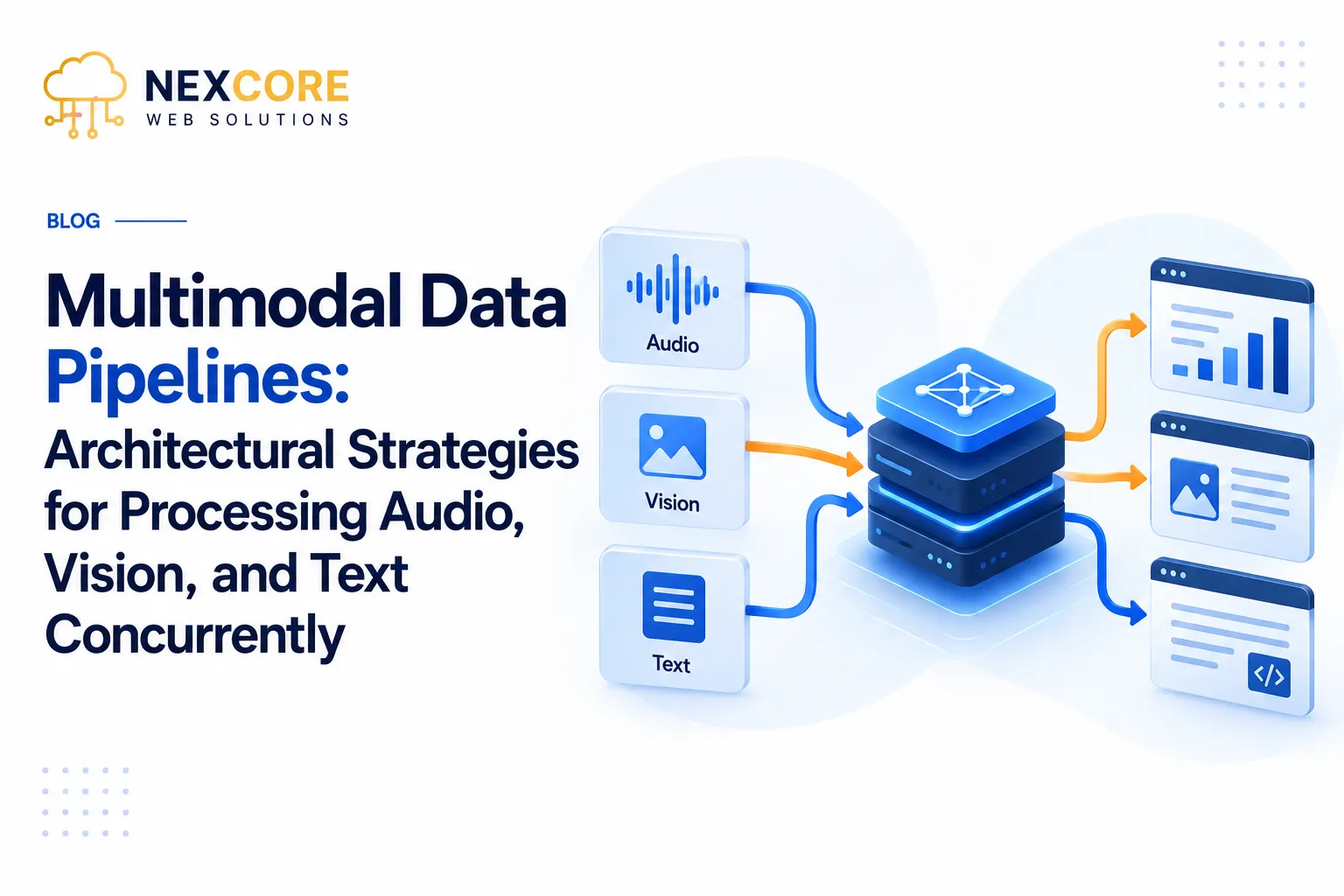
Modern applications increasingly need to understand more than one type of information at a time. A customer support platform may analyze spoken conversations, recognize objects in uploaded images, and interpret written messages to provide a complete response. These capabilities depend on multimodal data pipelines that collect, process, synchronize, and combine audio, vision, and text. Building such systems requires more than connecting separate machine learning models. Architects must consider data formats, processing speed, synchronization, storage, security, and scalability. A well-designed pipeline allows different modalities to work together without creating unnecessary delays or infrastructure complexity. As businesses adopt multimodal AI, reliable pipeline architecture becomes essential for delivering accurate and responsive applications.
Understanding Multimodal Data Pipelines
A multimodal data pipeline is an infrastructure system designed to process multiple data types within a coordinated workflow. Unlike traditional pipelines that handle structured records or individual media formats, multimodal systems combine information from different sources. Audio may arrive through microphones, video through cameras, and text through applications or documents. Each input requires specific processing before the system can connect the information.
For example, an industrial monitoring application may receive video from factory cameras, audio from machine sensors, and text from maintenance reports. Computer vision can identify visible equipment damage, audio models can detect unusual operating sounds, and language models can interpret technician observations. Combining these outputs gives the application a broader understanding of equipment conditions. This approach supports more informed decisions than analyzing each input independently.
Core Architectural Components
Data Ingestion and Normalization
The ingestion layer receives incoming information from devices, applications, APIs, and streaming platforms. It should support different formats, including audio streams, image files, video frames, and text records. Normalization converts these inputs into consistent representations while preserving important metadata such as timestamps, source identifiers, and session information. Without reliable metadata, connecting information from different sources becomes difficult.
A practical architecture uses dedicated ingestion services for each modality. Audio services may receive microphone streams, while vision services process uploaded images or extracted video frames. Text services can collect messages, transcripts, and documents. These services publish standardized events to a shared messaging layer, allowing downstream components to process information independently.
Modality-Specific Processing
Each data type requires specialized processing techniques. Audio pipelines may perform noise reduction, speech recognition, speaker identification, and sound classification. Vision pipelines commonly use image preprocessing, object detection, optical character recognition, and scene analysis. Text pipelines may handle language detection, entity extraction, summarization, and semantic classification.
Keeping these operations separate improves maintainability and allows teams to select suitable models for each task. However, the outputs should follow common interface contracts. For example, an audio service might produce a timestamped transcript, while a vision service returns detected objects with confidence scores. Consistent output structures make it easier for later components to combine their results.
Synchronizing Audio, Vision, and Text
Synchronization is one of the most challenging parts of multimodal architecture. Information from different sources rarely arrives at exactly the same time. A video frame, spoken instruction, and written annotation may describe the same event but have different timestamps. If the system combines unrelated moments, its final interpretation can become inaccurate.
Architects can address this problem through event timestamps, session identifiers, and bounded processing windows. A video conferencing platform, for instance, can associate speech transcripts with the corresponding video frames using synchronized timestamps. Event-time processing also helps manage delayed messages and out-of-order delivery. These mechanisms create a more consistent context for multimodal reasoning.
Choosing a Suitable Processing Architecture
Streaming and Batch Processing
Streaming architecture is useful when applications require immediate responses. Video monitoring, live transcription, and interactive assistants benefit from processing data continuously as it arrives. Message brokers and event streaming platforms can distribute incoming events to independent processing services. This design supports horizontal scaling and reduces direct dependencies between components.
Batch processing is more suitable for large collections of stored media. Organizations may use it to analyze recorded meetings, archived surveillance footage, or historical customer interactions. A hybrid architecture often provides the best balance by handling urgent events through streaming while processing resource-intensive historical workloads in batches.
Shared Storage and Message Queues
Multimodal systems should separate large media storage from event delivery. Object storage can hold audio recordings, images, and video files, while message queues carry references, metadata, and processing instructions. This prevents large media payloads from overwhelming messaging infrastructure. It also allows processing services to retrieve files when required.
Multimodal Fusion and AI Model Integration
After individual services process their inputs, the system needs a fusion strategy. Early fusion combines representations from different modalities before model inference, allowing the model to learn relationships between them. Late fusion processes each modality independently and combines the resulting predictions or embeddings. The appropriate method depends on the application’s accuracy, latency, and resource requirements.
For example, a virtual assistant may combine speech transcription, facial expressions, and written conversation history to understand a user’s request. Late fusion can simplify integration when different models already operate independently. Early fusion may provide richer context when synchronized inputs are available and the model supports multimodal representations. Teams should evaluate both approaches using representative data rather than assuming one method always performs better.
Scalability, Security, and Reliability
Multimodal workloads can consume significant computing resources, particularly when video processing and large neural networks operate simultaneously. GPU scheduling, workload isolation, autoscaling, and asynchronous execution help prevent one service from slowing down the entire pipeline. Monitoring should track processing latency, queue depth, model errors, resource utilization, and dropped events. These measurements reveal performance problems before they affect application users.
Security also requires attention at every processing stage. Audio recordings, facial images, and text conversations may contain sensitive personal or business information. Encryption, access controls, retention policies, and audit logs help protect these assets. Organizations should also validate incoming files, control model access, and apply appropriate privacy safeguards before using data for training or inference.
Conclusion
Multimodal data pipelines provide the foundation for applications that need to understand audio, images, and text together. Successful architecture depends on reliable ingestion, specialized processing, accurate synchronization, and an effective fusion strategy. Streaming and batch processing can work together to support both real-time experiences and large-scale analysis. Organizations must also prioritize scalability, observability, security, and consistent data contracts. Rather than building one complicated processing service, engineering teams should develop modular components that communicate through clearly defined interfaces. This approach makes multimodal systems easier to maintain, expand, and improve as new models and business requirements emerge.
FAQs
1. What is a multimodal data pipeline?
A multimodal data pipeline is a system that collects and processes different data types, such as audio, images, video, and text, within a coordinated architecture. It uses specialized processing services to extract useful information from each input. The resulting outputs can then be synchronized and combined to support applications such as intelligent assistants, video analytics, and automated monitoring.
2. How do multimodal pipelines process audio, vision, and text together?
Multimodal pipelines process each input through suitable services before combining their outputs. Audio services can generate transcripts, vision models can identify objects, and language processing services can interpret written information. Timestamps, session identifiers, and shared metadata connect related events. A fusion component then combines the processed information to create a more complete understanding of the situation.
3. What is the difference between early fusion and late fusion?
Early fusion combines information from multiple modalities before or during model inference, allowing a model to learn relationships between different inputs. Late fusion processes each modality separately and combines the resulting predictions or representations afterward. Early fusion can provide richer contextual learning, while late fusion offers flexibility when organizations use independent models for audio, vision, and text processing.
4. Which technologies are used to build multimodal data pipelines?
Multimodal architectures commonly use message brokers, streaming platforms, object storage, container orchestration, and machine learning frameworks. Technologies such as Apache Kafka can distribute events, while cloud object storage holds large media files. Specialized audio, computer vision, and language models handle modality-specific tasks. The final technology selection depends on workload size, latency requirements, deployment environment, and operational expertise.
5. What are the biggest challenges in multimodal pipeline architecture?
Major challenges include synchronizing different data streams, managing large media files, controlling processing latency, and maintaining consistent outputs across independent services. Resource-intensive models can also increase infrastructure costs, particularly for continuous video analysis. Security and privacy require additional controls because media may contain sensitive information. Modular architecture, monitoring, standardized interfaces, and careful workload management help address these challenges.




