
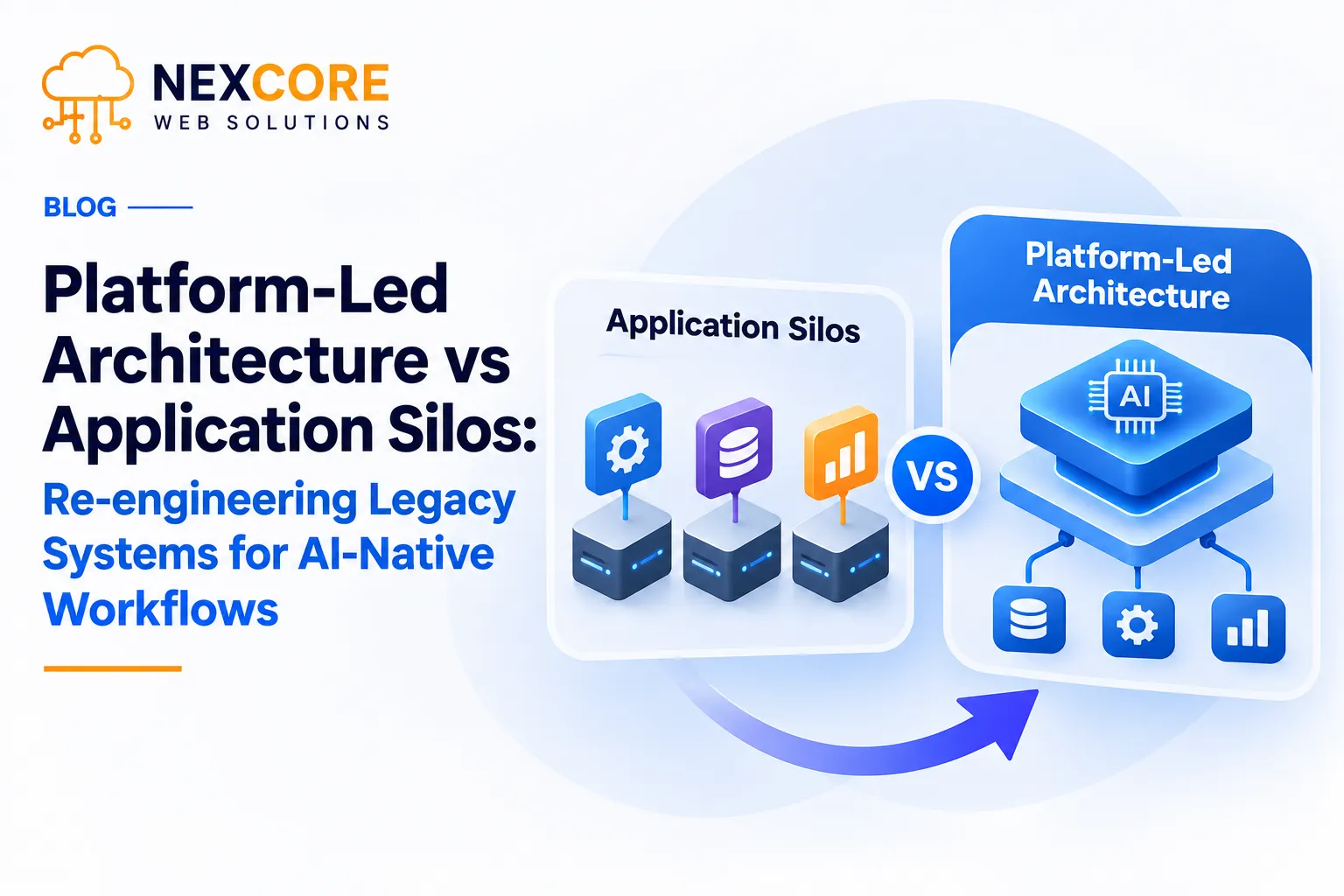
Many enterprises still operate legacy applications built around isolated databases, tightly coupled services, and department-specific workflows. These systems may support essential business operations, but they often struggle to accommodate modern artificial intelligence capabilities. AI-native workflows require applications to exchange information, access reliable data, coordinate automated agents, and respond to changing business requirements. Platform-led architecture offers a way to address these limitations by creating shared infrastructure and reusable services instead of maintaining disconnected application silos. Rather than replacing every legacy system, organizations can gradually connect existing technology through standardized interfaces and common data foundations. This approach helps businesses modernize their infrastructure while preparing applications for intelligent automation and AI-driven operations.
Understanding Application Silos in Legacy Infrastructure
Application silos develop when different departments build and maintain systems independently. A finance platform, customer relationship management system, inventory application, and support portal may each maintain separate databases and integration methods. Although these applications perform their individual functions effectively, sharing information between them often requires custom APIs, manual exports, or complicated middleware. Over time, duplicated data and inconsistent business rules make enterprise integration increasingly difficult.
These problems become more serious when organizations introduce AI capabilities. An AI assistant designed to answer customer questions may need information from several disconnected systems before producing a reliable response. If each application uses different data formats and access controls, developers must build additional integration logic for every workflow. This increases maintenance costs and makes it harder to scale AI solutions across the organization.
What Platform-Led Architecture Changes
Platform-led architecture introduces a shared technical foundation that allows applications and services to communicate through consistent interfaces. Instead of creating separate infrastructure for every department, organizations provide reusable capabilities for identity management, data access, event processing, monitoring, and AI integration. Individual applications can continue serving their business purposes while relying on common platform services. This reduces duplicated engineering work and creates a more consistent environment for future development.
The platform should operate as an enabling layer rather than another centralized application that controls every business decision. Development teams retain ownership of their domain-specific functionality while using approved shared components. For example, multiple applications can use the same authentication service without implementing separate identity systems. This balance between standardization and independence makes platform-led architecture practical for large enterprise environments.
Key Differences Between Platform Architecture and Application Silos
The main difference is how systems share capabilities and manage information. Application silos prioritize independent development, which can provide flexibility but often creates duplicated infrastructure. Platform-led architecture emphasizes reusable services, standardized integration, and shared governance. The comparison becomes particularly important when businesses need to introduce AI agents that operate across multiple applications.
| Architecture Area | Application Silos | Platform-Led Architecture |
|---|---|---|
| Data management | Separate databases and inconsistent formats | Shared data standards and governed access |
| Integration | Custom connections between applications | Reusable APIs and integration services |
| AI adoption | Individual AI integrations | Shared AI infrastructure and services |
| Security | Different controls across systems | Centralized identity and consistent policies |
| Development | Repeated implementation work | Reusable components and platform capabilities |
| Scalability | Integration complexity increases | Standardized services support expansion |
Platform architecture does not mean every application must use the same technology or database. It creates common standards for communication and governance while allowing teams to select suitable implementation tools. This distinction helps organizations modernize without forcing unnecessary changes to systems that already deliver business value.
Preparing Legacy Systems for AI-Native Workflows
AI-native workflows require more than connecting a language model to an existing application. Agents need structured access to business information, reliable permissions, and predictable ways to execute approved operations. Legacy applications often expose limited interfaces or depend on manual processes that are difficult to automate. Re-engineering these systems begins by identifying important business capabilities and making them accessible through well-defined services.
Modernizing Through APIs and Service Boundaries
A practical starting point is to expose selected legacy capabilities through stable APIs. For example, an inventory application can provide approved endpoints for checking stock levels, retrieving product details, and submitting reservation requests. An AI agent can then use these interfaces without directly accessing the application’s internal database. This reduces coupling and allows the underlying application to evolve independently.
Organizations should also define clear service boundaries. Customer information, billing operations, inventory management, and order processing may require different permissions and reliability requirements. Separating these responsibilities makes it easier to control what an AI agent can access or modify. It also improves testing because individual capabilities can be validated without executing an entire legacy workflow.
Building the Data Foundation for AI
AI systems depend heavily on information quality. When enterprise applications maintain conflicting customer records, outdated product information, or inconsistent transaction identifiers, AI-generated responses can become unreliable. A platform-led architecture should therefore include data governance, standardized identifiers, metadata management, and controlled access to authoritative sources. These capabilities help agents retrieve information from the correct systems rather than relying on disconnected copies.
Organizations may use event streaming, data integration pipelines, and retrieval systems to make information available across applications. For example, a completed payment event can update financial reporting, customer account information, and an operational dashboard. AI agents can consume these events to monitor business processes or identify unusual activity. However, teams must preserve data ownership and validation rules instead of assuming that every connected system contains equally trustworthy information.
Integrating AI Agents Into Enterprise Platforms
AI agents become more useful when they can interact with enterprise capabilities through controlled interfaces. A platform can provide reusable services for model access, prompt management, tool execution, identity verification, and audit logging. This allows different departments to build specialized agents without independently implementing every supporting component. It also makes it easier to enforce consistent security and operational requirements.
For example, a customer support agent could retrieve order information, check delivery status, and prepare a response using approved platform services. A separate finance agent could analyze payment exceptions using authorized financial data. Both agents can share common infrastructure while maintaining different permissions and responsibilities. This approach supports collaboration without giving every agent unrestricted access to enterprise systems.
Security and Governance Considerations
Connecting previously isolated applications creates new security responsibilities. AI agents may access sensitive information or execute actions that affect business operations, so permissions must be carefully controlled. Organizations should use role-based or attribute-based access controls, secure authentication, and detailed audit trails. High-impact actions such as issuing refunds or changing financial records may also require human approval.
Governance should cover data retention, model usage, third-party integrations, and monitoring of automated decisions. Teams need to understand which information an agent accessed and what actions it performed. Platform-level policies make these requirements easier to apply consistently across departments. Without governance, a connected architecture can increase organizational risk instead of reducing technical complexity.
A Practical Modernization Strategy
Enterprises should avoid attempting to replace every legacy application at once. A safer approach begins with identifying high-value workflows that suffer from duplicated data or repeated manual integration. Teams can select one business capability, expose it through a controlled interface, and connect it to shared platform services. Once the approach demonstrates measurable value, the organization can expand it to additional applications.
Progress should be measured through integration effort, workflow completion time, data quality, system reliability, and AI task accuracy. Developer feedback is also important because a platform that is difficult to use will encourage teams to build independent alternatives. Clear ownership, documentation, and reusable implementation patterns help maintain adoption. Continuous improvement allows the architecture to evolve alongside changing business and AI requirements.
Conclusion
Platform-led architecture provides enterprises with a practical way to move beyond disconnected application silos and prepare legacy infrastructure for AI-native workflows. By introducing reusable services, governed data access, standardized APIs, and shared AI capabilities, organizations can connect existing systems without immediately replacing them. Successful modernization requires more than technical integration; it also depends on security, clear ownership, reliable data, and measurable business outcomes. Enterprises should begin with high-value workflows, modernize gradually, and treat their platform as a product that supports development teams. This approach creates a stronger foundation for intelligent automation while protecting the value of existing business systems.
FAQs
What is platform-led architecture?
Platform-led architecture is an approach in which organizations provide shared infrastructure, reusable services, and standardized integration capabilities for multiple applications. Instead of allowing every department to build separate solutions, teams use common services for identity, data access, monitoring, and automation. This improves consistency while allowing individual applications to maintain their specific business responsibilities.
Why are application silos a problem for AI adoption?
Application silos make it difficult for AI systems to access consistent information across departments. Different databases, APIs, permissions, and data formats require additional integration work before agents can complete business tasks. These inconsistencies can also produce incomplete or inaccurate responses. Connecting systems through governed interfaces creates a more reliable foundation for enterprise AI workflows.
Can legacy applications support AI-native workflows?
Yes, legacy applications can support AI-native workflows when organizations expose their business capabilities through secure and well-defined interfaces. APIs, event-driven integration, and controlled data services allow AI agents to interact with existing systems without requiring a complete replacement. The modernization process should prioritize important workflows and preserve existing business rules wherever they remain valid.
What role do APIs play in platform-led architecture?
APIs provide standardized ways for applications and AI agents to access business capabilities. They reduce direct dependencies on internal databases and allow different systems to communicate through documented interfaces. Well-designed APIs also support authentication, permission checks, input validation, and monitoring. This makes integration more manageable as organizations introduce additional applications and automated workflows.
How can enterprises migrate from application silos to platform-led architecture?
Enterprises should begin by identifying duplicated capabilities, disconnected data, and workflows that require frequent manual integration. They can then introduce shared services and expose selected legacy functions through secure APIs. Gradual adoption reduces migration risk and allows teams to measure improvements. Strong governance, developer feedback, and clear platform ownership help sustain the transition.




