
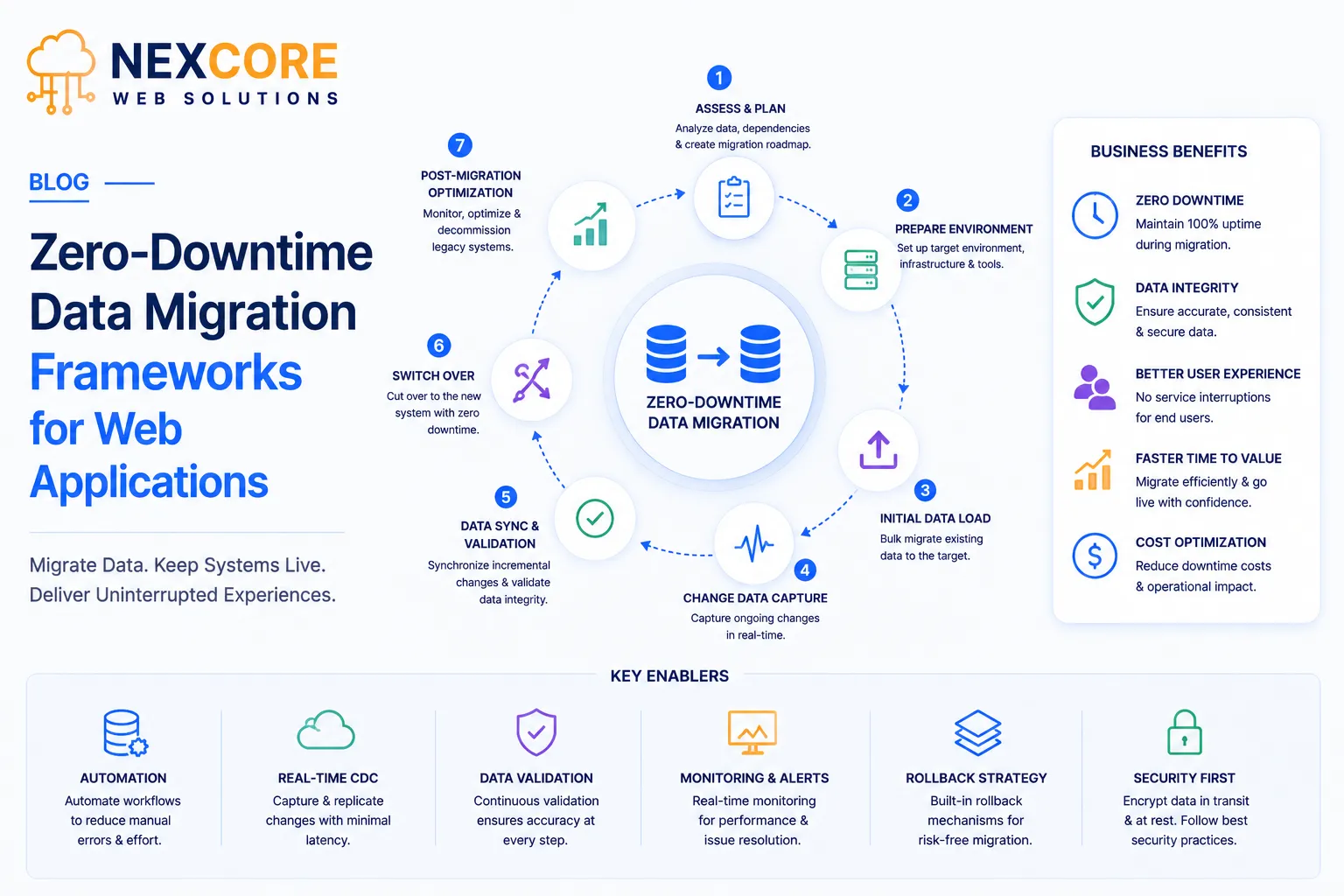
Modern web applications rarely remain static. Businesses regularly upgrade databases, migrate to cloud platforms, redesign application architecture, or introduce new services to support growth. While these improvements are essential, migrating production data presents significant risks because even a few minutes of downtime can interrupt business operations, reduce customer trust, and impact revenue. This challenge is especially important for eCommerce platforms, SaaS products, financial systems, healthcare applications, and enterprise portals that must remain available around the clock. Zero-downtime data migration frameworks provide structured approaches for moving data between environments without disrupting users. By combining careful planning, incremental synchronization, automated validation, and controlled deployment strategies, organizations can modernize their infrastructure while maintaining continuous service availability and protecting critical business data throughout the migration process.
Understanding Zero-Downtime Migration
What Is Zero-Downtime Data Migration?
Zero-downtime data migration is the process of transferring application data from one system to another while keeping the application fully operational. Users continue accessing services throughout the migration without experiencing interruptions or maintenance windows. This approach requires careful synchronization between source and destination environments until the final transition is completed. Successful migrations prioritize business continuity alongside technical accuracy.
Why Traditional Migrations Create Problems
Traditional migrations often require applications to be taken offline while databases are copied, verified, and reconfigured. During this period, customers may be unable to log in, complete transactions, or access critical information. Extended downtime affects user satisfaction and may result in financial losses. Zero-downtime frameworks eliminate these risks by maintaining service availability during every migration stage.
Planning Before Migration
Assess Existing Infrastructure
Every migration begins with a detailed assessment of the current application environment. Engineering teams should evaluate database size, dependencies, storage requirements, application architecture, integrations, and expected traffic volumes. Understanding the existing infrastructure helps identify technical constraints before migration activities begin. Comprehensive planning reduces unexpected complications during execution.
Define Migration Objectives
Organizations should establish clear migration goals before modifying production systems. Objectives may include cloud adoption, database upgrades, performance improvements, infrastructure consolidation, or regulatory compliance. Clearly defined goals simplify technical decision-making throughout the migration process. Success metrics also help evaluate migration outcomes after deployment.
Data Synchronization Strategies
Incremental Data Replication
Rather than copying all information during a single maintenance window, incremental replication continuously transfers changes from the source database to the destination. New records, updates, and deletions remain synchronized while users continue working normally. This significantly reduces the amount of data requiring transfer during final cutover. Continuous replication minimizes operational risk.
Dual-Write Architecture
Some migration frameworks temporarily write incoming transactions to both the old and new databases simultaneously. This dual-write approach ensures both systems remain synchronized throughout the migration period. Although implementation requires careful consistency management, it reduces the possibility of missing critical business data during transition. Thorough testing remains essential before production deployment.
Application Deployment Strategies
Blue-Green Deployment
Blue-green deployment maintains two identical production environments. One environment serves live traffic while the other receives updates and migrated data. Once validation confirms successful migration, user traffic switches seamlessly to the updated environment. If problems occur, organizations can immediately revert to the previous environment. This strategy significantly reduces deployment risk.
Canary Releases
Canary deployments gradually introduce migrated infrastructure to a small percentage of users before expanding availability. Engineering teams monitor application performance, error rates, and user behavior throughout each deployment stage. If issues appear, traffic returns to the original environment without affecting the majority of users. Gradual rollout improves operational confidence.
Data Validation and Testing
Verify Data Integrity
Successful migration depends not only on transferring data but also on confirming its accuracy. Validation processes compare records, relationships, indexes, and transaction counts between source and destination databases. Automated verification detects inconsistencies before users encounter problems. Reliable validation protects both business operations and customer trust.
Performance Testing
Migrated databases should demonstrate performance equal to or better than the original environment before production traffic increases. Load testing, stress testing, and response time analysis reveal performance bottlenecks that may not appear during functional testing alone. Performance validation ensures infrastructure remains prepared for real-world workloads.
Monitoring During Migration
Real-Time Observability
Continuous monitoring provides visibility into synchronization status, replication delays, application errors, database performance, and infrastructure health. Centralized dashboards allow engineering teams to detect anomalies immediately and respond before customer experience is affected. Real-time observability supports confident decision-making throughout migration activities.
Rollback Preparedness
Even carefully planned migrations may encounter unexpected issues. Maintaining reliable rollback procedures allows organizations to restore previous production environments quickly if necessary. Backup verification, recovery testing, and documented rollback workflows reduce operational uncertainty. Preparedness strengthens overall migration resilience.
Best Practices for Long-Term Success
Zero-downtime migration frameworks should become repeatable organizational processes rather than isolated technical projects. Standardized automation, infrastructure as code, version-controlled migration scripts, comprehensive documentation, and regular disaster recovery exercises improve consistency across future migrations. Organizations that invest in repeatable operational practices reduce deployment risk while accelerating future modernization initiatives. Continuous improvement strengthens both engineering efficiency and business reliability.
Conclusion
Zero-downtime data migration has become an essential capability for organizations operating modern web applications where continuous availability directly affects customer satisfaction and business performance. Successful migration frameworks combine careful planning, incremental replication, deployment automation, thorough validation, real-time monitoring, and reliable rollback strategies to minimize operational risk. Rather than relying on extended maintenance windows, businesses can modernize infrastructure while maintaining uninterrupted service for users. As digital platforms continue evolving through cloud adoption, database modernization, and architectural transformation, well-designed migration frameworks provide the confidence needed to implement change without sacrificing reliability, scalability, or customer trust. Investing in structured migration processes supports sustainable long-term technology growth.
FAQs
1. What is zero-downtime data migration?
Zero-downtime data migration is the process of moving application data between databases, servers, or cloud environments while keeping the application continuously available. Users can continue accessing services throughout the migration because data synchronization, validation, and deployment occur without requiring extended maintenance windows or service interruptions.
2. Why is zero-downtime migration important?
Zero-downtime migration prevents service disruptions that can negatively affect customer experience, revenue, and business operations. It enables organizations to upgrade infrastructure, modernize databases, or migrate to cloud platforms while maintaining continuous availability. This approach is particularly valuable for business-critical applications that operate around the clock.
3. What is incremental data replication?
Incremental data replication continuously transfers only new, modified, or deleted records from the source database to the destination system. Instead of copying the entire dataset repeatedly, it synchronizes ongoing changes in real time, reducing migration time, minimizing downtime risk, and improving overall migration efficiency.
4. How does blue-green deployment support data migration?
Blue-green deployment uses two identical production environments, allowing one environment to remain live while the other receives migrated data and software updates. After successful testing and validation, traffic switches seamlessly to the updated environment. This strategy reduces deployment risk and enables rapid rollback if issues occur.
5. What should organizations monitor during data migration?
Organizations should monitor replication status, synchronization delays, application performance, database health, infrastructure utilization, error rates, transaction consistency, and user experience throughout the migration process. Continuous monitoring helps identify potential issues early, ensuring the migration remains stable while maintaining uninterrupted service for end users.




