
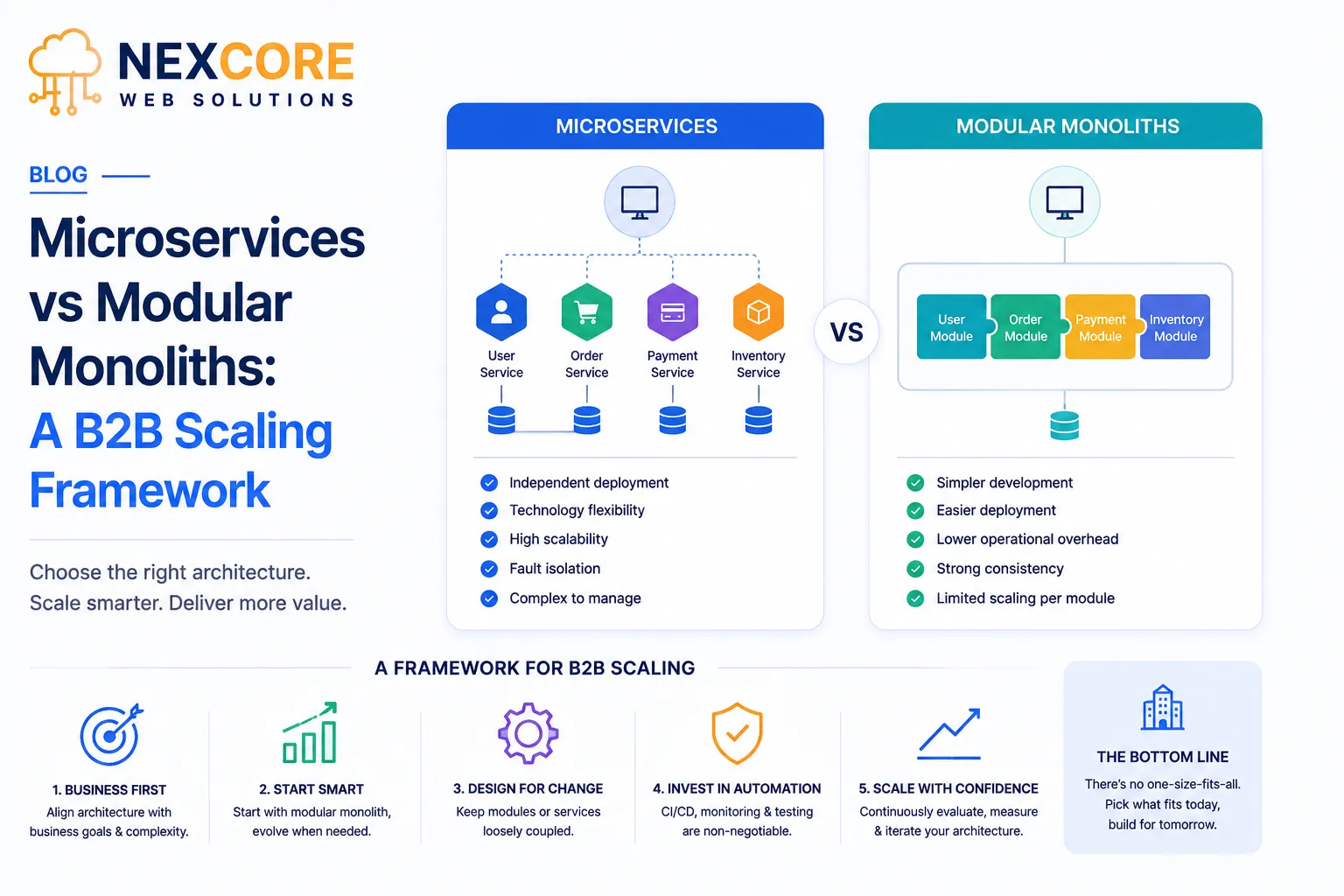
As B2B software platforms expand, choosing the right application architecture becomes one of the most important technical decisions an organization can make. An architecture that performs well for a startup may struggle as customer numbers, development teams, and feature complexity increase. Two of the most common approaches are microservices and modular monoliths. While both aim to improve maintainability and scalability, they solve different business and engineering challenges. Microservices divide applications into independently deployable services, whereas modular monoliths organize functionality into well-defined modules within a single application. Selecting the wrong architecture can increase operational costs, slow development, and introduce unnecessary complexity. Understanding the strengths, limitations, and practical use cases of both approaches helps businesses create scalable systems that align with long-term product strategy, team structure, and operational requirements.
Understanding Modern Software Architecture
What Is a Modular Monolith?
A modular monolith is a single application divided into clearly separated modules that each handle a specific business function. Although everything is deployed together, each module maintains defined responsibilities and communicates through structured interfaces. This design keeps the codebase organized while avoiding the operational complexity associated with distributed systems. Many successful enterprise applications begin with this architecture.
What Are Microservices?
Microservices divide an application into multiple independent services, each responsible for a specific capability such as authentication, payments, inventory, or reporting. Every service can be developed, deployed, and scaled separately. Communication typically occurs through APIs or messaging systems. This approach offers greater flexibility but requires more sophisticated infrastructure and operational management.
Comparing Development Complexity
Simpler Development with Modular Monoliths
A modular monolith allows developers to work within one repository, one deployment pipeline, and one application environment. Debugging becomes easier because developers can trace functionality without navigating multiple distributed services. Local development is generally faster, and onboarding new engineers requires less infrastructure knowledge. Smaller engineering teams often benefit from this simplified workflow.
Operational Complexity of Microservices
Microservices require service discovery, API gateways, distributed logging, monitoring, container orchestration, network security, and deployment automation. While these technologies provide flexibility, they also increase engineering effort and operational overhead. Organizations need mature DevOps practices to manage distributed environments successfully. Without sufficient expertise, complexity can outweigh the benefits.
Scalability Considerations
Scaling Modular Applications
A modular monolith scales by expanding the resources allocated to a single application. Modern cloud infrastructure allows applications to handle significant workloads through vertical and horizontal scaling techniques. For many B2B platforms, this level of scalability remains sufficient for years. Performance bottlenecks can often be resolved through optimization before architectural changes become necessary.
Independent Scaling with Microservices
Microservices allow organizations to scale only the services experiencing high demand rather than the entire application. For example, reporting services or payment processing can receive additional resources independently. This targeted scaling improves infrastructure efficiency while reducing unnecessary operational costs. Large enterprise platforms frequently benefit from this flexibility.
Deployment and Maintenance
Faster Initial Delivery
Modular monoliths typically enable faster product development during the early stages of a project. Development teams spend more time building business functionality instead of configuring distributed infrastructure. Deployment remains straightforward because the application operates as a single unit. Businesses launching new products often value this simplicity.
Continuous Delivery for Microservices
Independent deployment allows microservices teams to release updates without affecting unrelated services. Different teams can work simultaneously on separate business domains with fewer deployment conflicts. However, organizations must maintain strong testing, versioning, and deployment automation to prevent service compatibility issues. Reliable continuous delivery becomes essential.
Performance and Reliability
Internal Communication
Modules within a monolithic application communicate directly through internal function calls, resulting in minimal communication overhead. Response times remain predictable because network latency is not introduced between components. This simplicity benefits applications requiring frequent interactions between business functions. Internal communication also simplifies debugging and performance optimization.
Distributed Resilience
Microservices improve resilience by isolating failures within individual services rather than affecting the entire application. If one service experiences problems, other services may continue operating normally depending on architectural design. Implementing resilience requires circuit breakers, retries, monitoring, and fault-tolerant communication patterns. Reliability depends on thoughtful engineering practices.
Organizational Factors
Team Size Matters
Architecture decisions should reflect organizational structure as much as technical requirements. Small and medium-sized development teams often manage modular monoliths more efficiently because communication remains centralized. Larger enterprises with multiple specialized teams may benefit from independently owned microservices. Conway’s Law frequently influences architectural success.
Business Growth
Not every growing business immediately requires microservices. Many organizations successfully support thousands of customers using well-designed modular monoliths. Architectural evolution should follow genuine business needs rather than technology trends. Migrating prematurely increases complexity without necessarily improving customer outcomes.
Choosing the Right Framework
The best architecture depends on application complexity, expected growth, engineering maturity, deployment frequency, operational capabilities, and long-term business objectives. Organizations should evaluate whether current challenges involve scalability, team coordination, deployment speed, or operational efficiency before selecting an architectural model. Many successful companies intentionally begin with modular monoliths before gradually extracting independent services as scaling requirements become more demanding.
Conclusion
Both microservices and modular monoliths provide valuable architectural advantages, but neither represents a universal solution for every B2B platform. Modular monoliths offer simplicity, faster development, easier debugging, and lower operational overhead, making them an excellent choice for many growing businesses. Microservices provide greater flexibility, independent scalability, and deployment autonomy but require advanced infrastructure, monitoring, and engineering expertise. The most effective scaling strategy is one that aligns technical architecture with organizational maturity, product complexity, and business objectives. Rather than adopting architecture based on industry trends, organizations should make evidence-based decisions that balance scalability, maintainability, operational efficiency, and long-term sustainability as their software platforms continue evolving.
FAQs
1. What is the difference between a modular monolith and microservices?
A modular monolith organizes application functionality into well-defined modules within a single deployable application, while microservices separate functionality into independent services that can be deployed and scaled individually. The primary difference lies in deployment independence, operational complexity, and infrastructure requirements.
2. When should a business choose a modular monolith?
A business should consider a modular monolith when building a new application, working with a smaller engineering team, or requiring faster development with simpler operations. It provides clear code organization while avoiding the additional infrastructure and maintenance challenges associated with distributed microservices.
3. Are microservices always better for scalability?
No. Microservices provide excellent scalability for large, complex systems, but they also introduce operational overhead. Many B2B applications scale successfully using modular monoliths supported by modern cloud infrastructure. Architecture should be selected based on actual business needs rather than assumptions about future growth.
4. What are the biggest challenges of microservices?
The biggest challenges include distributed system complexity, service communication, monitoring, deployment automation, data consistency, security, and debugging across multiple services. Organizations adopting microservices require mature DevOps practices and experienced engineering teams to manage these operational responsibilities effectively.
5. Can a modular monolith evolve into microservices?
Yes. Many successful software platforms begin as modular monoliths and gradually extract specific modules into independent microservices as scalability requirements increase. This incremental approach reduces unnecessary complexity during the early stages of development while providing flexibility for future architectural evolution.




