
Modern web portals serve millions of users across different regions, devices, and network conditions. Whether supporting eCommerce platforms, enterprise applications, financial services, healthcare systems, or SaaS products, users expect fast and reliable digital experiences regardless of their geographic location. Traditional centralized API architectures often struggle to meet these expectations because every request must travel long distances before reaching backend services. Edge API gateways solve this challenge by processing requests closer to users through globally distributed infrastructure. This approach reduces network latency, improves application responsiveness, strengthens security, and enhances scalability during periods of heavy traffic. As businesses continue expanding internationally, understanding how edge API gateways optimize request handling becomes increasingly important for maintaining high-performance web portals that deliver consistent user experiences while supporting long-term digital growth.
Understanding Edge API Gateways
What Is an Edge API Gateway?
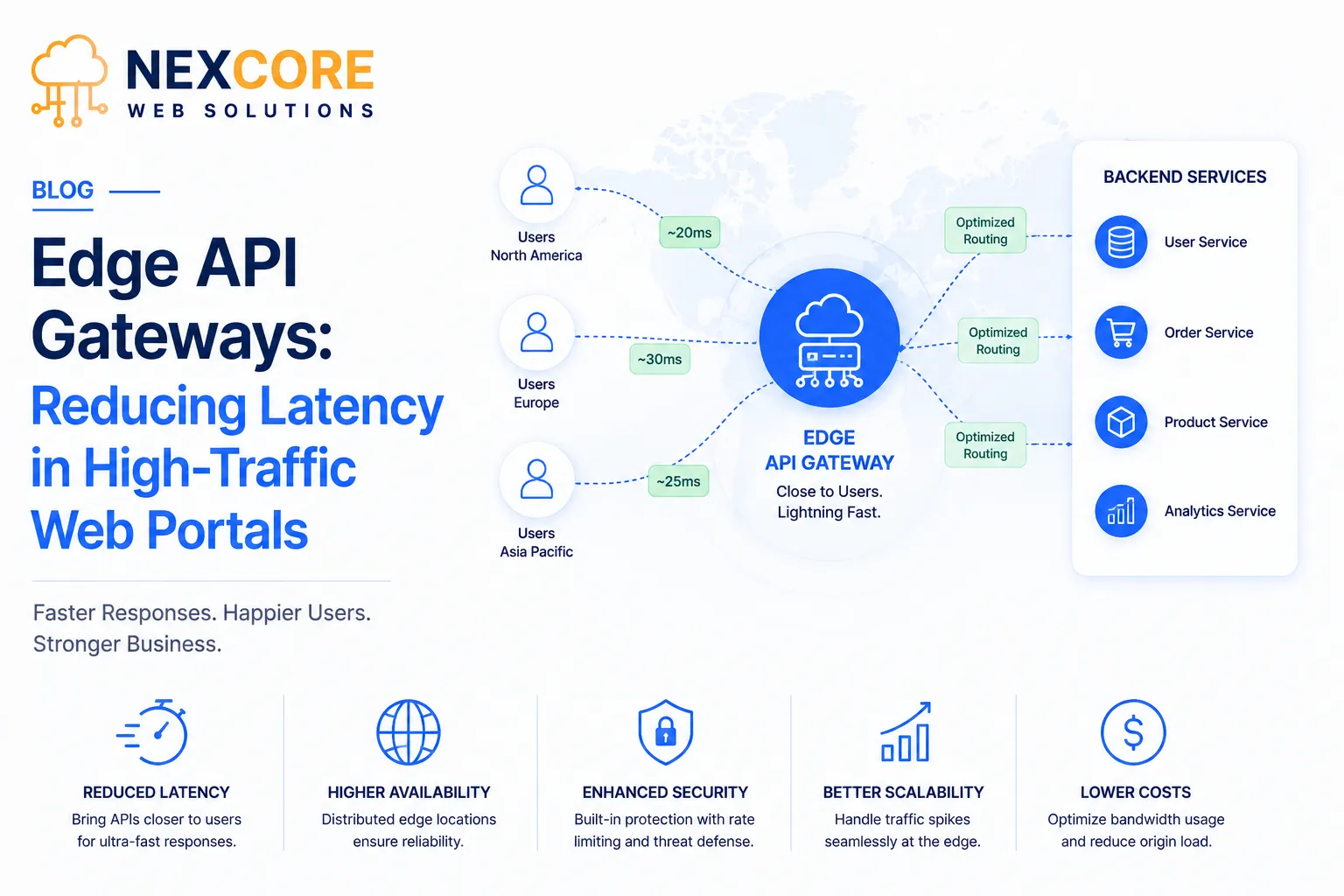
An edge API gateway is a distributed gateway deployed across multiple geographic locations close to end users. Instead of forwarding every request directly to centralized backend infrastructure, edge gateways process authentication, routing, caching, rate limiting, and request validation at nearby network locations. This significantly reduces response times while improving overall application efficiency. Edge computing extends processing beyond traditional data centers.
Why Latency Matters
Latency measures the time required for information to travel between users and application servers. Even small delays can affect page loading, API responsiveness, user satisfaction, and business conversions. High-traffic portals serving international audiences experience greater latency because requests often cross multiple network regions. Reducing this delay creates smoother digital experiences while improving customer engagement and retention.
How Edge Gateways Improve Performance
Process Requests Closer to Users
Traditional architectures require every API request to reach centralized infrastructure before processing begins. Edge gateways shorten this journey by handling requests at nearby regional locations whenever possible. Authentication, caching, routing, and basic processing occur closer to users, reducing unnecessary network travel. Faster request handling improves application responsiveness across global markets.
Intelligent Traffic Routing
Edge gateways continuously evaluate network conditions and direct requests toward the most efficient backend services. Instead of relying on static routing configurations, intelligent routing selects healthy infrastructure with the lowest available latency. Dynamic traffic management improves reliability during outages while maintaining consistent user experiences. Efficient routing also balances workloads across distributed systems.
Caching and Content Delivery
API Response Caching
Frequently requested API responses often contain identical information for multiple users. Edge gateways store these responses temporarily, allowing subsequent requests to be served immediately without contacting backend systems repeatedly. Response caching significantly reduces processing overhead while improving performance during periods of heavy demand. Efficient caching also lowers infrastructure costs.
Static Asset Optimization
Many web portals deliver images, scripts, style sheets, and other static resources alongside dynamic API responses. Edge infrastructure integrates naturally with content delivery networks, enabling assets to load rapidly from nearby locations. Faster resource delivery improves page rendering while enhancing Core Web Vitals. Optimized content distribution benefits users across every geographic region.
Security at the Edge
Request Filtering
Edge API gateways provide an opportunity to inspect requests before they reach backend applications. Malicious traffic, invalid requests, and suspicious activity can be identified and blocked at the network edge rather than consuming backend resources. Early filtering strengthens overall application security while reducing unnecessary server workload. Preventive protection improves operational resilience.
Rate Limiting and Authentication
High-traffic web portals often experience automated attacks, excessive API usage, or unauthorized access attempts. Edge gateways enforce authentication, rate limiting, and access control before forwarding requests to internal services. Processing these security controls closer to users improves efficiency while protecting sensitive backend systems. Distributed enforcement strengthens enterprise security architecture.
Supporting Scalability
Handling Traffic Spikes
Unexpected traffic increases resulting from product launches, promotional campaigns, or breaking news can overwhelm centralized infrastructure. Edge gateways absorb significant portions of incoming traffic by distributing request processing across multiple geographic regions. Load balancing and caching reduce backend pressure while maintaining stable performance. Distributed architectures support reliable application availability during peak demand.
Microservices Integration
Many enterprise applications rely on microservices that communicate through numerous APIs. Edge gateways simplify interactions between clients and backend services by providing a unified entry point. Request routing, protocol translation, and service discovery occur transparently, reducing architectural complexity. Simplified communication improves maintainability while supporting scalable application growth.
Monitoring and Observability
Performance Analytics
Continuous monitoring helps organizations understand request latency, traffic distribution, cache performance, error rates, and regional infrastructure health. Performance dashboards provide valuable insights into user experiences across different geographic locations. Historical analytics also support capacity planning and infrastructure optimization. Data-driven monitoring enables proactive operational improvements.
Operational Visibility
Edge gateways generate detailed logs describing request processing, authentication events, routing decisions, and security activity. Centralized observability platforms combine these logs with application metrics to simplify troubleshooting. Engineering teams gain better visibility into distributed environments while reducing incident response times. Comprehensive monitoring strengthens long-term operational reliability.
Designing an Effective Edge Strategy
Successful edge architectures require careful planning beyond simply deploying distributed gateways. Organizations should evaluate application workloads, user distribution, security requirements, backend dependencies, and infrastructure costs before implementation. Combining edge gateways with caching, load balancing, content delivery networks, and resilient backend services creates balanced architectures capable of supporting global digital experiences. Strategic planning ensures long-term scalability while maximizing return on infrastructure investments.
Conclusion
Edge API gateways have become an essential component of modern web architecture because they reduce latency, improve scalability, strengthen security, and enhance user experiences across globally distributed applications. Processing requests closer to users minimizes network delays while intelligent routing, response caching, authentication, and traffic management improve operational efficiency. Businesses serving large audiences benefit from faster application performance without placing unnecessary pressure on centralized backend infrastructure. As digital platforms continue expanding internationally, organizations that adopt thoughtfully designed edge architectures position themselves to deliver responsive, reliable, and secure services capable of supporting sustained business growth. Investing in edge API gateways provides both immediate performance improvements and a scalable foundation for future technological evolution.
FAQs
1. What is an edge API gateway?
An edge API gateway is a distributed gateway that processes API requests at locations closer to end users rather than relying entirely on centralized servers. It handles routing, authentication, caching, security, and traffic management to reduce latency, improve performance, and enhance application scalability across geographically distributed environments.
2. How do edge API gateways reduce latency?
Edge API gateways reduce latency by processing requests near users instead of sending every request to distant backend servers. Local request handling, response caching, intelligent routing, and regional infrastructure significantly decrease network travel time, resulting in faster API responses and improved user experiences.
3. Are edge API gateways suitable for enterprise applications?
Yes. Enterprise applications benefit greatly from edge API gateways because they improve scalability, strengthen security, optimize traffic routing, reduce infrastructure bottlenecks, and support global user bases. Organizations operating high-traffic portals often implement edge architectures to maintain consistent performance across multiple geographic regions.
4. How does caching improve edge gateway performance?
Caching stores frequently requested API responses closer to users, allowing repeated requests to be served immediately without contacting backend systems. This reduces server workload, improves response times, lowers infrastructure costs, and enables applications to handle larger traffic volumes more efficiently during peak usage periods.
5. What security features do edge API gateways provide?
Edge API gateways commonly provide authentication, authorization, rate limiting, request validation, web application firewall integration, distributed denial-of-service protection, encrypted communication, and malicious traffic filtering. These capabilities strengthen application security while preventing unnecessary requests from reaching backend infrastructure.




