
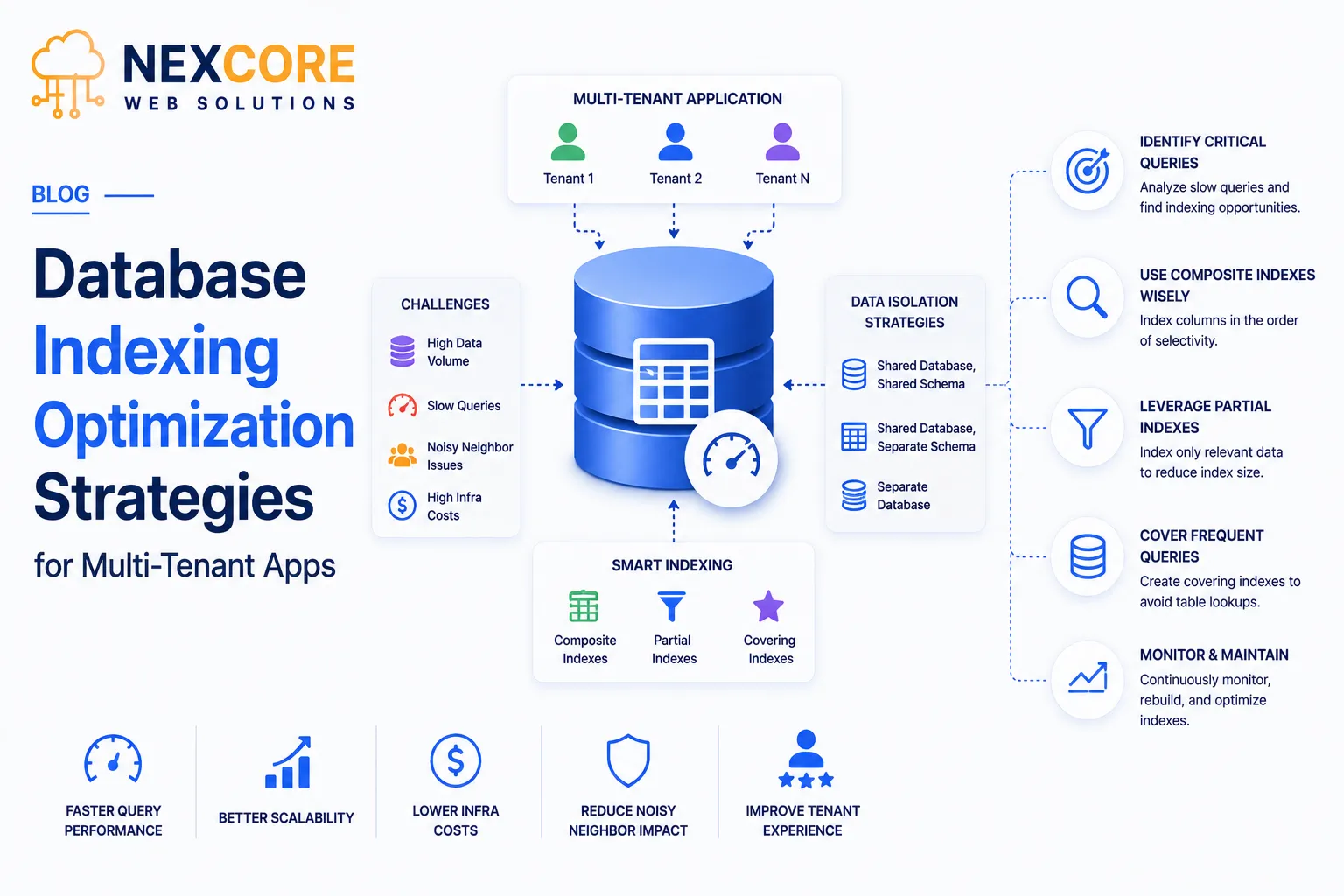
Multi-tenant applications have become the preferred architecture for many SaaS platforms because they allow multiple customers to share the same infrastructure while keeping their data logically isolated. Although this approach improves scalability and operational efficiency, it also introduces significant database performance challenges as the number of tenants and records continues to grow. One of the most effective ways to maintain fast query execution is through proper database indexing. Well-designed indexes reduce data retrieval time, improve application responsiveness, and support high-concurrency workloads. However, poorly planned indexes can increase storage usage, slow write operations, and create unnecessary maintenance overhead. Understanding database indexing optimization strategies enables engineering teams to build scalable multi-tenant applications that deliver consistent performance, efficient resource utilization, and reliable user experiences even under demanding production workloads.
Understanding Database Indexing
What Is Database Indexing?
Database indexes are specialized data structures that help database engines locate records more efficiently without scanning entire tables. Similar to an index in a book, they provide quick access to the information applications request most frequently. Proper indexing significantly improves query performance while reducing response times for users. Efficient indexes become increasingly valuable as datasets continue expanding.
Why Multi-Tenant Applications Need Better Indexing
Unlike single-tenant systems, multi-tenant applications store information belonging to many customers within shared database resources. Every query typically filters data using tenant identifiers alongside business-specific conditions. Without optimized indexes, databases perform unnecessary scans that consume CPU, memory, and storage resources. Well-designed indexing strategies ensure each tenant receives consistent application performance regardless of overall database size.
Designing Effective Indexes
Index Tenant Identifiers
Tenant identifiers appear in nearly every database query within shared multi-tenant architectures. Creating indexes that include tenant identifiers helps databases isolate customer-specific records quickly while avoiding expensive full-table scans. Combining tenant identifiers with frequently filtered columns often provides even greater performance improvements. This strategy supports predictable response times across growing customer bases.
Use Composite Indexes Carefully
Composite indexes include multiple columns arranged in a specific order. These indexes improve performance when queries consistently filter or sort using the same column combinations. However, creating excessive composite indexes increases storage requirements and slows write operations because every insert or update must maintain additional index structures. Index design should always reflect actual query patterns.
Balancing Read and Write Performance
Optimize Frequently Executed Queries
Not every database operation requires dedicated indexing. Development teams should analyze application workloads to identify queries executed most frequently or consuming the greatest resources. Prioritizing these high-impact operations delivers meaningful performance improvements while minimizing unnecessary index creation. Performance optimization should remain workload-driven rather than assumption-based.
Avoid Over-Indexing
Although indexes accelerate data retrieval, every additional index increases maintenance overhead during insert, update, and delete operations. Excessive indexing also consumes storage unnecessarily while extending backup and maintenance processes. Organizations should periodically review existing indexes to identify unused or redundant structures. Balanced indexing supports both performance and operational efficiency.
Managing Large Datasets
Partition Large Tables
As multi-tenant applications grow, database tables may contain millions or even billions of records. Table partitioning divides large datasets into smaller logical segments based on tenant identifiers, dates, or other meaningful criteria. Partitioning reduces query scope while simplifying maintenance activities. Combined with optimized indexing, partitioning significantly improves scalability.
Archive Historical Data
Older records often remain valuable for compliance or reporting purposes but receive far fewer queries than active business data. Archiving historical information into separate storage reduces the size of production tables and associated indexes. Smaller indexes improve lookup performance while lowering storage requirements. Effective data lifecycle management supports long-term scalability.
Monitoring Index Performance
Analyze Query Execution Plans
Modern database systems provide execution plans that explain how queries access data. Reviewing these plans helps identify missing indexes, inefficient scans, and unnecessary processing steps. Database administrators can then refine indexing strategies based on actual execution behavior rather than assumptions. Continuous analysis improves long-term application performance.
Monitor Index Usage
Not every index continues providing value as applications evolve. Monitoring tools identify indexes that receive little or no usage during normal operations. Removing unnecessary indexes reduces storage consumption while improving write performance. Regular reviews keep database environments efficient as workloads change over time.
Supporting High-Concurrency Workloads
Reduce Lock Contention
Large multi-tenant applications frequently process thousands of simultaneous transactions. Efficient indexing reduces the time queries hold database locks, minimizing contention between concurrent users. Faster operations improve throughput while maintaining consistent response times during traffic spikes. High-performance indexing contributes directly to application scalability.
Combine Indexing with Caching
Indexes improve database efficiency, but frequently requested information may benefit from application-level caching as well. Caching reduces repeated database access for commonly requested records, lowering overall infrastructure workload. Combining intelligent caching with optimized indexing provides stronger performance than either approach alone. Layered optimization supports enterprise-scale applications.
Continuous Optimization
Database indexing should evolve alongside application growth rather than remaining static after deployment. New features, changing query patterns, expanding datasets, and increasing tenant activity continuously influence database performance. Regular performance reviews, workload analysis, and controlled testing help engineering teams adapt indexing strategies to current operational requirements. Ongoing optimization ensures databases remain efficient as business demands continue changing.
Conclusion
Database indexing is one of the most important performance optimization techniques for multi-tenant applications because it directly affects query speed, scalability, and overall user experience. Effective indexing strategies focus on tenant identifiers, composite indexes, workload analysis, partitioning, monitoring, and balanced resource utilization rather than simply creating more indexes. Organizations that continuously evaluate query performance and adapt their indexing strategies can support growing customer bases without sacrificing responsiveness or operational efficiency. As SaaS platforms continue expanding in scale and complexity, thoughtful database indexing remains a fundamental component of building reliable, high-performance multi-tenant architectures capable of delivering consistent experiences for every customer.
FAQs
1. What is database indexing?
Database indexing is a technique that creates specialized data structures to help database systems locate records more efficiently. Instead of scanning entire tables, indexes enable faster data retrieval, improving query performance and reducing response times for applications handling large volumes of information.
2. Why are indexes important for multi-tenant applications?
Indexes are essential for multi-tenant applications because they help databases quickly isolate records belonging to individual tenants. Efficient indexing reduces query execution time, improves scalability, minimizes resource consumption, and ensures consistent performance as the number of customers and stored records continues growing.
3. What is a composite index?
A composite index is a database index built using multiple columns arranged in a specific order. It improves performance for queries that filter or sort using those column combinations. Properly designed composite indexes significantly accelerate complex queries while supporting efficient data retrieval in multi-tenant systems.
4. Can too many indexes reduce database performance?
Yes. Excessive indexing increases storage requirements and slows insert, update, and delete operations because every index must be maintained whenever data changes. Organizations should monitor index usage regularly and remove redundant or unused indexes to maintain balanced database performance and operational efficiency.
5. How often should database indexes be reviewed?
Database indexes should be reviewed regularly, particularly after significant application updates, feature releases, workload changes, or rapid data growth. Continuous monitoring of query execution plans, index usage, and database performance helps ensure indexing strategies remain optimized as application requirements evolve.




