
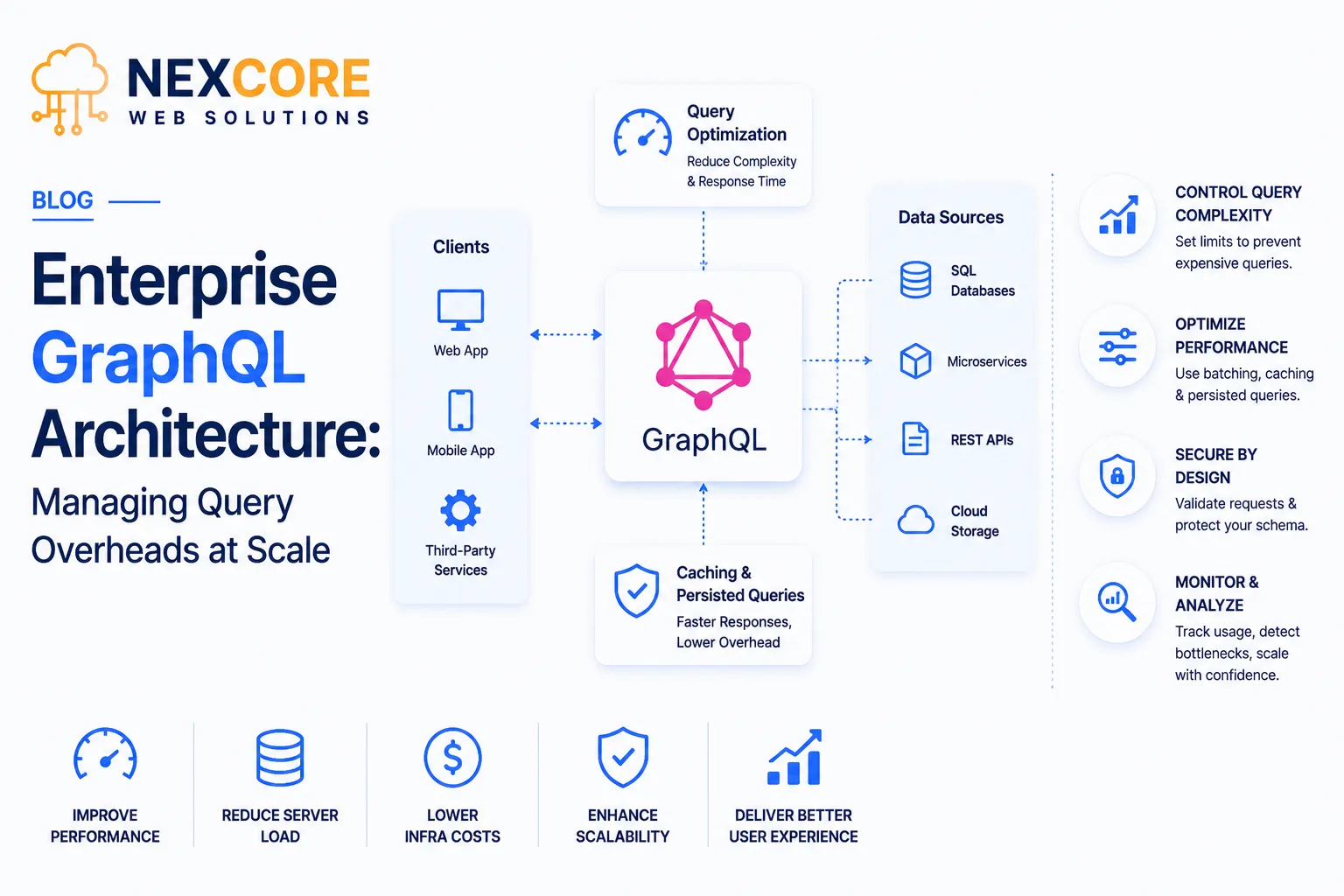
GraphQL has become a popular API technology for enterprise applications because it allows clients to request exactly the data they need through a single endpoint. This flexibility simplifies frontend development, reduces unnecessary data transfer, and supports modern web and mobile experiences. However, as enterprise systems grow in complexity, GraphQL introduces new architectural challenges that traditional REST APIs often avoid. Poorly optimized queries, deeply nested relationships, inefficient resolvers, and uncontrolled client requests can significantly increase server load and infrastructure costs. Managing query overhead is therefore essential for maintaining high performance, scalability, and reliability across large enterprise environments. Organizations that design GraphQL architectures with performance, governance, and observability in mind can deliver responsive applications while ensuring their APIs remain secure, maintainable, and capable of supporting millions of requests efficiently.
Understanding GraphQL at Enterprise Scale
Why Enterprises Choose GraphQL
Large organizations frequently operate multiple frontend applications, including websites, mobile apps, customer portals, and internal dashboards. GraphQL enables all these clients to retrieve precisely the data they require without relying on numerous REST endpoints. This flexibility accelerates frontend development while reducing over-fetching and under-fetching of data. Development teams benefit from improved productivity and a more consistent API experience.
Challenges Beyond Small Projects
As applications expand, GraphQL queries become increasingly complex. Hundreds of clients may access the same API simultaneously while requesting different combinations of nested data. Without careful architectural planning, these requests can overload backend services, increase database activity, and create performance bottlenecks. Enterprise environments therefore require stronger governance than smaller GraphQL implementations.
Managing Query Complexity
Limit Deeply Nested Queries
GraphQL allows clients to request multiple related resources within a single query. Although this capability improves flexibility, excessive nesting increases execution time and backend resource consumption. Establishing query depth limits prevents inefficient requests from affecting overall system performance. Reasonable restrictions encourage developers to design efficient client queries while protecting server stability.
Apply Query Cost Analysis
Not every GraphQL query requires the same processing effort. Some requests retrieve only a few fields, while others access complex relationships across numerous services. Query cost analysis assigns resource values to requested operations, allowing APIs to reject excessively expensive requests before execution begins. This proactive approach protects infrastructure from abusive or inefficient workloads.
Improving Resolver Performance
Avoid the N+1 Query Problem
One of the most common GraphQL performance issues occurs when resolvers execute individual database queries repeatedly for related records. This N+1 query problem dramatically increases database activity as application traffic grows. Data loaders and request-level batching combine similar queries into fewer database operations. Efficient resolver design significantly improves application scalability.
Optimize Data Sources
Resolvers should retrieve only the information necessary to satisfy client requests. Inefficient database queries, unnecessary joins, or repeated external API calls increase response times and infrastructure costs. Optimized data access strategies reduce processing overhead while maintaining consistent application performance. Backend efficiency directly influences GraphQL responsiveness.
Caching Strategies
Response Caching
Although GraphQL queries differ between clients, many requests still return identical information. Response caching stores frequently requested results, allowing servers to deliver data without repeating expensive processing. Caching reduces backend workload while improving response times for commonly accessed resources. Organizations should carefully define cache expiration policies to maintain data accuracy.
Persisted Queries
Persisted queries replace lengthy client-generated queries with predefined identifiers stored on the server. Instead of transmitting large query payloads repeatedly, clients send compact identifiers that reference approved operations. This approach reduces bandwidth consumption, improves security, and simplifies request validation. Persisted queries also strengthen API governance across enterprise environments.
Security and Governance
Authentication and Authorization
Enterprise GraphQL APIs frequently expose sensitive business information, customer records, and operational data. Authentication verifies user identity, while authorization determines which fields and operations each user may access. Fine-grained access controls prevent unauthorized data exposure even within complex queries. Security should remain integrated throughout every layer of the GraphQL architecture.
Rate Limiting
GraphQL’s flexibility makes rate limiting especially important because a single endpoint processes many different operations. Limiting request frequency prevents abuse, protects infrastructure from excessive workloads, and maintains consistent performance for legitimate users. Combined with query complexity analysis, rate limiting strengthens overall API resilience.
Monitoring and Observability
Track Query Performance
Continuous monitoring helps engineering teams identify slow queries, expensive resolvers, and high-resource operations before they affect production systems. Performance dashboards reveal execution times, request patterns, error rates, and infrastructure utilization. Historical analytics also support capacity planning as enterprise applications continue growing. Visibility enables informed optimization decisions.
Error Analysis
GraphQL errors often originate from resolver failures, authentication issues, network interruptions, or backend service dependencies. Centralized logging and structured error reporting simplify troubleshooting while improving operational reliability. Rapid issue identification minimizes service disruptions and strengthens user experience across distributed enterprise systems.
Scaling Enterprise GraphQL
Enterprise GraphQL architectures benefit from modular schema design, distributed infrastructure, horizontal scaling, and automated deployment pipelines. Separating responsibilities across specialized services simplifies maintenance while reducing operational complexity. As organizations expand, governance policies, performance testing, and continuous optimization become increasingly important. Successful GraphQL adoption depends on balancing developer flexibility with operational discipline and infrastructure efficiency.
Conclusion
GraphQL provides significant advantages for enterprise application development by enabling flexible data retrieval through a unified API layer. However, its flexibility also introduces performance challenges that require careful architectural planning. Query complexity management, optimized resolvers, efficient caching, persisted queries, strong security controls, and continuous monitoring all contribute to scalable GraphQL implementations capable of supporting enterprise workloads. Organizations that proactively manage query overhead can deliver fast, reliable, and secure APIs while controlling infrastructure costs and maintaining excellent user experiences. As enterprise applications continue growing in scale and complexity, thoughtful GraphQL architecture becomes essential for building resilient digital platforms capable of supporting long-term business objectives.
FAQs
1. What is GraphQL architecture?
GraphQL architecture is the design and implementation of GraphQL APIs that allow clients to request exactly the data they need through a single endpoint. It includes schema design, resolvers, data sources, security, caching, monitoring, and infrastructure components that work together to deliver scalable and efficient API services.
2. Why can GraphQL queries become expensive?
GraphQL queries become expensive when they request deeply nested data, trigger inefficient resolvers, generate excessive database operations, or access multiple backend services simultaneously. Without query limits and optimization strategies, complex requests can significantly increase server workload, response times, and infrastructure costs.
3. What is the N+1 query problem in GraphQL?
The N+1 query problem occurs when GraphQL resolvers execute one database query for a parent object and then additional queries for each related child object. This creates unnecessary database activity that grows rapidly with larger datasets. Batching techniques and data loaders help eliminate this performance issue.
4. How do persisted queries improve GraphQL performance?
Persisted queries store approved GraphQL operations on the server and replace large client-generated queries with lightweight identifiers. This reduces network traffic, improves request validation, strengthens security, and decreases server processing overhead while ensuring only authorized query structures are executed.
5. How can enterprises monitor GraphQL performance?
Enterprises should continuously monitor GraphQL performance using query analytics, execution time measurements, resolver metrics, error tracking, infrastructure monitoring, and centralized logging. These insights help identify bottlenecks, optimize resource utilization, improve response times, and maintain reliable API performance as applications scale.




