
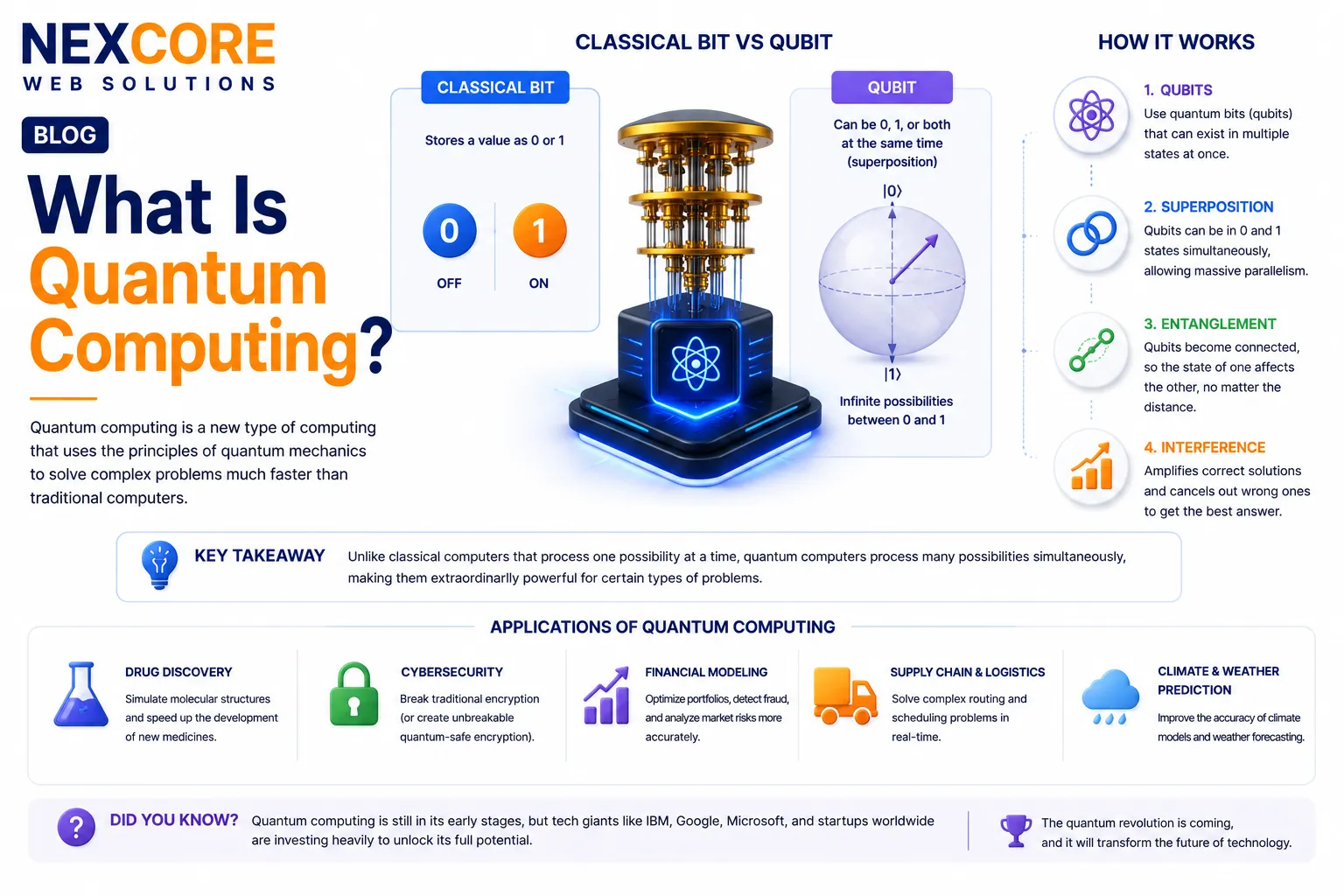
Quantum computing is a type of computing that uses principles from quantum physics to process information in ways that differ fundamentally from traditional computers. Conventional computers represent information using bits that have values of either 0 or 1, while quantum computers use quantum bits, or qubits, that can exist in combinations of states. This does not mean a quantum computer simply performs every calculation faster than a normal computer. Instead, quantum computing is designed to provide advantages for particular classes of problems, especially those involving complex mathematical structures, simulation, and optimization. The technology is still developing, and practical large-scale quantum computing remains challenging. Understanding its basic concepts helps explain why researchers, technology companies, governments, and industries are investing heavily in this emerging field.
How Does Quantum Computing Work?
Quantum computers operate using phenomena described by quantum mechanics. Instead of treating information only as definite 0 or 1 values, quantum systems can use properties such as superposition and entanglement to represent and manipulate information. Quantum algorithms are designed to exploit these properties to solve certain problems in fundamentally different ways. The final result is obtained through measurement, which means the design of a quantum algorithm must carefully control probabilities so useful information can be extracted.
Understanding Qubits
A qubit is the basic unit of quantum information. A traditional bit can be represented as either 0 or 1, while a qubit can occupy a quantum state that combines these possibilities until it is measured. This property is known as superposition. However, superposition should not be interpreted as a simple way to store unlimited classical information, because measurement produces a specific outcome and quantum states are sensitive to disturbances.
What Is Superposition?
Superposition allows a quantum system to exist in a combination of possible states. Quantum algorithms use carefully controlled operations to manipulate these states before measurement. The purpose is not merely to create more possible states, but to arrange quantum amplitudes so that useful outcomes become more likely while unwanted outcomes can cancel or become less likely. This process, known as quantum interference, is an important part of how quantum algorithms can achieve advantages for specific problems.
What Is Quantum Entanglement?
Entanglement is a quantum phenomenon in which the states of multiple quantum systems become correlated in ways that cannot be described simply by treating each system independently. Quantum algorithms can use entangled qubits as part of their computational operations. Entanglement does not allow information to travel instantly or violate the principles of relativity. Instead, it provides a resource that can help quantum systems represent and process relationships between quantum states.
Quantum Computers vs Traditional Computers
Traditional computers use electronic circuits and bits to execute instructions through established logic operations. They are extremely effective for everyday applications such as web browsing, gaming, databases, software development, and business systems. Quantum computers use physical quantum systems and specialized operations to perform quantum computations. They are not expected to replace traditional computers for most everyday tasks; instead, quantum processors may eventually work alongside classical systems for specialized workloads.
A Practical Comparison
Imagine a problem involving a very large mathematical search space. A traditional computer might need to examine possibilities using a classical algorithm, while a quantum algorithm could exploit quantum properties to improve the process for certain structured problems. The advantage depends entirely on the algorithm and problem type. Quantum computing is therefore better understood as a specialized computational approach rather than a universal replacement for existing computers.
What Are Quantum Gates?
Quantum gates are operations that manipulate qubits. They are conceptually similar to logic gates in classical computing, but they operate according to the rules of quantum mechanics. Gates can change quantum states, create superpositions, and contribute to entanglement between qubits. Quantum circuits combine sequences of these operations to implement algorithms and produce measurable outcomes.
Quantum Algorithms
Researchers have developed several quantum algorithms that demonstrate potential advantages over known classical approaches for specific problems. Shor’s algorithm, for example, provides a theoretical method for efficiently factoring large integers on a sufficiently capable fault-tolerant quantum computer. Grover’s algorithm can provide a quadratic speedup for certain unstructured search problems. These examples are important because they show that quantum computing can offer mathematically meaningful advantages, although implementing them at useful real-world scales remains difficult.
What Is Quantum Error Correction?
Quantum systems are extremely sensitive to environmental noise and unwanted interactions. Small disturbances can cause errors in quantum states, a problem known as decoherence. Quantum error correction uses additional physical qubits and carefully designed procedures to protect useful quantum information from these errors. Building reliable logical qubits from imperfect physical qubits is one of the major engineering challenges facing the field.
Why Error Correction Matters
A practical quantum computer capable of solving significant problems may require many physical qubits to create a smaller number of reliable logical qubits. The required overhead depends on hardware quality, error rates, architecture, and the error-correction approach used. Improving these factors is essential for running long and complex quantum algorithms. Without sufficient error correction, computational errors can overwhelm the useful quantum signal.
Potential Applications of Quantum Computing
Quantum computing is being investigated for applications in areas such as chemistry, materials science, optimization, cryptography, finance, and drug discovery. Quantum simulations could eventually help researchers study molecular systems that are difficult to model accurately with classical methods. Optimization research explores whether quantum techniques can improve certain scheduling, routing, and resource-allocation problems. However, many proposed applications remain experimental, and practical advantages must be demonstrated rather than assumed.
Quantum Computing and Cryptography
Quantum computing has important implications for cybersecurity because sufficiently powerful quantum computers could threaten some widely used public-key cryptographic systems. This has encouraged researchers and organizations to develop post-quantum cryptographic algorithms designed to resist attacks from quantum computers. The transition to quantum-resistant security can take many years because organizations often operate complex systems with long-lived data and infrastructure. Quantum computing therefore matters to cybersecurity even before large fault-tolerant quantum computers become widely available.
Challenges of Quantum Computing
Quantum computers face significant technical challenges involving noise, error rates, cooling, control electronics, scalability, and manufacturing. Different hardware approaches use technologies such as superconducting circuits, trapped ions, neutral atoms, photons, and other quantum systems. Each approach has advantages and engineering trade-offs. Researchers are still working to determine how to build systems with enough reliable qubits to deliver practical advantages on important real-world problems.
The Future of Quantum Computing
Quantum computing is developing through a combination of theoretical research, hardware engineering, algorithm design, and experimentation. Progress should be measured carefully because demonstrations of quantum behavior do not automatically translate into useful commercial applications. Future systems may become increasingly capable as hardware quality improves and error-correction techniques mature. Classical and quantum computers are likely to coexist, with quantum processors potentially acting as specialized accelerators for problems where they offer a meaningful advantage.
Conclusion
Quantum computing is an emerging form of computation based on quantum mechanical principles such as superposition, entanglement, and interference. Its fundamental unit, the qubit, behaves differently from a classical bit, allowing specially designed algorithms to process information in new ways. Quantum computers are not universal replacements for traditional machines, but they may eventually provide significant advantages for selected problems involving simulation, optimization, cryptography, and complex mathematics. Major challenges remain, particularly around noise, error correction, scalability, and practical performance. As research continues, understanding both the possibilities and limitations of quantum computing will be important for technology professionals, businesses, researchers, and anyone interested in the future of computing.
FAQs
1. What is quantum computing in simple words?
Quantum computing is a computing approach that uses quantum mechanical properties to process information. Instead of using only classical bits with values of 0 or 1, quantum computers use qubits that can occupy combinations of quantum states. Carefully designed algorithms use properties such as interference and entanglement to solve certain problems in ways that may provide advantages over classical algorithms.
2. Are quantum computers faster than normal computers?
Quantum computers are not automatically faster for every task. They are designed to provide advantages for specific types of computational problems where suitable quantum algorithms exist. Everyday tasks such as browsing the internet, running office applications, or managing conventional databases remain well suited to classical computers. Quantum processors are more likely to complement classical systems than completely replace them.
3. What is a qubit?
A qubit is the basic unit of quantum information. Unlike a classical bit, which has a definite value of 0 or 1, a qubit can occupy a quantum superposition of possible states before measurement. Qubits can also become entangled with one another. Because quantum states are sensitive to environmental disturbances, maintaining reliable qubits is one of the central challenges in quantum computing.
4. What are the main uses of quantum computing?
Potential applications include molecular simulation, materials research, optimization, cryptography, financial modeling, and drug discovery. Quantum computers may be particularly valuable for problems where their algorithms can exploit quantum mechanical properties to achieve an advantage. Many applications remain under research, however, and practical benefits depend on having sufficiently capable hardware, effective algorithms, and error-corrected quantum systems.
5. Will quantum computers replace traditional computers?
Quantum computers are unlikely to replace traditional computers for most everyday computing tasks. Classical computers are efficient, affordable, reliable, and highly optimized for general-purpose workloads. Quantum processors are expected to serve specialized purposes where quantum algorithms can provide meaningful advantages. Future computing environments may therefore combine classical processors with quantum hardware, allowing each technology to handle the types of problems for which it is best suited.




