
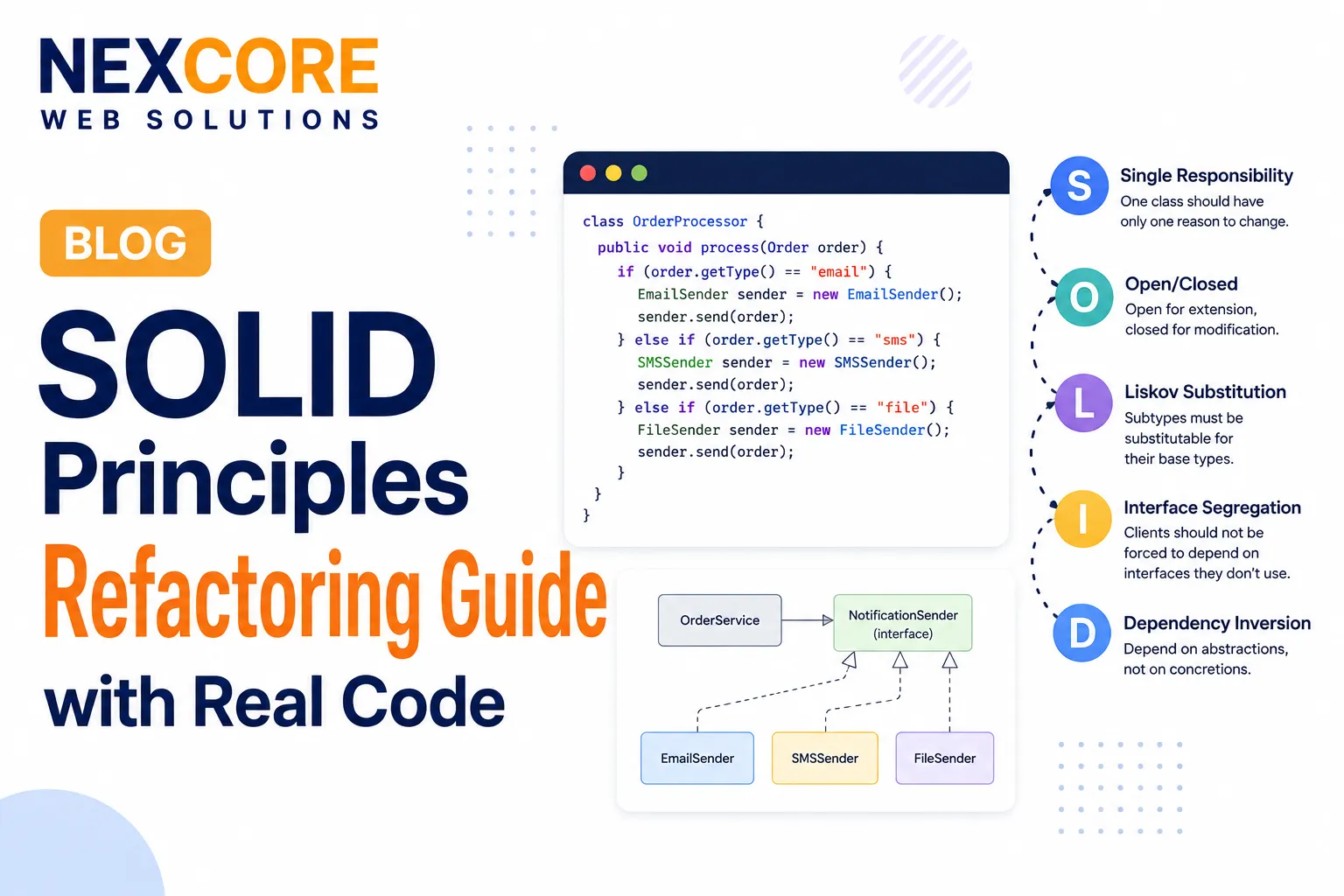
SOLID principles are five object-oriented design guidelines that help developers create software that is easier to understand, test, extend, and maintain. The principles were popularized by Robert C. Martin and are especially useful when applications become larger and requirements change frequently. SOLID does not mean adding more classes or making every piece of code abstract. Instead, it encourages developers to give components clear responsibilities, reduce unnecessary dependencies, and design code that can evolve without causing widespread breakage. Refactoring with SOLID principles is particularly valuable when working with legacy code that has become difficult to modify safely. By examining realistic code examples, developers can see how small structural changes can improve flexibility without changing the application’s intended behavior.
What Does SOLID Mean?
SOLID is an acronym representing five related principles: Single Responsibility, Open/Closed, Liskov Substitution, Interface Segregation, and Dependency Inversion. Each principle addresses a different source of design problems commonly found in object-oriented applications. They are not strict laws, and applying them mechanically can create unnecessary complexity. The goal is to use them as practical guidelines when code shows signs of tight coupling, duplicated responsibilities, difficult testing, or frequent modification.
Single Responsibility Principle
The Single Responsibility Principle, or SRP, states that a class should have one reason to change. A common violation occurs when one class handles unrelated responsibilities such as calculating an invoice, saving it to a database, and sending an email. Changes to database infrastructure would then affect the same class responsible for business logic. Separating these concerns makes each component easier to understand and test.
Before Refactoring
class InvoiceService { public function createInvoice($items) { // Calculate invoice // Save invoice to database // Send invoice email }}
This class is responsible for several different operations. A better design separates calculation, persistence, and notification into focused components. The resulting classes can change independently without forcing unrelated code to change.
class InvoiceCalculator { public function calculate($items) { // Calculate invoice }}class InvoiceRepository { public function save($invoice) { // Save invoice }}class InvoiceMailer { public function send($invoice) { // Send email }}
Open/Closed Principle
The Open/Closed Principle says software components should be open for extension but closed for modification. This means new behavior should ideally be added without repeatedly changing stable, existing code. A typical example is a payment service containing a large conditional statement for every payment provider. Each new provider forces developers to modify the same class, increasing the chance of regression.
Refactoring Payment Logic
Instead, define a common contract and create separate implementations.
interface PaymentGateway { public function pay(float $amount): bool;}class StripeGateway implements PaymentGateway { public function pay(float $amount): bool { return true; }}class PayPalGateway implements PaymentGateway { public function pay(float $amount): bool { return true; }}
The payment service can work with the interface rather than knowing every provider. Adding another gateway requires a new implementation instead of modifying the core payment logic. This approach becomes especially useful when integrations are expected to grow over time.
Liskov Substitution Principle
The Liskov Substitution Principle, or LSP, states that objects of a subtype should be usable wherever their base type is expected without breaking the application’s behavior. Problems often appear when inheritance is used for classes that do not genuinely share the same behavioral contract. A classic example is a base class that defines a method that one subclass cannot logically support. When that happens, inheritance may be hiding a poor abstraction.
Practical Refactoring
Suppose a Bird class requires every bird to implement fly(), but a penguin cannot fly. Instead of forcing the penguin into an unsuitable contract, separate flying behavior from general bird behavior.
interface Bird { public function eat(): void;}interface FlyingBird extends Bird { public function fly(): void;}
Now flying birds can implement FlyingBird, while birds that cannot fly only implement the behavior they genuinely support. This prevents callers from making assumptions that a subtype cannot satisfy.
Interface Segregation Principle
The Interface Segregation Principle recommends creating focused interfaces instead of forcing classes to depend on methods they do not use. Large interfaces often become difficult to implement because different classes need different subsets of functionality. A printer, for example, should not be forced to implement scanning and faxing methods if it only supports printing. Smaller interfaces make dependencies clearer and implementations simpler.
interface Printer { public function printDocument($document): void;}interface Scanner { public function scanDocument(): string;}
A basic printer can now implement only Printer, while a multifunction device can implement both interfaces. This design reduces unnecessary coupling and makes testing easier because components depend only on capabilities they actually require.
Dependency Inversion Principle
The Dependency Inversion Principle encourages high-level business logic to depend on abstractions rather than concrete implementation details. Without this principle, a service may directly instantiate a database repository, payment gateway, or external API client. Such dependencies make unit testing harder and replacing infrastructure more expensive. Dependency injection provides a practical way to implement this principle.
Before and After
Instead of writing:
class OrderService { private $database = new MySqlDatabase();}
use an abstraction:
class OrderService { public function __construct( private Database $database ) {}}
The service can now receive different implementations during testing or deployment. A real database can be used in production, while a fake or in-memory implementation can be supplied during unit tests. This separation keeps business rules independent from infrastructure details.
When Should You Refactor?
SOLID refactoring is most useful when code has clear maintainability problems rather than simply because a principle can be applied. Warning signs include classes that are difficult to test, large conditional blocks, excessive dependencies, duplicated responsibilities, and changes that repeatedly break unrelated features. Refactoring should be incremental, supported by tests, and focused on improving a specific design problem. Developers should avoid turning simple code into an elaborate architecture without a genuine requirement.
Conclusion
SOLID principles provide a practical framework for improving object-oriented software design, especially when existing code has become tightly coupled or difficult to extend. The five principles encourage focused responsibilities, controlled extension, valid abstractions, smaller interfaces, and dependency management. Refactoring does not require rewriting an entire application; developers can gradually separate responsibilities, introduce interfaces, and replace concrete dependencies while preserving existing behavior. The most effective use of SOLID comes from applying judgment rather than following rules mechanically. When combined with meaningful tests and incremental changes, SOLID-based refactoring can make software easier to maintain, adapt, and understand as requirements evolve.
FAQs
1. What are the five SOLID principles?
SOLID represents five object-oriented design principles: Single Responsibility, Open/Closed, Liskov Substitution, Interface Segregation, and Dependency Inversion. Together, they encourage developers to create focused components, reduce unnecessary coupling, use reliable abstractions, and make software easier to extend and test. The principles are guidelines rather than mandatory rules, so developers should apply them according to the application’s actual complexity and requirements.
2. Does SOLID apply only to large applications?
No. SOLID principles can improve code at different scales, but their value becomes more noticeable as software grows and requirements change. Small applications may not need extensive abstractions because additional structure can create unnecessary complexity. Developers should introduce SOLID-based designs when they solve real problems such as difficult testing, tight coupling, repeated changes, or unclear responsibilities rather than applying every principle automatically.
3. Does SOLID mean creating more classes?
Not necessarily. SOLID can lead to additional classes or interfaces when responsibilities genuinely need to be separated, but creating more files is not the objective. The purpose is to establish clearer boundaries between components and reduce problematic dependencies. Excessive abstraction can make simple software harder to understand, so developers should balance clean design with practical simplicity and the project’s actual maintenance needs.
4. How does SOLID improve testing?
SOLID can make testing easier by reducing dependencies and separating responsibilities. For example, dependency inversion allows a service to receive a database abstraction instead of constructing a real database connection internally. Tests can then provide a fake implementation and focus on business behavior. Similarly, smaller classes and interfaces reduce the amount of unrelated functionality that must be configured when testing a specific component.
5. Should legacy code always be refactored using SOLID?
No. Legacy code should be refactored when there is a clear benefit, such as reducing defects, making changes safer, or improving testability. Applying SOLID mechanically to stable code can introduce unnecessary complexity and risk. A better approach is to identify a specific maintenance problem, add appropriate tests, make a small structural improvement, and verify that behavior remains correct before continuing with additional refactoring.




