
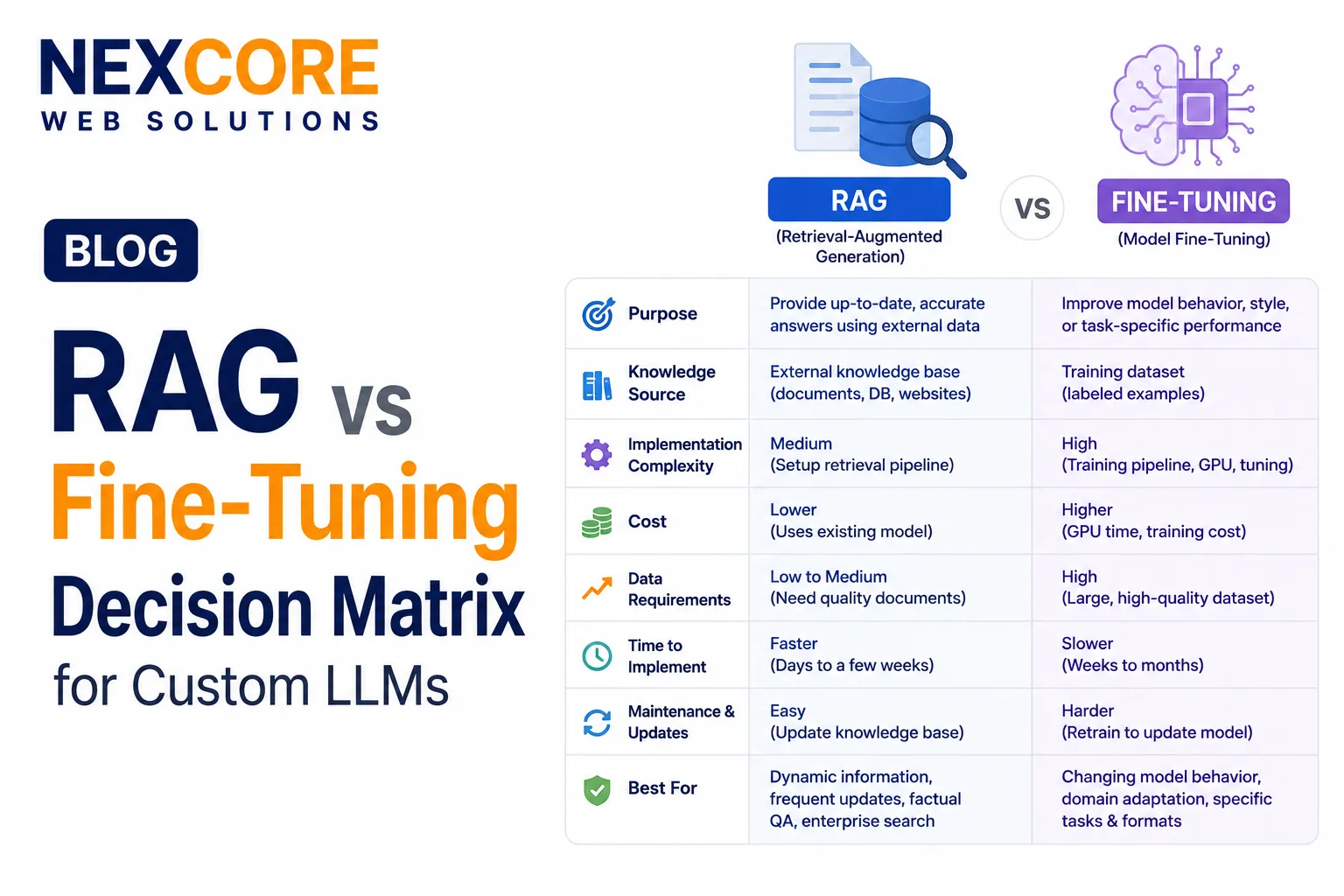
Building a custom large language model application often raises a practical question: should the model use retrieval-augmented generation (RAG), fine-tuning, or both? The answer depends on what needs to change, where the required information lives, and how frequently that information evolves. RAG gives a language model access to external knowledge at query time, while fine-tuning changes the model’s learned behavior by training it on additional examples. These approaches solve different problems, despite often being discussed as alternatives. Choosing the wrong approach can increase development costs, reduce response quality, or make maintenance unnecessarily difficult. A clear decision framework helps teams select an architecture that matches their data, security requirements, performance expectations, and long-term product goals.
What Is RAG?
Retrieval-augmented generation connects an LLM with an external knowledge source. When a user asks a question, the application retrieves relevant information from documents, databases, APIs, or vector stores and provides that context to the model before generating a response. This approach is particularly useful when answers depend on information that changes frequently or is specific to an organization. For example, an internal assistant can retrieve the latest company policies without retraining the underlying model whenever a document changes.
When RAG Makes Sense
RAG is usually the stronger choice when the main problem is knowledge access rather than model behavior. It works well for private documents, product catalogs, support documentation, internal policies, research materials, and frequently updated information. Retrieval also makes it possible to cite or trace answers back to source documents when the application is designed for grounded responses. However, retrieval quality depends heavily on document preparation, chunking, indexing, search strategy, and access controls.
What Is Fine-Tuning?
Fine-tuning involves training an existing model on a carefully prepared dataset so that it learns desired patterns, formats, behaviors, or task-specific responses. Unlike RAG, fine-tuning does not simply provide new documents to the model during a request. Instead, training modifies the model’s parameters so particular behaviors become more strongly represented. This makes fine-tuning useful when an application consistently needs a particular response style, classification behavior, structured output format, or specialized task performance.
When Fine-Tuning Makes Sense
Fine-tuning can be valuable when the desired improvement concerns how the model responds rather than what information it knows. For example, a company might train a model to consistently produce a specific JSON structure, follow a specialized communication style, classify support tickets, or perform a narrow domain task. Fine-tuning is less suitable as the primary method for storing frequently changing factual information because updating that information requires another training process. The training dataset must also be representative and carefully reviewed.
RAG vs Fine-Tuning: Decision Matrix
| Requirement | RAG | Fine-Tuning |
|---|---|---|
| Frequently changing knowledge | Excellent | Poor fit |
| Private company documents | Excellent | Possible, but less flexible |
| Custom response style | Limited | Excellent |
| Structured output behavior | Good with prompting | Excellent |
| Source citations | Strong | Not inherent |
| Updating knowledge | Simple document update | Requires retraining |
| Specialized task behavior | Moderate | Strong |
| Initial implementation | Often simpler | More involved |
| Data access control | Strong with proper design | More difficult |
| Best for factual retrieval | Excellent | Limited |
The matrix should not be treated as an absolute rule because real applications often have mixed requirements. A customer-support system, for example, may need RAG to retrieve current product information while using fine-tuning to produce responses in a consistent support format. The two techniques can therefore complement one another rather than compete directly. Teams should identify which part of the problem involves knowledge and which part involves behavior before choosing an architecture.
Comparing Cost and Maintenance
RAG and fine-tuning have different operational costs. RAG requires infrastructure for document processing, embeddings, retrieval, storage, and monitoring, but updating knowledge can often be as simple as adding or replacing documents. Fine-tuning requires dataset preparation, training resources, evaluation, model management, and potentially repeated training when requirements change. For organizations with rapidly changing information, RAG can therefore provide a more maintainable knowledge layer.
Evaluating Data
The nature of the available data is one of the most important decision factors. If the information exists as documents, records, manuals, policies, or frequently updated content, RAG is often appropriate because the model can retrieve the relevant material when needed. If the dataset consists primarily of high-quality examples demonstrating how the model should behave, fine-tuning may be more useful. Poor training examples can produce undesirable behavior, while poorly structured retrieval data can lead to irrelevant context.
Accuracy and Hallucination Considerations
RAG can reduce factual errors by supplying relevant source material, but retrieval does not guarantee a correct answer. If the search system retrieves irrelevant or incomplete information, the model may still produce a poor response. Fine-tuning can improve task behavior but does not guarantee factual accuracy for changing information. Both approaches therefore require evaluation using representative test cases, clear quality metrics, and monitoring after deployment.
Security and Privacy
Enterprise applications must consider how sensitive information enters and moves through the AI system. RAG can enforce document-level or user-level access controls before information reaches the model, making it useful for internal knowledge systems. Fine-tuning sensitive data into model parameters can create more complicated governance and data-removal considerations. Organizations should evaluate retention requirements, authorization, encryption, auditability, and data isolation before selecting either approach.
A Hybrid Approach
Many sophisticated custom LLM systems use both RAG and fine-tuning. Fine-tuning can teach the model a specific task, tone, output format, or workflow, while RAG supplies current and organization-specific knowledge. For example, a legal document assistant could be fine-tuned for consistent structured summaries while retrieving the latest approved documents through a secure knowledge base. This architecture separates behavioral customization from information retrieval, making each layer easier to evaluate and update.
Practical Decision Process
Start by asking whether the main problem is missing knowledge or inconsistent behavior. If the model needs access to changing facts, private documents, or external sources, begin by evaluating RAG. If the model already has the required knowledge but struggles with a specialized task or output pattern, investigate fine-tuning. If both problems exist, a hybrid architecture may be the most practical option. Before committing to production, test the chosen approach against real user queries and compare quality, latency, cost, security, and maintenance requirements.
Conclusion
RAG and fine-tuning are powerful techniques for customizing LLM applications, but they solve different problems. RAG is generally better for providing current, private, and externally stored knowledge, while fine-tuning is better suited to changing model behavior, specialized tasks, and consistent output patterns. Neither approach should be selected simply because it is technically popular. Teams should first identify whether their challenge involves knowledge, behavior, or both, then evaluate cost, security, accuracy, update frequency, and operational complexity. In many enterprise applications, the strongest solution combines both methods. A well-designed architecture keeps knowledge retrieval and model behavior as separate concerns, allowing each component to evolve without unnecessary retraining or system-wide changes.
FAQs
1. Is RAG better than fine-tuning?
Neither approach is universally better because they address different requirements. RAG is generally better when an application needs current, private, or frequently changing information from external sources. Fine-tuning is more appropriate when the goal is to change model behavior, improve a specialized task, or enforce consistent output patterns. The right choice depends on the application’s data, objectives, and maintenance requirements.
2. Can RAG and fine-tuning be used together?
Yes, RAG and fine-tuning can be combined effectively. Fine-tuning can teach a model how to perform a specialized task or follow a particular response format, while RAG provides current information from external knowledge sources. This separation can be especially useful for enterprise applications where both behavior customization and reliable access to changing internal information are important.
3. Does fine-tuning add new knowledge to an LLM?
Fine-tuning can influence what information and patterns a model produces, but it should not be treated as a simple database for storing factual knowledge. Information learned during fine-tuning is distributed within model parameters and is not easily updated or removed like a document in a knowledge base. For frequently changing or source-sensitive information, RAG is generally a more practical approach.
4. When should a company choose RAG?
A company should consider RAG when its AI application needs access to private documents, policies, product information, support content, databases, or other external knowledge. It is particularly useful when that information changes regularly and must be updated without retraining the model. RAG can also support source-based responses and access controls when the retrieval architecture is properly designed.
5. How do I decide between RAG and fine-tuning?
Begin by identifying the actual problem. If the model lacks access to relevant information, evaluate RAG; if it has the information but consistently performs a task incorrectly or uses the wrong format or style, consider fine-tuning. If both issues exist, evaluate a hybrid design. Then compare each option using real-world test cases, cost, latency, security, accuracy, and long-term maintenance.




