
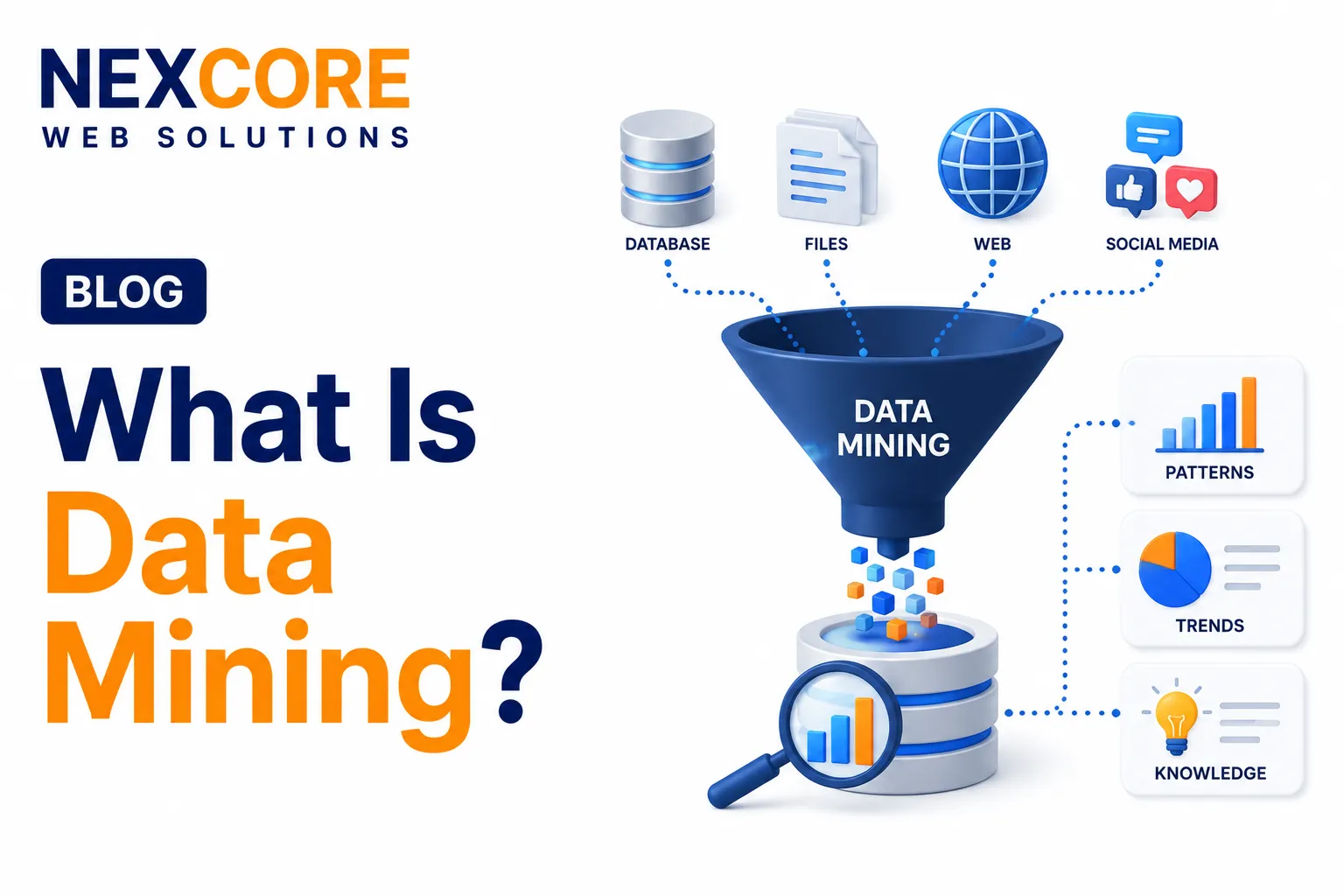
Data mining is the process of examining large collections of data to discover useful patterns, relationships, trends, and insights that may not be obvious at first glance. Businesses, researchers, governments, and technology companies use data mining to understand behavior, identify opportunities, detect unusual activity, and support better decisions. The process can involve statistics, databases, machine learning, pattern recognition, and specialized algorithms. For example, an online retailer can analyze thousands of purchases to discover which products customers frequently buy together. A bank can examine transaction patterns to identify potentially suspicious activity. Data mining is therefore not simply about collecting more information; it is about finding meaningful knowledge within existing data and turning that knowledge into practical action.
How Does Data Mining Work?
Data mining usually begins with a clear question or business problem rather than immediately applying an algorithm to a dataset. Analysts first identify relevant data sources and determine whether the available information is accurate and suitable for the intended task. The data may then be cleaned, transformed, and organized before analytical techniques are applied. Finally, the discovered patterns are evaluated and interpreted to determine whether they are useful and reliable.
Data Preparation
Raw datasets commonly contain missing values, duplicates, inconsistent formats, and incorrect records. Data preparation addresses these issues so that analysis does not produce misleading results. For example, a customer database might contain multiple spellings of the same city, making geographic analysis less reliable. Cleaning and standardizing such information can improve the quality of patterns discovered later.
Common Data Mining Techniques
Classification
Classification assigns records to predefined categories based on characteristics learned from existing examples. For instance, an email system might classify messages as spam or legitimate. A financial institution could classify transactions according to whether they appear normal or potentially fraudulent. Classification models require suitable training data and should be evaluated carefully to determine how accurately they perform on new information.
Clustering
Clustering groups similar records without requiring predefined categories. A retailer could use clustering to identify groups of customers with similar purchasing behavior. Marketing teams might then develop different strategies for each customer segment instead of treating every customer identically. The usefulness of clustering depends on selecting meaningful features and interpreting the resulting groups appropriately.
Association Rule Mining
Association analysis identifies items or events that frequently occur together. A classic retail example is discovering that customers who purchase one product often purchase another related product during the same shopping session. These relationships can support product recommendations, store layouts, promotional planning, and inventory decisions. Importantly, an association does not automatically prove that one event causes another.
Regression
Regression techniques examine relationships between variables and can be used to estimate numerical outcomes. A business might use historical sales data to estimate future revenue based on factors such as season, pricing, location, or advertising activity. Regression is useful for forecasting and understanding relationships, but predictions depend on the quality and relevance of the underlying data.
Data Mining vs Data Analysis
Data mining and data analysis are closely related, but they are not exactly the same. Data analysis can involve examining known questions, summarizing information, creating reports, and interpreting trends. Data mining focuses more heavily on discovering previously unknown or less obvious patterns within datasets. In practice, organizations may use both approaches together, with data analysis helping explain findings and data mining helping uncover relationships worth investigating further.
Data Mining and Machine Learning
Machine learning and data mining overlap significantly because both can use algorithms to identify patterns in data. Machine learning often focuses on building systems that learn from data to make predictions or decisions on new inputs. Data mining can use machine-learning techniques but also includes statistical and database-oriented methods for discovering useful relationships. The distinction depends partly on the project goal, because real-world data teams often combine methods rather than treating them as completely separate disciplines.
Applications of Data Mining
Data mining is used in many industries because organizations generate large amounts of structured and unstructured information. Retailers can analyze purchasing patterns, financial institutions can identify suspicious transactions, and healthcare organizations can examine operational or research data. Telecommunications companies can study customer behavior to understand service usage and potential churn. Manufacturers can analyze equipment information to identify conditions associated with failures or maintenance requirements.
E-Commerce Example
Consider an online store with millions of historical orders. Data mining can reveal which products are commonly purchased together, which customer groups respond to particular offers, and which products experience seasonal demand. The business can use these findings to improve recommendations, inventory planning, and marketing campaigns. The analysis becomes valuable when discovered patterns lead to measurable improvements rather than simply producing interesting statistics.
Benefits of Data Mining
One of the main benefits of data mining is that it can help organizations discover opportunities that would be difficult to identify through manual examination. It can support forecasting, customer segmentation, fraud detection, recommendation systems, operational improvements, and strategic planning. Automated analysis can also process datasets at a scale that would be impractical for people to review individually. However, the value of data mining depends on whether the resulting insights are accurate, relevant, and connected to real decisions.
Challenges and Limitations
Data mining can produce misleading conclusions when datasets are incomplete, biased, outdated, or poorly structured. A pattern found in historical data may not continue to exist when market conditions change. There is also a risk of finding correlations that appear meaningful but do not represent genuine relationships. Organizations should therefore validate important findings, consider alternative explanations, and avoid treating statistical patterns as unquestionable facts.
Privacy and Responsible Data Mining
Data mining can involve sensitive information about customers, employees, patients, or users. Organizations should understand what information they collect, why it is needed, how it is protected, and who can access the resulting insights. Privacy requirements may also restrict how certain categories of data can be collected or processed. Responsible data mining requires appropriate security, transparency, access controls, data minimization, and consideration of potential harm.
Tools Used for Data Mining
Data mining can be performed using databases, statistical software, programming languages, machine-learning frameworks, and business intelligence platforms. Python and R are commonly used for data processing and analysis, while SQL is essential for retrieving information from relational databases. Specialized platforms can help users build models and explore patterns without writing every algorithm manually. The appropriate tool depends on dataset size, technical requirements, organizational skills, and the complexity of the problem.
Conclusion
Data mining is a practical discipline for discovering useful patterns and relationships within large datasets. It combines data preparation, statistics, machine learning, database techniques, and analytical reasoning to turn raw information into actionable knowledge. Techniques such as classification, clustering, association analysis, and regression can support applications ranging from fraud detection and customer segmentation to forecasting and recommendation systems. However, successful data mining requires more than sophisticated algorithms. Reliable data, careful validation, privacy protection, and strong understanding of the underlying business or research problem are equally important. When used responsibly, data mining can help organizations make better decisions by revealing information that might otherwise remain hidden inside large and complex datasets.
FAQs
1. What is data mining in simple words?
Data mining is the process of examining large amounts of data to find useful patterns, relationships, trends, or unusual behavior. It uses techniques from statistics, machine learning, databases, and computer science to discover information that may not be immediately visible. Businesses can use data mining to understand customers, detect fraud, forecast demand, improve recommendations, and support better decision-making.
2. What are the main techniques of data mining?
Common data mining techniques include classification, clustering, association rule mining, and regression. Classification places records into predefined categories, while clustering groups similar records without predetermined labels. Association analysis identifies events or items that frequently occur together, and regression examines relationships between variables while often supporting numerical prediction. Different techniques are selected according to the type of problem and available data.
3. Is data mining the same as data science?
Data mining is an important activity within the broader field of data science, but the two terms are not identical. Data science can include data collection, cleaning, statistical analysis, visualization, experimentation, machine learning, and communication. Data mining focuses particularly on discovering useful patterns and relationships in datasets. In real projects, data scientists may use data mining techniques alongside many other analytical methods.
4. Where is data mining used?
Data mining is used in retail, banking, healthcare, manufacturing, telecommunications, marketing, technology, education, and many other sectors. Organizations can use it to identify fraudulent transactions, understand customer behavior, predict equipment failures, analyze purchasing patterns, segment users, and forecast demand. Its applications depend on the type of data available and the specific problems an organization wants to solve.
5. Is data mining safe for personal information?
Data mining can create privacy risks when it involves personal or sensitive information. Organizations should collect and process data for legitimate purposes, apply appropriate security controls, restrict access, and follow applicable privacy requirements. Data minimization and careful anonymization or de-identification can also reduce unnecessary exposure. Responsible data mining requires considering both the usefulness of the analysis and its potential impact on individuals.




