
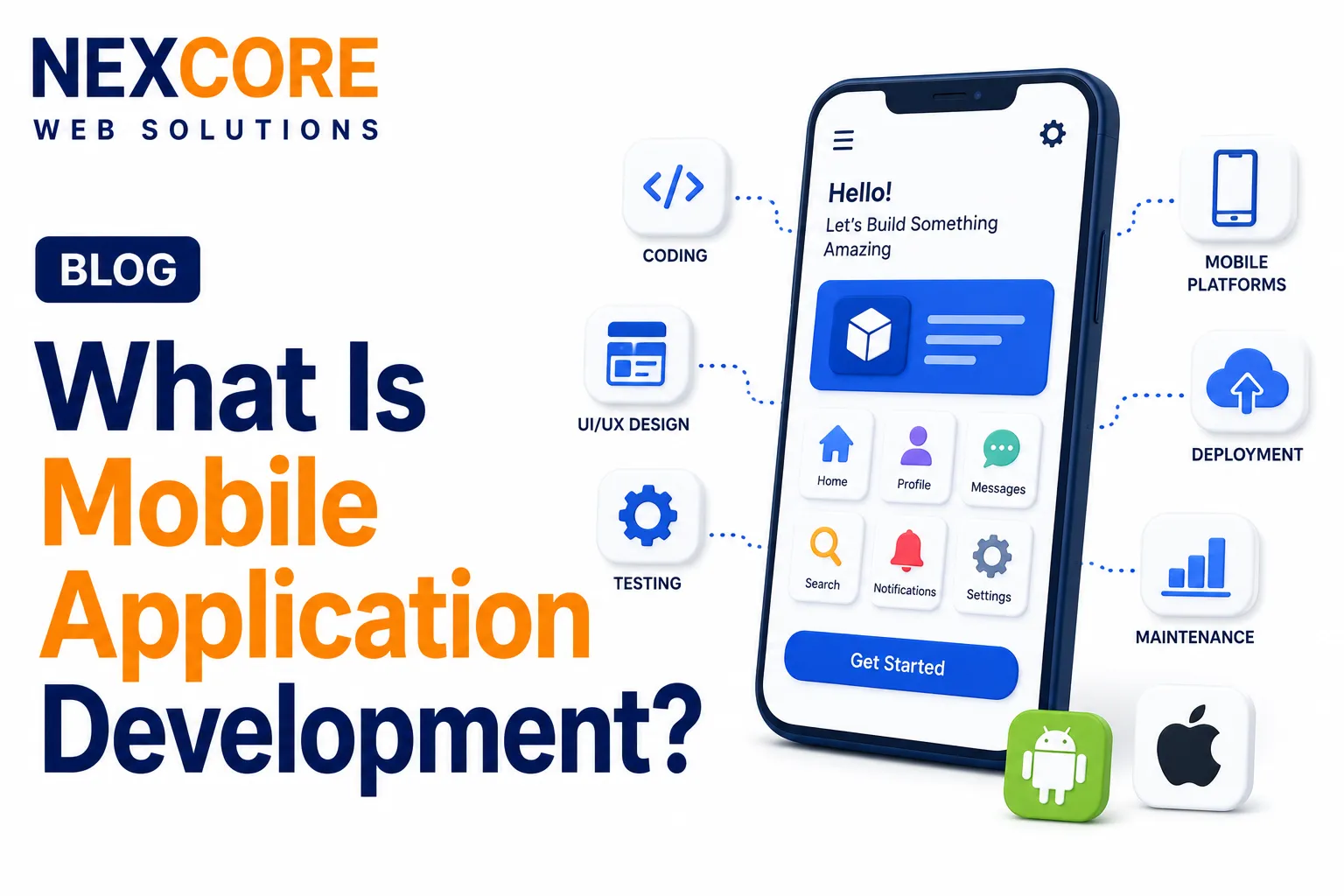
Mobile application development is the process of designing, building, testing, deploying, and maintaining software applications that run on smartphones and tablets. These applications can provide services ranging from online banking and shopping to education, entertainment, communication, healthcare, and business management. Unlike traditional desktop software, mobile applications must work within the constraints of smaller screens, touch interfaces, mobile networks, battery usage, and different device capabilities. Developers also need to consider operating systems, security, performance, accessibility, and app-store requirements. A successful mobile application is therefore more than a collection of screens and buttons. It combines thoughtful user experience, reliable programming, suitable architecture, secure data handling, and continuous improvement based on real user needs.
How Does Mobile App Development Work?
Mobile app development usually begins by defining the problem the application is intended to solve. Developers and product teams identify target users, important features, business requirements, and technical constraints before implementation begins. Designers then create user flows, wireframes, and interface concepts that show how people will interact with the application. After the requirements and design are sufficiently clear, developers build the application, connect required services, test its behavior, and prepare it for release.
Planning and Requirements
Good planning can prevent expensive changes later in development. A team may document features such as registration, authentication, payments, notifications, search, messaging, or offline access depending on the application’s purpose. Technical decisions also need to consider backend services, databases, APIs, third-party integrations, analytics, and security requirements. A clear minimum viable product can help teams launch essential functionality before expanding into more advanced features.
Types of Mobile App Development
Native App Development
Native applications are built specifically for a particular operating system and use technologies recommended for that platform. Android applications can be developed using Kotlin or Java, while iOS applications commonly use Swift or Objective-C. Native development provides strong access to platform features and can deliver excellent performance and user experience. However, organizations supporting both major platforms may need separate development efforts.
Cross-Platform Development
Cross-platform frameworks allow developers to build applications that target multiple operating systems from a shared codebase. Technologies such as Flutter and React Native are widely used for this purpose. Sharing code can reduce development effort and simplify maintenance, although platform-specific code may still be necessary for certain features. The right choice depends on project requirements, team expertise, performance expectations, and long-term maintenance needs.
Progressive Web Applications
Progressive Web Applications, or PWAs, use web technologies while providing features that can make a website feel more like an installed application. Depending on browser support and implementation, PWAs can offer installation, offline capabilities, notifications, and responsive interfaces. They can be useful when broad web accessibility is more important than deep native integration. However, they do not provide exactly the same capabilities as fully native applications on every platform.
Important Components of a Mobile Application
A mobile application typically contains several layers that work together. The user interface handles interaction, while application logic manages operations and business rules. A backend may provide authentication, database access, file storage, payments, notifications, or other services through APIs. A well-designed architecture keeps these responsibilities organized so developers can maintain and test the application as it grows.
User Interface and Experience
Mobile interfaces should be designed around touch interaction and limited screen space. Navigation needs to be predictable, text should remain readable, and important actions should be easy to discover without unnecessary steps. Designers also need to consider different screen sizes, orientations, accessibility requirements, and platform conventions. A visually attractive application can still fail if users cannot quickly understand how to complete common tasks.
Backend and APIs
Many mobile applications rely on backend systems rather than storing all information directly on the device. APIs allow the mobile client to communicate with servers that handle authentication, business logic, databases, and other services. For example, a shopping application can request product information from an API and submit orders through the same backend infrastructure. Secure API design is essential because mobile applications operate in environments that developers cannot fully control.
Mobile App Security
Security should be considered throughout the development lifecycle rather than added immediately before launch. Developers should protect authentication credentials, validate server-side requests, encrypt sensitive communications, minimize stored sensitive information, and apply appropriate authorization controls. Applications should also be tested for common vulnerabilities involving insecure APIs, improper data storage, weak authentication, and unsafe dependencies. Regular updates are important because new vulnerabilities can appear after an application has already been released.
Testing and Quality Assurance
Testing helps identify problems before users encounter them in production. Developers can perform unit testing, integration testing, interface testing, performance testing, security testing, and compatibility testing across supported devices and operating-system versions. Mobile applications should also be tested under realistic conditions such as slow networks, low battery, interrupted connections, and limited storage. Crash monitoring and user feedback after launch can reveal issues that controlled testing did not detect.
App Deployment and Maintenance
Publishing an application involves preparing release builds, meeting platform requirements, creating store listings, and completing the relevant review processes. Development does not end when the application reaches an app store. Developers must monitor crashes, performance, security issues, compatibility problems, and user feedback after release. Regular maintenance may include bug fixes, dependency updates, new features, operating-system compatibility changes, and improvements based on actual usage data.
Benefits of Mobile Applications
Mobile applications can provide direct access to services and features that are difficult to deliver through traditional channels. They can use device capabilities such as cameras, location services, biometric authentication, notifications, sensors, and secure storage when appropriate. Businesses can use applications to improve customer engagement, streamline internal workflows, and provide personalized experiences. The value depends on whether the application solves a genuine user problem rather than simply existing as another digital channel.
Conclusion
Mobile application development is a complete process that combines product planning, interface design, programming, backend integration, security, testing, deployment, and ongoing maintenance. Developers must choose an appropriate technology strategy based on platform requirements, performance, budget, team expertise, and future scalability. Native, cross-platform, and progressive web approaches each have different strengths and limitations. A successful mobile application is not defined only by how quickly it launches, but by how reliably and securely it serves users over time. Teams that understand their audience, prioritize essential functionality, test realistically, and continuously improve the product are better positioned to build applications that remain useful as technology and user expectations change.
FAQs
1. What is mobile application development in simple terms?
Mobile application development is the process of creating software designed to run on smartphones and tablets. It includes planning features, designing interfaces, writing code, connecting backend services, testing the application, publishing it, and maintaining it after release. Developers may build applications specifically for Android or iOS, or use cross-platform technologies to share code between different mobile operating systems.
2. What programming languages are used for mobile app development?
The language depends on the platform and development approach. Android applications commonly use Kotlin and Java, while iOS development commonly uses Swift. Cross-platform frameworks can use technologies such as Dart with Flutter or JavaScript and TypeScript with React Native. The best choice depends on the application’s requirements, available development skills, platform support, performance needs, and long-term maintenance plans.
3. How long does it take to develop a mobile application?
Development time varies significantly depending on the application’s complexity, number of platforms, required integrations, design requirements, and testing scope. A simple application with a small feature set may take considerably less time than a banking, ecommerce, or social platform. Teams should account for planning, design, development, testing, deployment, and post-launch maintenance rather than estimating only the coding phase.
4. What is the difference between native and cross-platform apps?
Native applications are developed specifically for a particular operating system and can provide strong access to platform-specific capabilities. Cross-platform applications use shared technologies or codebases to target multiple platforms, potentially reducing development and maintenance effort. Native development may offer advantages for highly specialized performance or platform features, while cross-platform development can be attractive when consistent functionality across platforms is the primary goal.
5. Is mobile app security important during development?
Yes, security should be included from the beginning of mobile application development. Applications may process credentials, personal information, payment details, location data, or business information, making security weaknesses potentially serious. Developers should protect communications, validate inputs, secure authentication, minimize sensitive local storage, control API access, update dependencies, and test for vulnerabilities throughout the application’s lifecycle.




