
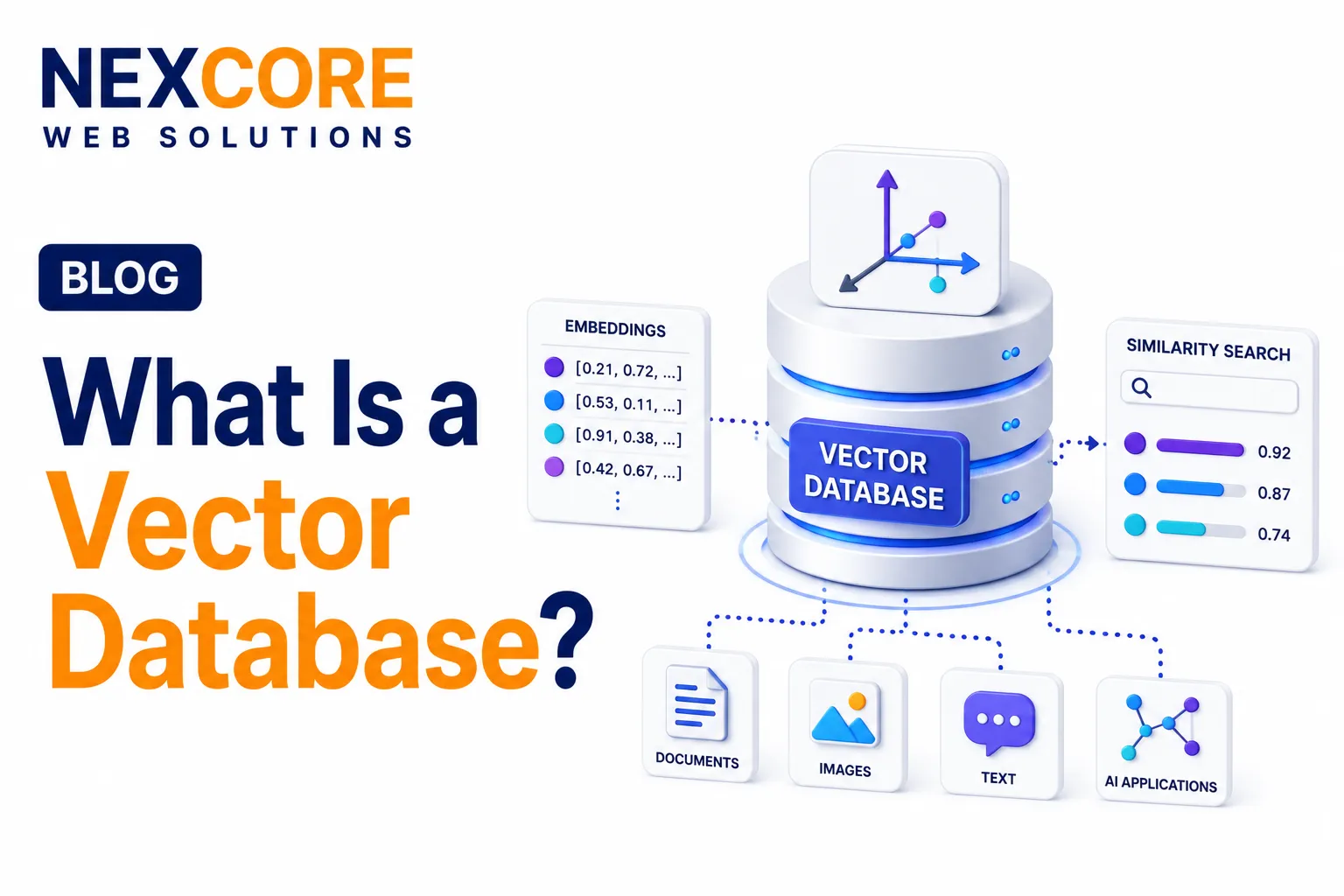
A vector database is a type of database designed to store, organize, and search numerical representations of information called vectors or embeddings. These vectors can represent text, images, audio, products, documents, and other types of data in a mathematical form that captures useful characteristics or relationships. Unlike a traditional database that commonly searches for exact values or keywords, a vector database can find information that is semantically similar to a query. This capability has become particularly important with artificial intelligence, machine learning, recommendation systems, and retrieval-augmented generation applications. For example, a user could search for “ways to reduce monthly electricity costs,” and a vector database could retrieve documents discussing energy efficiency even when those exact words do not appear in the documents.
How Does a Vector Database Work?
A vector database works by storing embeddings generated by an embedding model. An embedding is a numerical representation of information that places related concepts closer together in a multidimensional mathematical space. When a user submits a search query, the system converts that query into another vector and compares it with stored vectors. The database then returns records whose vectors are considered most similar according to a selected distance or similarity method.
Understanding Embeddings
Suppose a company has thousands of support documents covering products, troubleshooting procedures, and policies. An embedding model can convert each document or document section into a vector containing many numerical values. A question such as “How do I reset my account password?” is also converted into a vector. Even if a document uses wording such as “recover your login credentials,” the vectors may be close because the underlying meaning is related.
Vector Search vs Traditional Search
Traditional database searches are often based on exact matches, filters, structured fields, or keyword relevance. These methods remain extremely useful when users know specific values or need precise filtering. Vector search instead focuses on similarity in a numerical representation of information. This makes it particularly useful when the meaning of a query matters more than the exact words used.
A Practical Example
Imagine an online store containing thousands of product descriptions. A customer searches for “comfortable shoes for long-distance walking.” A keyword search may focus on terms such as “walking” or “comfortable,” while vector search can potentially identify products whose descriptions express similar concepts using different wording. The result can therefore be more relevant when users describe what they want naturally rather than entering exact product names.
Similarity Search Methods
Vector databases use mathematical methods to determine how close two vectors are to each other. Common approaches include cosine similarity, Euclidean distance, and dot product, although the appropriate method depends on the embedding model and application. These calculations help rank stored vectors according to their relationship with the query vector. The database can then return the most relevant results, often referred to as nearest neighbors.
Approximate Nearest Neighbor Search
Comparing a query against every stored vector can become expensive when a database contains millions or billions of records. Vector databases therefore commonly use indexing techniques designed to find approximate nearest neighbors efficiently. These indexes reduce the amount of computation required while maintaining useful search quality. The balance between retrieval speed, memory consumption, and accuracy is an important consideration when designing a vector-search system.
What Are Vector Databases Used For?
Vector databases are widely used in modern AI applications because they make semantic retrieval practical at scale. They can support recommendation systems, image similarity search, document retrieval, intelligent search, question-answering systems, personalization, and fraud analysis. In an AI assistant, a vector database can store relevant knowledge and retrieve appropriate information before a language model generates a response. This allows the application to use external or private information without requiring the model itself to memorize every document.
Retrieval-Augmented Generation
Retrieval-Augmented Generation, or RAG, is one of the most common applications of vector databases. Documents are converted into embeddings and stored in the database, often after being divided into smaller chunks. When a user asks a question, the application searches for relevant vectors and supplies the retrieved content to a language model. The model can then generate an answer using the retrieved context, which can make the application more useful for specialized or frequently changing information.
Metadata and Filtering
Vector similarity does not have to be the only way records are selected. Many vector databases also support metadata, allowing applications to filter results according to attributes such as department, date, document type, language, product category, or user permissions. For example, an internal company assistant could search semantically while restricting results to documents belonging to the employee’s department. Combining vector similarity with metadata filtering can improve relevance and security.
Popular Vector Database Options
Several technologies can provide vector storage and similarity search, including specialized vector databases and traditional databases with vector extensions. Examples include Pinecone, Weaviate, Milvus, Qdrant, Chroma, and PostgreSQL configurations using vector capabilities. The right choice depends on factors such as dataset size, infrastructure preferences, filtering requirements, latency expectations, scalability, and existing technology stacks. A small local AI project may have very different requirements from a large enterprise search platform.
Benefits of Vector Databases
Vector databases make semantic retrieval practical for applications dealing with unstructured or multimodal information. They can help systems find related content even when the wording differs substantially from the original material. They also support AI applications that need fast retrieval across large collections of embeddings. When combined with metadata filtering and appropriate indexing, vector databases can provide a flexible foundation for intelligent search and recommendation features.
Limitations and Challenges
Vector databases are not automatically better than traditional databases. Their effectiveness depends heavily on the quality of the embedding model, chunking strategy, indexing configuration, and retrieval parameters. Similarity search can also return results that appear conceptually related but are not actually useful for a particular question. Organizations must therefore evaluate retrieval quality, latency, storage requirements, and operational complexity before choosing a vector architecture.
Vector Database Security
Security becomes especially important when vectors represent confidential company documents, customer information, or proprietary knowledge. Access controls should ensure that users cannot retrieve embeddings or source content they are not authorized to access. Metadata filtering can help enforce these boundaries, but authorization should be designed carefully rather than treated as an optional search feature. Logging, encryption, secure infrastructure, and appropriate data-retention policies are also important for production deployments.
Conclusion
A vector database is designed to store and search numerical representations of information so applications can retrieve content based on semantic similarity. Unlike traditional keyword-focused searches, vector search can identify related information even when the wording differs, making it particularly valuable for AI assistants, recommendation systems, semantic search, and RAG applications. However, successful vector retrieval depends on more than simply storing embeddings. Developers must choose suitable embedding models, chunk information effectively, configure indexes, evaluate search quality, and apply appropriate security controls. Traditional databases remain essential for structured data and exact queries, while vector databases provide specialized capabilities for similarity-based retrieval. Understanding when to combine both approaches is often the key to building effective AI-powered applications.
FAQs
1. What is a vector database in simple terms?
A vector database stores numerical representations of information called vectors or embeddings and uses them to find similar content. Instead of looking only for exact words, it can compare the meaning represented by vectors. This makes vector databases useful for applications such as semantic search, recommendations, document retrieval, image similarity, and AI assistants that need to find relevant information quickly.
2. What is the difference between a vector database and a traditional database?
Traditional databases are designed primarily for structured information, exact queries, relationships, filtering, and transactional operations. Vector databases specialize in similarity searches across numerical representations of data. They can identify records that are mathematically close to a query vector even when their original text or content uses different wording. Many modern applications use both types of databases together.
3. Why are vector databases important for AI?
Vector databases help AI applications retrieve relevant information from large collections of documents, images, or other data. In a RAG system, for example, embeddings allow an application to find useful document sections before sending them to a language model. This can provide models with current or private information without requiring the model to contain all that knowledge internally.
4. What are embeddings in a vector database?
Embeddings are numerical representations generated by machine-learning models to capture meaningful characteristics of information. Text with related meanings can produce vectors that are relatively close in mathematical space. Applications store these vectors and later compare them with vectors generated from user queries. The quality of the embedding model strongly affects how accurately a vector database can retrieve relevant information.
5. Which vector database should beginners use?
There is no single best vector database for every beginner. A local project may benefit from a simple option such as Chroma, while larger applications may require platforms designed for greater scale, filtering, and operational requirements. Developers should consider dataset size, programming environment, deployment model, search performance, metadata needs, and security requirements before choosing a technology.




