
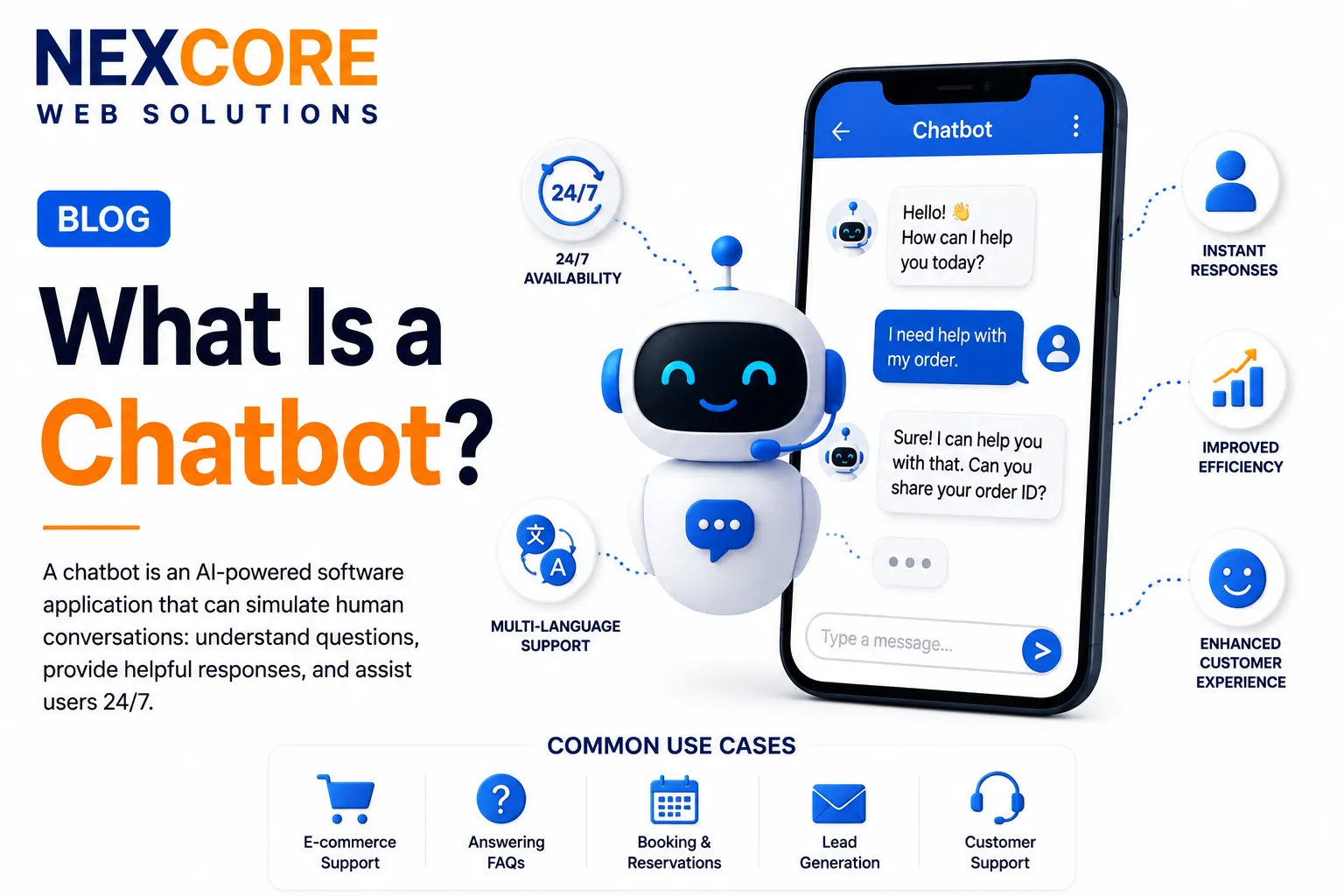
A chatbot is a software application designed to communicate with people through text, voice, or other conversational interfaces. Chatbots can answer questions, provide information, guide users through processes, collect details, and perform certain automated tasks. Early chatbots typically relied on fixed rules and predefined responses, while modern systems can use artificial intelligence, natural language processing, and machine learning to understand more flexible requests. People now encounter chatbots on websites, messaging platforms, mobile applications, online stores, banking services, and customer-support portals. Their usefulness comes from making digital services more conversational and accessible. However, a chatbot is not automatically intelligent simply because it can hold a conversation. Its capabilities depend on the technology, data, integrations, instructions, and safeguards behind it.
How Does a Chatbot Work?
A chatbot receives an input from a user and processes that input to determine an appropriate response or action. In a simple system, the software may look for specific words or match the message against predefined rules. More advanced chatbots can use natural language processing and machine-learning models to interpret intent, context, and meaning. The system may then retrieve information from a database, call an external service, or generate a response before presenting it to the user.
Rule-Based Chatbots
Rule-based chatbots follow predefined logic created by developers or content teams. For example, a customer-service bot might recognize phrases such as “shipping cost” and respond with a prepared explanation. These systems can be reliable for predictable workflows because their responses are controlled and tested. However, they may struggle when users ask questions using unexpected wording or request information outside the rules that have been programmed.
AI-Powered Chatbots
AI-powered chatbots can process natural language more flexibly and may use machine-learning models to determine what a user is asking. Some modern systems use large language models capable of generating responses based on instructions and contextual information. They can handle varied wording and continue conversations across multiple turns. However, their flexibility also creates risks because generated responses can sometimes be incorrect, incomplete, or misleading.
What Is Natural Language Processing?
Natural language processing, or NLP, is a field of artificial intelligence focused on enabling computers to process human language. NLP techniques can help systems identify intent, extract important information, classify messages, and interpret different forms of language. For example, a chatbot for an airline could interpret “Can I change my flight to Friday?” as a request involving a reservation and date modification. The system could then connect that intent to the appropriate workflow.
Types of Chatbots
Customer Service Chatbots
Customer-service chatbots help users find answers to common questions and complete routine support tasks. They may provide information about orders, refunds, account settings, shipping, or service availability. When a question requires human judgment, the chatbot can transfer the conversation to a support representative. A well-designed handoff prevents users from repeatedly explaining the same problem.
E-Commerce Chatbots
E-commerce chatbots can help shoppers find products, compare options, check order information, and understand delivery policies. A customer might describe a product requirement in natural language rather than searching through categories manually. The chatbot can then use product data and business rules to recommend relevant options. Integrating the chatbot with real-time inventory and order systems is important because outdated information can quickly damage customer trust.
Internal Business Chatbots
Organizations can also use chatbots internally for employee support. An internal assistant might help employees locate policies, understand procedures, search documentation, or find information about company systems. When connected to approved internal knowledge sources, such chatbots can reduce the time employees spend searching through large collections of documents. Access controls are essential because different employees may have different permissions.
Chatbots and Generative AI
Generative AI has changed what users expect from conversational systems. Instead of selecting responses from a fixed collection, a generative chatbot can produce new responses based on the conversation and available context. It can summarize documents, explain concepts, draft messages, assist with research, or help users complete complex workflows. However, organizations should verify important outputs and provide appropriate safeguards when chatbots influence financial, legal, medical, security, or other high-impact decisions.
Benefits of Chatbots
One major advantage of chatbots is their ability to provide assistance outside traditional business hours. They can handle multiple conversations simultaneously and respond to common questions without requiring a human agent for every interaction. Chatbots can also standardize responses to frequently asked questions and reduce repetitive workloads for support teams. Their value is highest when they are connected to accurate information and designed around specific user needs rather than being deployed simply because conversational technology is popular.
Limitations of Chatbots
Chatbots can misunderstand ambiguous questions, provide incomplete information, or fail when users describe unusual situations. AI-powered systems may also generate plausible-sounding answers that are not supported by reliable information. Rule-based systems have the opposite problem because they may be predictable but inflexible. For this reason, important chatbot applications should include testing, monitoring, clear escalation paths, and mechanisms for correcting inaccurate information.
Chatbot Security and Privacy
Chatbots may process sensitive information such as names, account details, conversations, payment-related information, or internal company documents. Developers should carefully determine what data the system needs and prevent unnecessary collection or retention. Authentication and authorization are particularly important when a chatbot can access private accounts or internal resources. Organizations should also protect API connections, monitor unusual activity, and establish policies governing how conversational data is stored and used.
How Businesses Build Chatbots
Building a chatbot usually involves defining its purpose, identifying user needs, designing conversation flows, selecting appropriate technology, connecting required data sources, and testing realistic scenarios. Developers may integrate databases, APIs, authentication systems, knowledge bases, payment services, or customer relationship platforms. The system should be evaluated using real-world questions rather than only ideal examples. Continuous monitoring after launch helps teams identify unanswered questions, incorrect responses, and opportunities to improve the experience.
Future of Chatbots
Chatbots are likely to become more capable as language models, voice interfaces, retrieval systems, and automation technologies improve. Future systems may handle longer workflows and interact with multiple business applications instead of simply answering questions. At the same time, organizations will need stronger approaches to privacy, security, reliability, transparency, and human oversight. The most effective chatbots will likely combine conversational flexibility with carefully controlled access to trusted information and business systems.
Conclusion
A chatbot is a software system that enables people to interact with digital services through conversation. Simple chatbots rely on predefined rules, while modern AI-powered systems can use natural language processing, machine learning, and generative models to handle more flexible interactions. Chatbots can support customer service, e-commerce, employee assistance, information retrieval, and many other workflows. Their effectiveness depends on accurate data, thoughtful design, reliable integrations, security controls, and appropriate human escalation. Businesses should focus on solving genuine user problems instead of measuring success only by how advanced the underlying AI appears. When implemented responsibly, chatbots can make digital services faster, more accessible, and easier to use.
FAQs
1. What is a chatbot in simple words?
A chatbot is a software program that communicates with people through conversation, usually using text or voice. It can answer questions, provide information, guide users through tasks, and connect with other systems. Basic chatbots follow predefined rules, while modern AI-powered chatbots can interpret natural language and generate responses. Their capabilities depend on the technology, data, integrations, and instructions used to build them.
2. What is the difference between a chatbot and AI?
A chatbot is an application or interface designed for conversation, while artificial intelligence is a broader field of computing. A chatbot can use AI, but it does not have to. Some chatbots use simple rules and predefined responses without machine learning. AI-powered chatbots can use language models and other techniques to understand requests, generate responses, retrieve information, or perform automated tasks.
3. Are chatbots available 24/7?
Yes, chatbots can generally operate continuously as long as the systems and services they depend on are available. This allows organizations to provide automated assistance outside normal business hours. However, continuous availability does not guarantee that every question can be answered correctly. Complex requests may still require human support, and organizations should provide a clear method for users to escalate important issues.
4. Can chatbots access company databases?
Yes, a chatbot can be connected to databases and other business systems through APIs or controlled application services. This can allow it to retrieve information such as product availability, order status, or approved internal documentation. Access should be carefully restricted using authentication and authorization controls. A chatbot should only be able to retrieve information that the requesting user is permitted to access.
5. Can AI chatbots give incorrect answers?
Yes, AI-powered chatbots can sometimes produce incorrect, outdated, incomplete, or unsupported information. Generative systems can create responses that sound confident even when the underlying information is wrong. Businesses should reduce this risk through trusted knowledge sources, retrieval systems, testing, monitoring, clear limitations, and human review for high-impact situations. Users should independently verify important information before relying on it.




