
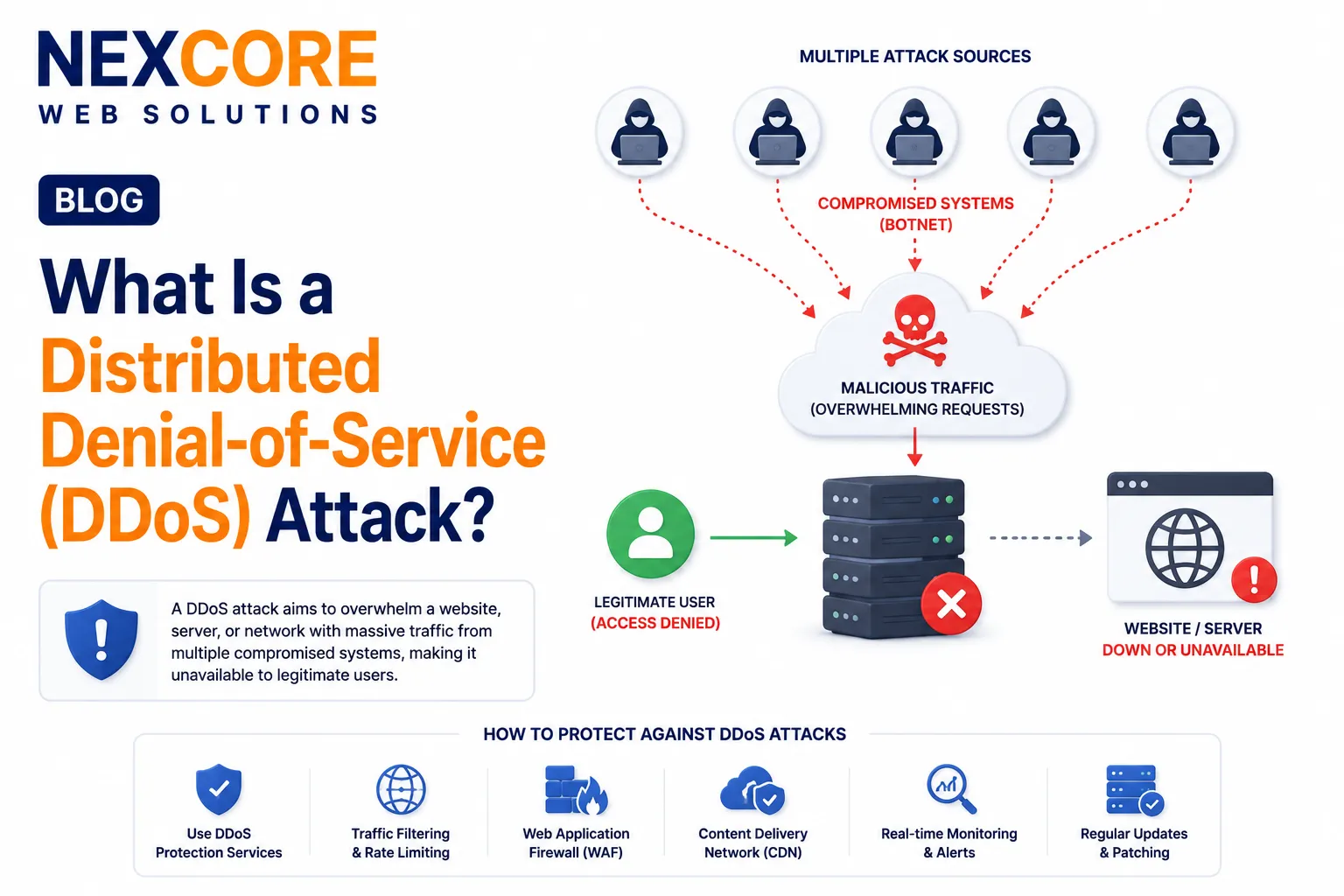
A distributed denial-of-service (DDoS) attack is a cyberattack designed to make a website, application, server, or online service difficult or impossible for legitimate users to access. Attackers achieve this by overwhelming the target with a large volume of requests, traffic, or other resource-intensive activity. The word “distributed” is important because the traffic typically comes from many compromised or controlled devices rather than one computer. DDoS attacks can affect businesses of all sizes, from small websites to large online platforms and essential digital services. Beyond temporary downtime, an attack can cause lost revenue, frustrated customers, increased infrastructure costs, and reputational damage. Understanding how DDoS attacks work and how organizations defend against them is an important part of modern cybersecurity.
How Does a DDoS Attack Work?
A DDoS attack attempts to exhaust resources that a service needs to respond to legitimate users. These resources may include network bandwidth, server processing capacity, memory, connection limits, or application-level resources. Attackers often coordinate large numbers of devices to send traffic or requests toward the same target at approximately the same time. When the incoming demand exceeds what the infrastructure can handle, legitimate requests may become slow, fail, or time out.
The Role of Botnets
Many DDoS attacks rely on botnets, which are networks of compromised devices controlled by an attacker. Infected computers, servers, routers, cameras, and other internet-connected devices can potentially become part of such a network. The owner of a compromised device may not realize that it is participating in an attack. By coordinating thousands or millions of devices, attackers can generate substantial traffic without relying on a single source.
Main Types of DDoS Attacks
Volumetric Attacks
Volumetric attacks attempt to consume the target’s available network bandwidth by sending large amounts of traffic. The goal is to create congestion before legitimate requests can reach the service. Organizations often rely on upstream filtering, traffic scrubbing, and scalable network infrastructure to reduce the impact. Monitoring unusual traffic patterns can also help security teams identify large-scale events quickly.
Protocol Attacks
Protocol attacks target weaknesses or resource limits in network and transport protocols. Instead of simply maximizing bandwidth, these attacks may consume resources on network devices, load balancers, firewalls, or servers. The resulting pressure can prevent legitimate connections from being processed efficiently. Defenses often include rate controls, filtering, resilient network architecture, and infrastructure capable of handling abnormal connection patterns.
Application-Layer Attacks
Application-layer DDoS attacks target specific functions within a web application rather than overwhelming the entire network. An attacker may generate large numbers of requests that require significant server-side processing. For example, expensive search, login, or database operations can consume application resources even when total network traffic appears relatively modest. These attacks can be difficult to distinguish from genuine user activity, making application-aware monitoring particularly important.
Why Are DDoS Attacks Dangerous?
A successful DDoS attack can interrupt websites, APIs, online stores, gaming services, communication platforms, and other internet-facing systems. Even a temporary outage can prevent customers from placing orders or accessing important information. Organizations may also spend additional money on emergency infrastructure, incident response, and technical investigation. Repeated attacks can damage customer confidence if users begin to associate a service with unreliable availability.
DDoS and Data Theft
A DDoS attack primarily targets availability rather than confidentiality. However, attackers may sometimes use a DDoS event as a distraction while attempting other malicious activities. Security teams should therefore avoid assuming that restoring availability automatically means the incident is completely resolved. Logs, authentication activity, system changes, and other security indicators should be reviewed when appropriate.
How Can Organizations Detect a DDoS Attack?
Detection usually involves monitoring network traffic, application performance, server resources, and request patterns. Security teams may look for sudden traffic increases, unusual geographic distributions, abnormal request rates, repeated connection attempts, or unexpected changes in resource consumption. Baselines are particularly useful because organizations need to understand what normal traffic looks like before identifying unusual behavior. Automated alerting can help teams respond quickly when important thresholds are exceeded.
How Are DDoS Attacks Prevented?
No single security tool can guarantee complete protection against every DDoS attack. Organizations typically use multiple layers of defense, including content delivery networks, traffic filtering, rate limiting, load balancing, scalable infrastructure, and specialized DDoS protection services. These controls can absorb, filter, or distribute malicious traffic before it overwhelms critical application resources. Security teams should also regularly review whether their protection matches expected traffic volumes and business requirements.
Rate Limiting
Rate limiting restricts how frequently a client or source can make requests within a defined period. It can protect expensive application functions from excessive traffic and help prevent one source from consuming disproportionate resources. However, simple source-based limits may not be sufficient when attackers distribute requests across many addresses. Effective rate limiting may therefore consider factors such as endpoint, authentication state, request behavior, and overall system capacity.
Using a CDN and Traffic Scrubbing
A content delivery network can distribute web content and help absorb certain types of unwanted traffic across a broader infrastructure. Specialized DDoS mitigation services can analyze incoming traffic and remove patterns identified as malicious before forwarding legitimate requests to the protected origin. This approach is especially valuable for internet-facing applications that cannot simply increase server capacity during every attack. Configuration should be tested carefully so that legitimate users are not accidentally blocked.
Building a DDoS Response Plan
Organizations should prepare for DDoS incidents before they occur. A response plan can define who receives alerts, who contacts infrastructure providers, which systems require protection, and what actions should be taken during different attack scenarios. Teams should also document escalation paths and communication procedures for customers or employees. Periodic testing can reveal gaps in monitoring, filtering, capacity, and decision-making.
DDoS Protection for Small Websites
Smaller websites may not have dedicated security teams or large infrastructure budgets, but they can still implement basic defenses. Keeping software updated, using reputable hosting infrastructure, enabling appropriate CDN protection, applying sensible rate limits, and monitoring traffic can reduce exposure. Website owners should also maintain backups and document recovery procedures. If an attack occurs, contacting the hosting provider or security service quickly can help determine the appropriate mitigation steps.
Conclusion
A distributed denial-of-service attack attempts to disrupt an online service by overwhelming its available resources with coordinated traffic or requests. Attacks can target network bandwidth, protocols, or application functions, and modern incidents may combine several techniques. Effective protection requires more than simply adding server capacity; organizations should use layered controls such as traffic filtering, rate limiting, monitoring, scalable infrastructure, CDNs, and specialized mitigation services. A tested response plan is equally important because rapid decisions can limit downtime and business impact. DDoS attacks cannot always be prevented, but organizations can significantly improve resilience by understanding their normal traffic patterns, identifying critical resources, strengthening internet-facing systems, and preparing for incidents before they happen.
FAQs
1. What is a DDoS attack in simple words?
A DDoS attack is an attempt to make a website, server, or online service unavailable by sending it an overwhelming amount of traffic or requests. The traffic usually comes from many devices working together, often as part of a botnet. When the target’s resources become overloaded, legitimate users may experience slow performance, failed connections, or complete service disruption.
2. What is the difference between DoS and DDoS?
A denial-of-service attack generally attempts to disrupt a service from one primary source or a limited number of sources. A distributed denial-of-service attack uses many sources simultaneously, making it more difficult to block based only on the attacker’s origin. Because DDoS traffic can come from numerous compromised or coordinated devices, mitigation usually requires broader traffic analysis and filtering.
3. Can a DDoS attack steal personal data?
A DDoS attack primarily aims to affect availability rather than directly steal information. However, attackers can sometimes use a DDoS event as a distraction while attempting other malicious activities. Organizations should therefore investigate security logs and related activity during serious incidents. A service recovering from a traffic attack should still verify that authentication systems, applications, and data have not experienced separate security problems.
4. How can a website protect itself from DDoS attacks?
Websites can use layered defenses such as a content delivery network, DDoS protection service, traffic filtering, rate limiting, load balancing, monitoring, and scalable hosting infrastructure. Keeping applications and servers updated is also important. The appropriate protection depends on the website’s traffic volume, architecture, business importance, and likely threats. A tested incident-response plan can further reduce downtime during an attack.
5. Can DDoS attacks be completely prevented?
No security measure can guarantee that every DDoS attack will be completely prevented. However, organizations can make services significantly more resilient by distributing infrastructure, filtering suspicious traffic, limiting abusive requests, monitoring performance, and using specialized mitigation capabilities. Preparing response procedures in advance is also important. The goal is generally to absorb or filter malicious traffic while keeping legitimate users connected to the service.




