
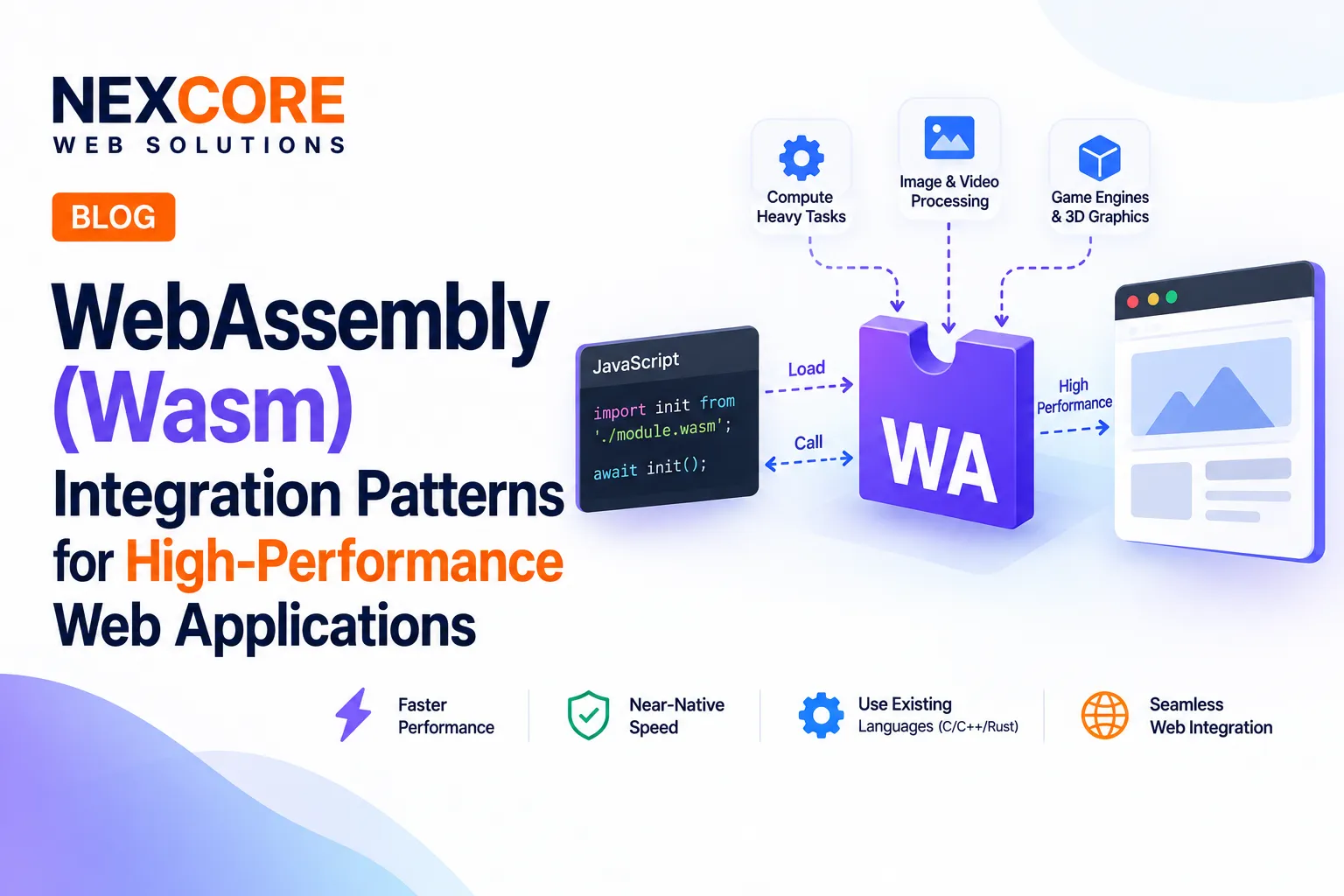
WebAssembly (Wasm) has become an important technology for web applications that need more computational performance than traditional JavaScript can consistently provide. It allows code written in languages such as Rust, C, C++, and Go to run in browsers through a compact binary format designed for efficient execution. However, simply adding Wasm to a project does not automatically make an application faster. The real benefits depend on choosing the right integration pattern, managing communication between JavaScript and Wasm, and keeping expensive work away from the main thread. Understanding these patterns helps developers use Wasm where it delivers measurable value without adding unnecessary architectural complexity.
Why Use WebAssembly?
JavaScript remains an excellent choice for most interface logic, networking, and application workflows. Wasm becomes particularly useful when an application performs CPU-intensive operations such as image processing, video manipulation, cryptography, simulations, audio processing, or complex data transformation. These workloads can consume significant main-thread time when implemented entirely in JavaScript. Moving the computationally expensive portion to Wasm can improve execution efficiency while allowing JavaScript to continue managing the user interface.
Wasm Is Not a JavaScript Replacement
Wasm works best as a complementary technology rather than a replacement for JavaScript. Browser APIs and DOM manipulation remain primarily accessible through JavaScript and related web interfaces. A practical architecture often keeps UI orchestration in JavaScript while delegating computational kernels to Wasm. This separation lets each technology handle the type of work for which it is most appropriate.
Core Wasm Integration Patterns
Direct JavaScript-to-Wasm Calls
The simplest integration pattern exposes selected Wasm functions directly to JavaScript. JavaScript loads the Wasm module, initializes it, and calls exported functions when expensive operations are required. This pattern is easy to understand and works well for relatively small computational tasks. For example, a browser-based image editor could send pixel data to a Wasm function that applies a complex filter before displaying the result.
The main consideration is the cost of transferring data between JavaScript and Wasm. Passing small primitive values is generally straightforward, but repeatedly copying large arrays can reduce the performance gains from faster computation. Developers should minimize unnecessary transfers and reuse allocated memory where practical. Typed arrays and shared memory techniques can help make data exchange more efficient.
Wasm as a Computational Module
A larger application can treat Wasm as a specialized computational module inside its architecture. JavaScript controls application state and user interactions while Wasm provides capabilities such as compression, parsing, numerical calculations, or cryptographic processing. This approach creates a clear boundary between application orchestration and performance-sensitive code. It is particularly useful when the same computational logic can be reused across multiple features.
Running Wasm in Web Workers
CPU-heavy Wasm code can still make an application feel slow if it executes on the browser’s main thread. Web Workers provide a useful integration pattern by moving Wasm computation into a background thread. The main thread can continue responding to user input and updating the interface while the worker processes data. This is valuable for applications such as document analysis, large file processing, and interactive scientific visualization.
Worker Communication
Worker-based architectures require message passing between the UI thread and the worker. Large data transfers can introduce overhead, so developers should design messages around meaningful batches rather than sending frequent small updates. Transferable objects can reduce copying for supported data types. For workloads requiring coordinated access to memory, SharedArrayBuffer can provide another option when the application’s security and browser requirements are satisfied.
Streaming and Lazy Initialization
Wasm modules do not always need to be loaded during the first stage of page rendering. If a feature is only used after a user opens an editor, starts a calculation, or uploads a file, its Wasm module can often be loaded on demand. Lazy initialization reduces the initial JavaScript and Wasm workload and prevents unused functionality from affecting startup. Streaming compilation can also allow compatible browsers to compile Wasm while its bytes are being downloaded.
Code Splitting
Large Wasm applications can be divided into feature-specific modules rather than shipping everything at once. A graphics application, for instance, might load a rendering module only when a visualization is opened. This approach reduces unnecessary network transfer and initialization work. Developers should measure the complete user journey because a smaller initial payload does not automatically guarantee faster interaction if later loading is poorly managed.
Memory Management Considerations
Wasm uses a linear memory model that requires developers to think carefully about allocation and data lifetime. Frequent allocation and deallocation can create overhead in applications that process large amounts of data. Reusing buffers and designing predictable memory ownership can improve stability and performance. Developers should also monitor memory growth because excessive usage can increase browser resource consumption.
When Wasm Is the Right Choice
Wasm should be introduced when profiling shows that computational work is a meaningful performance bottleneck. Good candidates include image codecs, audio engines, CAD calculations, encryption, scientific algorithms, and specialized parsers. It is usually unnecessary for ordinary form handling, simple business logic, or routine DOM operations. Adding Wasm without a measurable performance requirement can increase build complexity and debugging effort without producing a meaningful user benefit.
Conclusion
WebAssembly provides a powerful way to bring high-performance computation to modern web applications, but successful integration depends on architecture rather than technology choice alone. Direct function calls work well for simple workloads, while dedicated computational modules create cleaner boundaries for larger applications. Web Workers can keep intensive processing away from the main thread, and lazy loading can prevent Wasm from increasing initial page costs unnecessarily. Developers should also consider memory management and JavaScript-to-Wasm data transfer overhead. The strongest approach is to profile first, identify genuine bottlenecks, and introduce Wasm only where its performance advantages justify the additional complexity.
FAQs
What is WebAssembly used for in web applications?
WebAssembly is mainly used for performance-intensive computation that may be expensive to execute repeatedly in JavaScript. Common examples include image and video processing, audio applications, games, cryptography, simulations, CAD tools, and complex data processing. Wasm works alongside JavaScript rather than replacing it, allowing developers to keep interface and browser-related logic in JavaScript while moving specialized computation into compiled Wasm modules.
Is WebAssembly faster than JavaScript?
WebAssembly can provide significant performance benefits for certain computational workloads, particularly predictable, CPU-intensive algorithms. However, it is not automatically faster for every task. Data transfer between JavaScript and Wasm, memory management, module startup, and algorithm design can affect the final result. Developers should benchmark the complete workflow rather than comparing isolated function execution and assuming that Wasm will always be faster.
Can WebAssembly run in a Web Worker?
Yes, WebAssembly modules can run inside Web Workers. This pattern is useful when Wasm performs CPU-intensive operations that could otherwise block the browser’s main thread. The worker can process data independently while the user interface remains responsive. Developers need to design efficient communication between the worker and main thread, especially when processing large datasets or sending frequent progress updates.
How does JavaScript communicate with WebAssembly?
JavaScript communicates with WebAssembly through exported functions, imported functions, and WebAssembly memory. Simple numeric values can be passed directly, while larger datasets commonly use typed arrays backed by Wasm memory. The application must carefully manage data allocation and transfer because copying large buffers repeatedly can introduce overhead. Efficient interfaces usually minimize crossings between JavaScript and Wasm.
When should developers use WebAssembly?
Developers should consider WebAssembly when profiling identifies CPU-intensive code as a significant performance bottleneck. It is particularly suitable for specialized workloads such as image processing, simulations, codecs, cryptography, and complex numerical algorithms. Wasm is less useful for simple UI logic or ordinary DOM operations. A measured performance requirement should justify its additional build, testing, memory-management, and debugging complexity.




