
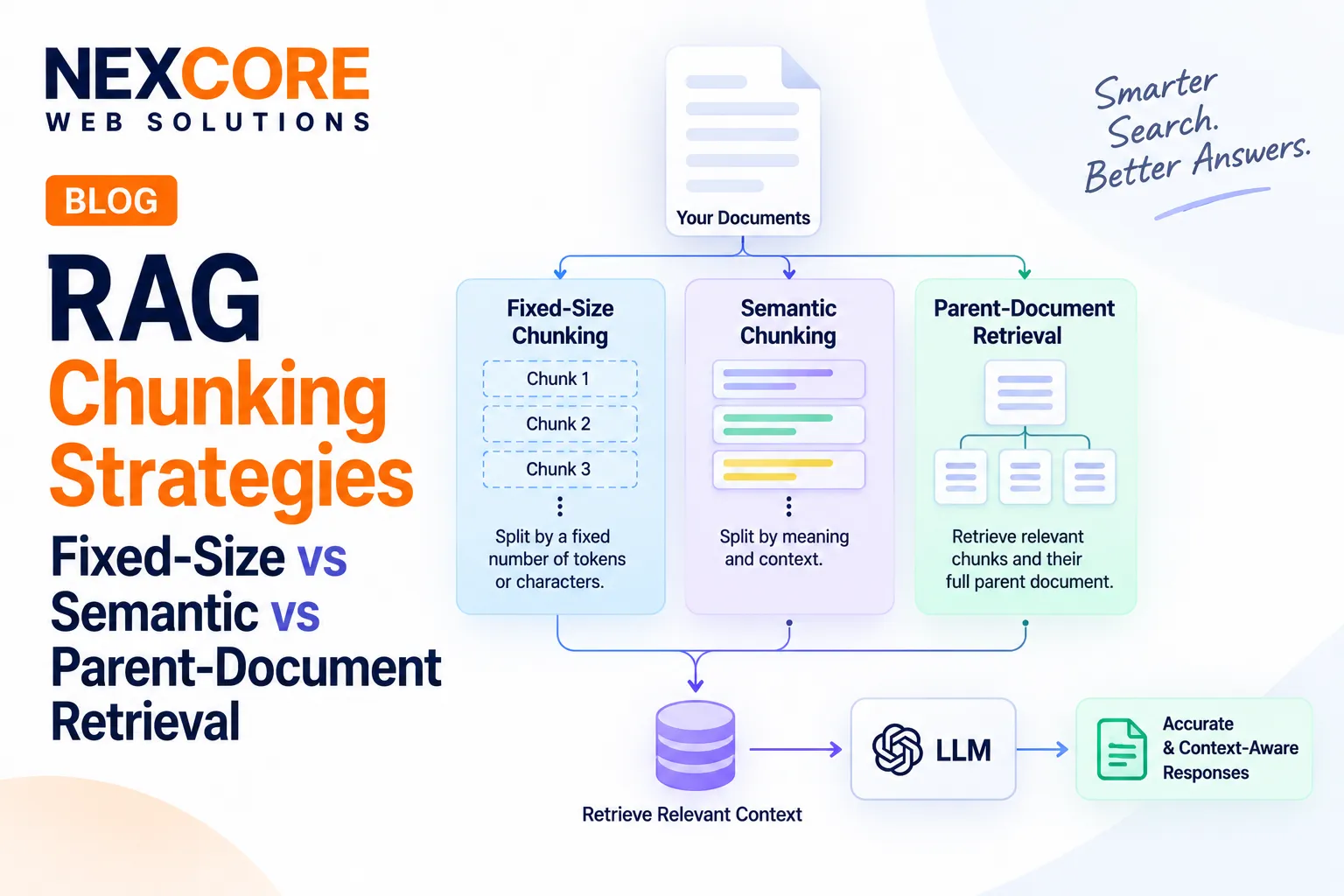
Retrieval-Augmented Generation (RAG) systems depend heavily on how source documents are divided before they are embedded and indexed. This process, known as chunking, directly affects retrieval accuracy, context quality, latency, and even the final answers produced by a language model. A chunk that is too large may contain irrelevant information, while a chunk that is too small can lose the context needed to understand an answer. Three widely used approaches are fixed-size chunking, semantic chunking, and parent-document retrieval. Choosing between them requires understanding the structure of your content, the retrieval task, and how much context the generation model needs.
Why Chunking Matters in RAG
A typical RAG pipeline converts documents into smaller pieces, generates embeddings for those pieces, and stores them in a vector database. When a user asks a question, the system retrieves relevant chunks and provides them to the language model as context. Poor chunk boundaries can cause important information to be separated across multiple records. Good chunking preserves useful meaning while keeping retrieved context focused and manageable.
The Retrieval Trade-Off
Chunking involves balancing precision against context. Smaller chunks can make vector search more specific because each embedding represents a narrower idea. However, small fragments may lack definitions, references, or surrounding explanations. Larger chunks preserve more context but can introduce irrelevant content and consume more model context during generation.
Fixed-Size Chunking
Fixed-size chunking divides documents according to a predetermined number of characters or tokens. Developers often add overlap between neighboring chunks so information near a boundary is not completely lost. This method is simple, predictable, and fast to implement. It works particularly well when documents have reasonably consistent structure or when a baseline RAG system needs to be built quickly.
Advantages and Limitations
The main advantage of fixed-size chunking is operational simplicity. It provides consistent chunk sizes, predictable indexing behavior, and straightforward processing across large document collections. The weakness is that boundaries do not understand meaning, so a paragraph, table explanation, or step-by-step instruction can be split in the middle. Increasing overlap can reduce this problem, but it also increases storage and retrieval costs.
Semantic Chunking
Semantic chunking attempts to divide content according to meaning rather than an arbitrary token count. A document can be analyzed to identify related sentences, paragraphs, headings, or topic transitions. Similar ideas remain together while major conceptual changes create new boundaries. This approach can produce more meaningful retrieval units for knowledge bases containing structured and narrative information.
When Semantic Chunking Works Best
Semantic chunking is especially useful for technical documentation, research material, policies, and detailed guides where individual sections contain complete ideas. For example, a troubleshooting document may contain separate sections for installation, configuration, authentication, and error handling. Keeping each concept together can improve retrieval because a question about authentication is less likely to return unrelated installation instructions. The trade-off is greater preprocessing complexity and potentially higher indexing costs.
Parent-Document Retrieval
Parent-document retrieval separates the unit used for search from the context supplied to the language model. Smaller child chunks are embedded and indexed to improve retrieval precision, while each child points back to a larger parent section or document. When a child matches a query, the system can return the associated parent content for generation. This strategy combines fine-grained retrieval with broader contextual understanding.
A Practical Example
Consider a 30-page software manual containing detailed sections about authentication. Instead of embedding every large section as a single vector, the system can create smaller child chunks containing individual explanations or procedures. A query about token expiration may match one child chunk strongly. The system can then retrieve its parent section, giving the model enough surrounding information to answer accurately without searching only against large documents.
Comparing the Three Strategies
Each approach has a different balance of simplicity, precision, context, and operational cost. Fixed-size chunking is often the easiest starting point, while semantic chunking can provide better boundaries when document meaning matters. Parent-document retrieval is useful when precise search and broader generation context are both important. The best choice should therefore depend on actual retrieval performance rather than architectural preference alone.
| Strategy | Retrieval Precision | Context Preservation | Complexity |
|---|---|---|---|
| Fixed-size | Moderate | Moderate | Low |
| Semantic | High | High | Medium |
| Parent-document | High | Very high | Medium |
How to Choose a Chunking Strategy
Start by examining the documents and questions your RAG system must support. If the content consists of repetitive records or consistently formatted text, fixed-size chunking may provide strong results with minimal engineering effort. If documents contain clear conceptual sections, semantic chunking may produce better retrieval boundaries. Parent-document retrieval becomes attractive when users need answers that depend on both a precise passage and its surrounding explanation.
Evaluate With Real Queries
Do not judge chunking quality only by looking at vector similarity scores. Build a representative evaluation set containing common questions, difficult questions, and queries requiring information from multiple parts of a document. Compare retrieval relevance, answer correctness, citation quality, latency, and token consumption. Testing several chunk sizes and overlap values can reveal whether a seemingly sophisticated strategy actually improves the complete RAG pipeline.
Conclusion
RAG chunking is not merely a preprocessing detail; it is a core design decision that influences retrieval and generation quality. Fixed-size chunking offers simplicity and predictable performance, semantic chunking preserves meaningful boundaries, and parent-document retrieval combines precise matching with richer context. No single strategy works equally well for every knowledge base. Teams should inspect their source material, understand user queries, and evaluate alternatives using real retrieval and answer-quality measurements. In many production systems, a hybrid approach can deliver the best balance by using different chunking and retrieval techniques for different document types.
FAQs
What is chunking in a RAG system?
Chunking is the process of dividing source documents into smaller sections before generating embeddings and indexing them for retrieval. The chunks become the units that a RAG system searches when answering user questions. Effective chunking keeps related information together while avoiding excessive irrelevant context. Chunk size, overlap, document structure, and retrieval requirements all influence the quality of the final generated response.
Is semantic chunking better than fixed-size chunking?
Semantic chunking can produce better results when documents contain clearly defined topics or concepts because it attempts to preserve meaningful boundaries. Fixed-size chunking remains useful because it is simpler, faster, and easier to operate at scale. The better option depends on the dataset and queries. Teams should compare both approaches using representative retrieval and answer-quality evaluations rather than assuming one is universally superior.
What is parent-document retrieval in RAG?
Parent-document retrieval uses smaller child chunks for precise vector search while connecting those chunks to larger parent sections or documents. When a child chunk matches a query, the system can return its parent context for generation. This design helps balance retrieval precision with contextual completeness, making it useful for manuals, documentation, policies, and other sources where surrounding information affects interpretation.
How much overlap should RAG chunks have?
There is no universal overlap percentage that works for every RAG application. Overlap is useful when important sentences or concepts may cross chunk boundaries, but excessive overlap creates duplicate content, increases storage requirements, and can waste model context. A practical approach is to test several values with representative queries. Measure retrieval recall, answer quality, token usage, and latency before selecting a configuration.
Can different chunking strategies be combined?
Yes, combining strategies can be effective for complex knowledge bases. A system might use semantic boundaries for documentation, fixed-size chunks for repetitive records, and parent-document retrieval where broader context is necessary. Retrieval can also use metadata filters or reranking after initial vector search. The important consideration is maintaining consistent metadata and evaluation methods so each strategy can be measured against the same quality goals.




