
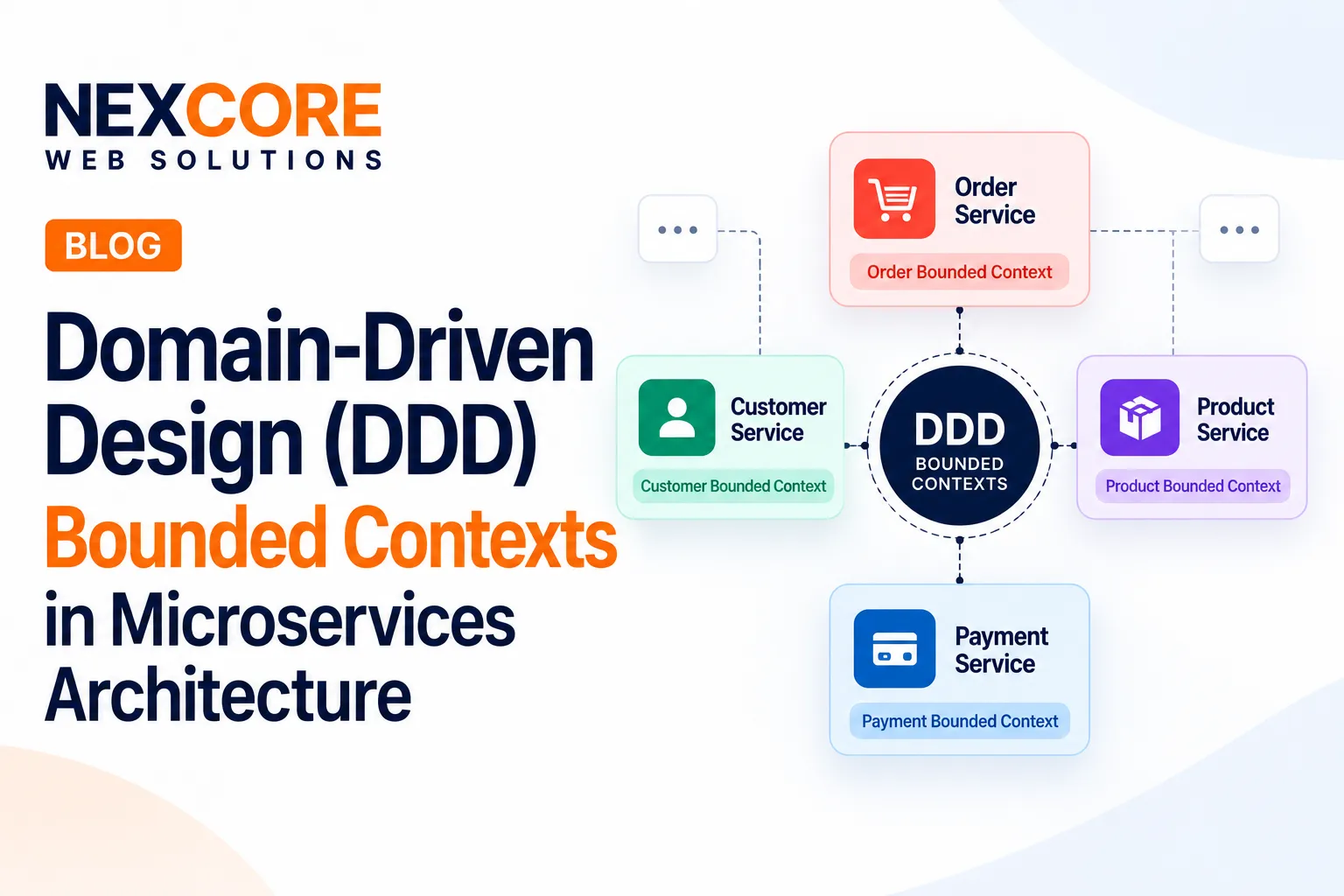
Domain-Driven Design (DDD) helps software teams design systems around real business concepts instead of forcing business rules into technical structures. In microservices architecture, one of its most useful ideas is the bounded context, which defines where a particular domain model, language, and set of business rules apply. Without clear boundaries, microservices can become tightly coupled and difficult to change independently. Bounded contexts provide a practical way to decide what belongs inside a service and what should remain outside it. This approach becomes especially valuable in large applications where teams manage different business capabilities, workflows, and data responsibilities.
What Is a Bounded Context?
A bounded context is a clearly defined boundary within which a domain model has a specific meaning. The same business term can legitimately mean different things in different contexts. For example, an ecommerce system may use the term “customer” differently in its marketing, billing, and support domains. Instead of creating one universal customer model, DDD allows each context to maintain the model that best serves its business responsibilities.
Bounded Context vs Microservice
A bounded context and a microservice are related, but they are not identical concepts. A bounded context represents a business and modeling boundary, while a microservice is a technical deployment and runtime unit. In many systems, one bounded context maps naturally to one microservice, but this is not a mandatory rule. A complex context may initially contain multiple components, while several closely related contexts may temporarily operate within one deployable application.
Identifying Bounded Contexts
Finding the right boundaries requires understanding the business rather than starting with database tables or existing application modules. Teams should examine business capabilities, workflows, terminology, ownership, and the decisions made by different departments. Event Storming and domain workshops can help developers, architects, and domain experts discover where responsibilities naturally separate. Useful boundaries often appear where language, business rules, data ownership, and team responsibilities change.
For example, an online retail platform might contain ordering, inventory, payment, shipping, and customer support contexts. The ordering context decides whether an order can be created or cancelled, while the inventory context manages stock availability. Payment handles transactions and refunds, whereas shipping focuses on fulfillment and delivery status. Each area has different rules even though all of them interact with the same overall customer journey.
Designing Microservices Around Contexts
Once boundaries are identified, services should encapsulate the business logic belonging to their context. A service should own its important data and expose capabilities through well-defined interfaces or events. Other services should not directly manipulate its internal database because that creates hidden dependencies. Clear ownership makes it easier to evolve schemas, business rules, and implementation details independently.
Avoiding Shared Models
A shared domain model may appear convenient because it reduces duplicated code, but it can create strong coupling between services. If several services depend on the same customer object, a change made for one business requirement can unexpectedly affect others. Instead, each context can maintain its own representation and translate information at integration boundaries. Some duplication is often healthier than sharing a model that has conflicting meanings.
Context Mapping and Service Communication
Context mapping describes how bounded contexts relate to one another. DDD provides patterns such as Customer-Supplier, Conformist, Anti-Corruption Layer, and Published Language to describe integration relationships. These patterns help teams decide who controls a contract and how one model should interact with another. The goal is not simply to connect services, but to make the relationship explicit and manageable.
Anti-Corruption Layers
An Anti-Corruption Layer protects one bounded context from concepts that do not belong in its domain model. For example, a payment service may receive a complex order structure from another system but only require an invoice amount and transaction identifier. A translation layer can convert external data into payment-specific concepts. This prevents external terminology and assumptions from leaking into internal business logic.
Data Ownership and Consistency
Bounded contexts work best when each service owns the data required to enforce its business rules. This approach often leads to separate databases or independently managed schemas in a microservices environment. Cross-service transactions should not be treated like ordinary local database transactions because network failures and partial execution are possible. Instead, teams can use domain events, asynchronous messaging, sagas, and compensating actions where eventual consistency is acceptable.
Common DDD Mistakes
One common mistake is creating a microservice for every small entity or database table. This produces excessive network communication and makes the architecture harder to operate. Another mistake is splitting services before understanding the business domain, resulting in boundaries that reflect technical layers rather than meaningful capabilities. Teams should also avoid treating bounded contexts as permanent structures because business boundaries can evolve as organizations and products change.
Practical Implementation Strategy
A practical DDD microservices adoption can begin with one business area instead of attempting a complete architectural transformation. Start by identifying core domain capabilities, mapping important workflows, and documenting terminology differences. Establish ownership for each context and define APIs or events around business capabilities rather than database structures. Then measure operational complexity and adjust boundaries based on real development experience.
Conclusion
Bounded contexts give microservices architecture a business-focused foundation by defining where models, terminology, and rules have meaning. They help teams reduce accidental coupling while allowing services to evolve according to their own responsibilities. Effective boundaries come from understanding business capabilities, not simply dividing an existing monolith into technical pieces. Data ownership, explicit integration contracts, context mapping, and translation layers further strengthen the design. DDD is most valuable when treated as a continuous modeling practice rather than a one-time architecture exercise. As the business changes, teams should regularly revisit context boundaries and refine them based on real system behavior.
FAQs
What is a bounded context in Domain-Driven Design?
A bounded context is a defined area in which a particular domain model, terminology, and business rules have consistent meaning. Different contexts can use the same business terms differently without creating confusion. In microservices, a bounded context often provides the conceptual foundation for a service, helping teams establish clear responsibilities, data ownership, and integration boundaries.
Is every bounded context a microservice?
No. A bounded context is a domain concept, while a microservice is a technical deployment unit. They often align because a service can independently implement one business context, but the relationship is not mandatory. A bounded context may contain multiple deployable components, and an application can temporarily combine related contexts when operational or organizational constraints make that approach more practical.
How do you identify bounded contexts?
Identify bounded contexts by studying business capabilities, workflows, terminology, rules, data ownership, and team responsibilities. Workshops involving developers and domain experts can reveal where concepts change meaning or where different teams make independent decisions. Event Storming is one useful technique for discovering these boundaries. Existing database tables should not be treated as the primary source for defining domain boundaries.
Why should microservices avoid shared domain models?
Shared domain models can create tight coupling because multiple services become dependent on the same structure and assumptions. A change required by one context may then affect unrelated services. Allowing each bounded context to maintain its own model provides greater independence. Translation at integration boundaries can convert external concepts into models that match each service’s specific business responsibilities.
What is an Anti-Corruption Layer in DDD?
An Anti-Corruption Layer is a translation boundary that protects one bounded context from another context’s models and terminology. It converts external concepts into representations that make sense inside the receiving domain. This is particularly useful when integrating legacy systems or services with different business models. It prevents external design decisions from gradually contaminating internal domain logic.




