
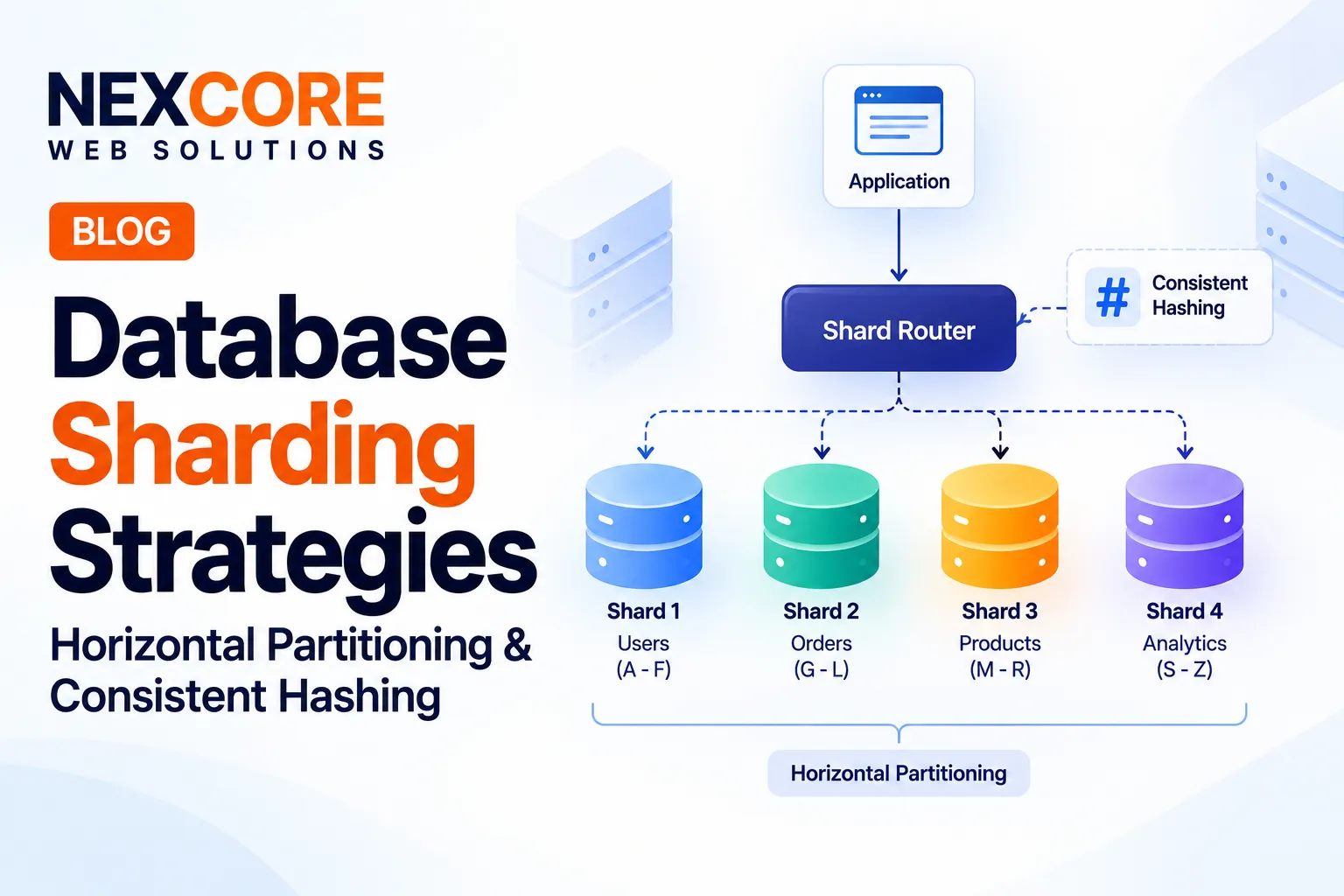
As applications grow, a single database server can eventually become a serious bottleneck for performance, storage, and availability. Database sharding addresses this problem by distributing rows across multiple database instances, allowing workloads to scale beyond the limits of one machine. Two important concepts in this architecture are horizontal partitioning and consistent hashing, which determine how records are distributed and how the system handles growth. Choosing the right strategy requires more than simply splitting data across servers. Developers must consider query patterns, shard keys, traffic distribution, rebalancing, operational complexity, and failure recovery to build a reliable sharded database.
What Is Database Sharding?
Database sharding divides a large logical dataset into smaller pieces called shards. Each shard typically stores a subset of records and can run on a separate database server or cluster. Instead of sending every query to one database, the application routes requests to the shard containing the required data. This can increase capacity because storage, CPU, memory, and database connections are distributed across multiple machines.
Horizontal vs Vertical Partitioning
Horizontal partitioning divides rows while keeping the same general table structure across shards. For example, a customer table containing millions of users could be divided according to customer IDs. Vertical partitioning takes a different approach by separating columns or functional data into different structures. Sharding generally refers to horizontal distribution when discussing large-scale distributed database architectures.
Choosing a Shard Key
The shard key determines where each record is stored, making it one of the most important architectural decisions. A good key distributes traffic and storage relatively evenly while supporting the application’s most common queries. Customer ID, tenant ID, geographic region, or account ID can be suitable depending on the workload. A poor key can create hot shards where one database receives significantly more traffic than the others.
Avoiding Hotspots
Sequential identifiers can cause uneven write distribution when a sharding method places nearby values on the same shard. Geographic or tenant-based keys can also create hotspots if one region or customer generates substantially more activity. Developers should examine real workload patterns before selecting a key. Monitoring shard size, query volume, latency, and write rates helps identify distribution problems early.
Horizontal Partitioning Strategies
A simple horizontal partitioning strategy uses ranges of shard-key values. For example, users with IDs from one range can reside on one shard, while later ranges are stored elsewhere. Range-based partitioning makes some queries efficient because the destination can be determined from the value range. However, growing applications may require frequent range management and can experience uneven traffic when newer records are concentrated in one range.
Another approach uses a hash function to calculate the destination shard. Hash-based partitioning usually produces a more balanced distribution because records are spread according to the resulting hash value. Its weakness is that changing the number of shards can require substantial data movement when a simple modulo operation determines placement. This is where consistent hashing becomes useful.
Consistent Hashing
Consistent hashing maps both data keys and database nodes onto a logical hash ring. A record is assigned to the next appropriate node on the ring according to its hash position. When a new shard is added, only a portion of existing keys generally needs to move rather than requiring the entire dataset to be redistributed. This property makes consistent hashing attractive for systems where infrastructure changes frequently.
Virtual Nodes
Production systems commonly use virtual nodes to improve distribution. Instead of assigning each physical database server to one position, a server receives multiple positions around the hash ring. This reduces the chance that one physical node receives a disproportionate amount of data or traffic. Virtual nodes also make rebalancing more predictable when servers are added or removed.
Sharding and Query Routing
A sharded database needs a routing layer that determines which shard should receive each operation. Applications may implement routing directly, use a database proxy, or rely on capabilities provided by a distributed database platform. Queries that include the shard key can usually be routed efficiently to a specific shard. Queries without it may require scatter-gather operations across multiple shards, increasing latency and resource consumption.
Cross-Shard Operations
Transactions and joins become more complicated when related records are stored on different shards. A local transaction is relatively straightforward, but a cross-shard transaction may require distributed coordination and can reduce availability or performance. Schema and shard-key design should therefore keep frequently related data together when practical. Applications should also avoid depending heavily on cross-shard joins for routine operations.
Rebalancing and Operational Challenges
Sharding introduces operational responsibilities that do not exist in the same way with a single database. Teams must plan for shard expansion, data migration, backups, monitoring, replication, and node failures. Rebalancing should happen gradually to avoid overwhelming production systems with migration traffic. Automated tooling can help, but engineers still need clear procedures for detecting imbalance and recovering from failed migrations.
Conclusion
Database sharding allows applications to scale data storage and workload across multiple database instances, but its success depends heavily on partitioning and routing decisions. Horizontal partitioning provides a practical foundation by distributing rows according to ranges, hashes, tenants, or other meaningful keys. Consistent hashing improves flexibility when shards are added or removed by limiting the amount of data that needs to move. However, sharding also introduces challenges involving query routing, cross-shard operations, hotspots, and rebalancing. Teams should therefore choose shard keys from real access patterns and continuously monitor distribution as the system grows.
FAQs
What is database sharding?
Database sharding is a technique for distributing a large dataset across multiple database instances called shards. Each shard stores a portion of the overall data, allowing storage and workload to be distributed across machines. Applications route requests to the appropriate shard instead of sending every operation to one database. This approach can improve scalability, but it also introduces additional routing and operational complexity.
What is horizontal partitioning in databases?
Horizontal partitioning divides a table’s rows into separate partitions while generally keeping the same columns and structure. In a sharded architecture, these partitions can be placed on different database servers. For example, customer records can be distributed according to customer ID ranges or hash values. The technique helps spread storage and database workload while preserving a consistent logical data model.
What is consistent hashing used for in sharding?
Consistent hashing determines shard placement using a logical hash ring containing data keys and database nodes. When nodes are added or removed, only a relatively small portion of keys typically needs to be reassigned. This reduces the data movement associated with traditional modulo-based hashing. Virtual nodes can further improve distribution and make rebalancing more predictable across physical database servers.
How do you choose a good shard key?
A good shard key should distribute data and traffic evenly while supporting common query patterns. Developers should examine how frequently records are read, written, and accessed together before choosing a key. Customer ID, tenant ID, account ID, or another stable identifier may work depending on the application. Avoid keys that create predictable hotspots or force frequent cross-shard queries.
What are the disadvantages of database sharding?
Sharding increases architectural and operational complexity. Developers must handle shard routing, data rebalancing, backups, monitoring, failures, and potentially cross-shard transactions or queries. Poor shard-key selection can also create hotspots and uneven storage utilization. Because of these trade-offs, sharding should usually be introduced when database scaling requirements justify the additional complexity rather than as an automatic choice for every application.




