
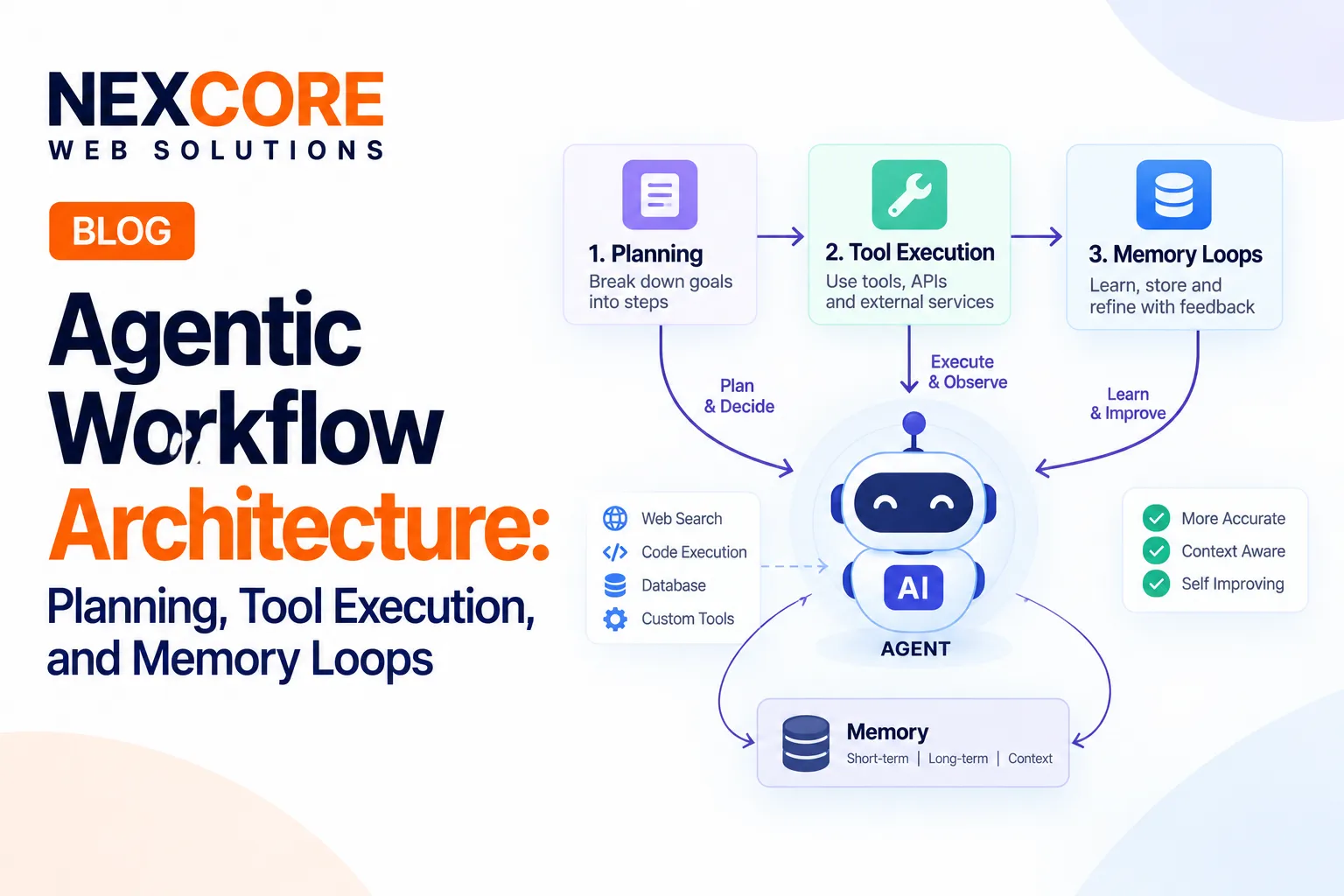
Agentic AI systems go beyond generating a single response by deciding what actions are needed to complete a goal. An agent can interpret a request, create a plan, call external tools, inspect results, revise its approach, and continue until the task reaches a useful outcome. This behavior requires more than a capable language model because the surrounding architecture must control state, execution, memory, and failures. Planning, tool execution, and memory loops therefore form the foundation of reliable agentic workflows. When these components are designed carefully, agents can handle multi-step tasks while remaining observable, controllable, and efficient.
What Is Agentic Workflow Architecture?
Agentic workflow architecture defines how an AI agent moves from a user goal to completed actions. Instead of following one fixed sequence, the system can evaluate intermediate results and choose its next step dynamically. A typical workflow contains an orchestrator, language model, tools, state management, memory, and validation mechanisms. The orchestrator coordinates these components and determines when the agent should continue, retry, ask for clarification, or stop.
Planning as a Control Layer
Planning converts a broad objective into smaller executable steps. For example, an agent asked to research competitors might identify companies, gather information, compare pricing, verify sources, and prepare a summary. The plan should remain flexible because tool results may change what needs to happen next. Good planning also limits unnecessary actions by defining clear completion conditions.
Tool Execution
Tools give agents capabilities that language models do not possess directly. Depending on the application, an agent may use search systems, databases, APIs, calculators, code execution environments, or internal business services. Each tool should expose a predictable interface with explicit inputs, outputs, permissions, and error behavior. Clear contracts reduce accidental misuse and make workflows easier to test.
Tool Selection and Validation
The agent should select tools based on the current task state rather than calling tools indiscriminately. Before execution, arguments should be validated against the expected schema and business rules. After execution, the result should be checked for errors, missing information, or unexpected formats. This creates a feedback loop where the agent can retry with corrected parameters or choose another action.
The Agentic Loop
A basic agentic loop can be represented as:
- Understand the goal.
- Create or update a plan.
- Select the next action.
- Execute a tool or generate a response.
- Inspect the result.
- Update state and memory.
- Decide whether to continue or finish.
This loop is more powerful than a static workflow because every step can influence the next decision. However, unrestricted loops can create excessive tool calls, rising costs, or repeated actions. Production systems should therefore enforce limits on iterations, execution time, token usage, and tool calls.
Memory Loops
Memory allows an agent to retain information beyond the immediate model context. Short-term memory can store the current task state, recent observations, tool outputs, and intermediate decisions. Long-term memory can preserve useful information across sessions, such as stable preferences or previously established facts. These forms of memory should be separated carefully because not every temporary observation deserves permanent storage.
Retrieval-Based Memory
Many agents implement long-term memory using a retrieval layer rather than inserting an entire history into every prompt. Relevant memories are retrieved when the current task requires them. Metadata, timestamps, confidence scores, and source information can help determine whether a memory remains useful. Memory should also support correction or deletion because stored information can become outdated or incorrect.
State Management
Reliable agents need explicit state rather than depending entirely on conversation history. State can include the current objective, completed steps, pending actions, tool results, errors, and approval requirements. Structured state makes workflows easier to resume after failures and easier to inspect during debugging. It also prevents the agent from losing important context when conversations or execution traces become large.
Reliability and Safety
Agentic systems can produce unpredictable behavior when tools have real-world consequences. Actions such as sending messages, modifying records, purchasing services, or changing infrastructure should use appropriate authorization and confirmation controls. Idempotency is also important because retries can otherwise execute the same operation multiple times. Logging tool calls, decisions, results, and failures provides the evidence needed to investigate unexpected behavior.
Human-in-the-Loop Controls
Not every decision should be fully autonomous. High-impact actions can pause the workflow and request human approval before execution. The approval step should clearly show what the agent intends to do and what information will be affected. This approach preserves automation for routine tasks while adding oversight where mistakes could be costly.
Evaluating Agentic Workflows
Evaluation should measure the complete workflow rather than judging only the language model’s response. Useful metrics include task completion rate, tool-call accuracy, latency, cost, recovery from failures, and unnecessary actions. Teams should create test scenarios containing ambiguous inputs, failed tools, incomplete data, and changing conditions. Observability data can then reveal whether problems originate in planning, tool selection, memory retrieval, or execution.
Conclusion
Agentic workflow architecture provides the structure required for AI systems that can reason through multi-step tasks and interact with external environments. Planning determines what needs to happen, tool execution provides practical capabilities, and memory loops preserve information needed for future decisions. Explicit state, validation, execution limits, observability, and human approval controls make these systems safer and easier to operate. The strongest architectures do not maximize autonomy at every opportunity. Instead, they give agents enough freedom to adapt while keeping important decisions bounded by reliable system controls.
FAQs
What is an agentic workflow?
An agentic workflow is a system in which an AI agent can interpret a goal, plan actions, use tools, evaluate results, and continue through multiple steps until a defined outcome is reached. Unlike a simple prompt-and-response system, it can adapt its behavior based on intermediate results. The workflow typically combines a language model with orchestration, tools, state management, memory, and validation.
What is the role of planning in an AI agent?
Planning helps an AI agent transform a broad objective into manageable actions. It determines which steps are required, which tools may be useful, and what conditions indicate completion. Effective plans should remain adaptable because tool results can change the next action. Planning also helps prevent unnecessary tool calls and gives the workflow clearer boundaries for execution.
How do AI agents use tools?
AI agents use tools through structured interfaces that expose specific capabilities such as search, database access, calculations, APIs, or code execution. The agent selects a suitable tool, supplies validated arguments, executes the operation, and evaluates the returned result. Tool contracts should define expected inputs, outputs, permissions, and errors so that the agent can recover safely when an operation fails.
What is memory in an agentic system?
Memory allows an agent to retain useful information beyond the immediate model context. Short-term memory generally stores current task state and recent observations, while long-term memory can preserve information across sessions. Retrieval systems can selectively provide relevant memories when needed. Good memory architectures also track sources and support correction or removal when stored information becomes outdated.
How can agentic workflows be made reliable?
Reliable agentic workflows use explicit state, validated tool inputs, execution limits, structured error handling, observability, and appropriate authorization. Developers should test failures, ambiguous requests, repeated tool calls, and incomplete results rather than evaluating only successful scenarios. High-impact actions can require human approval, while idempotency and logging help prevent or diagnose unintended effects during retries.




