
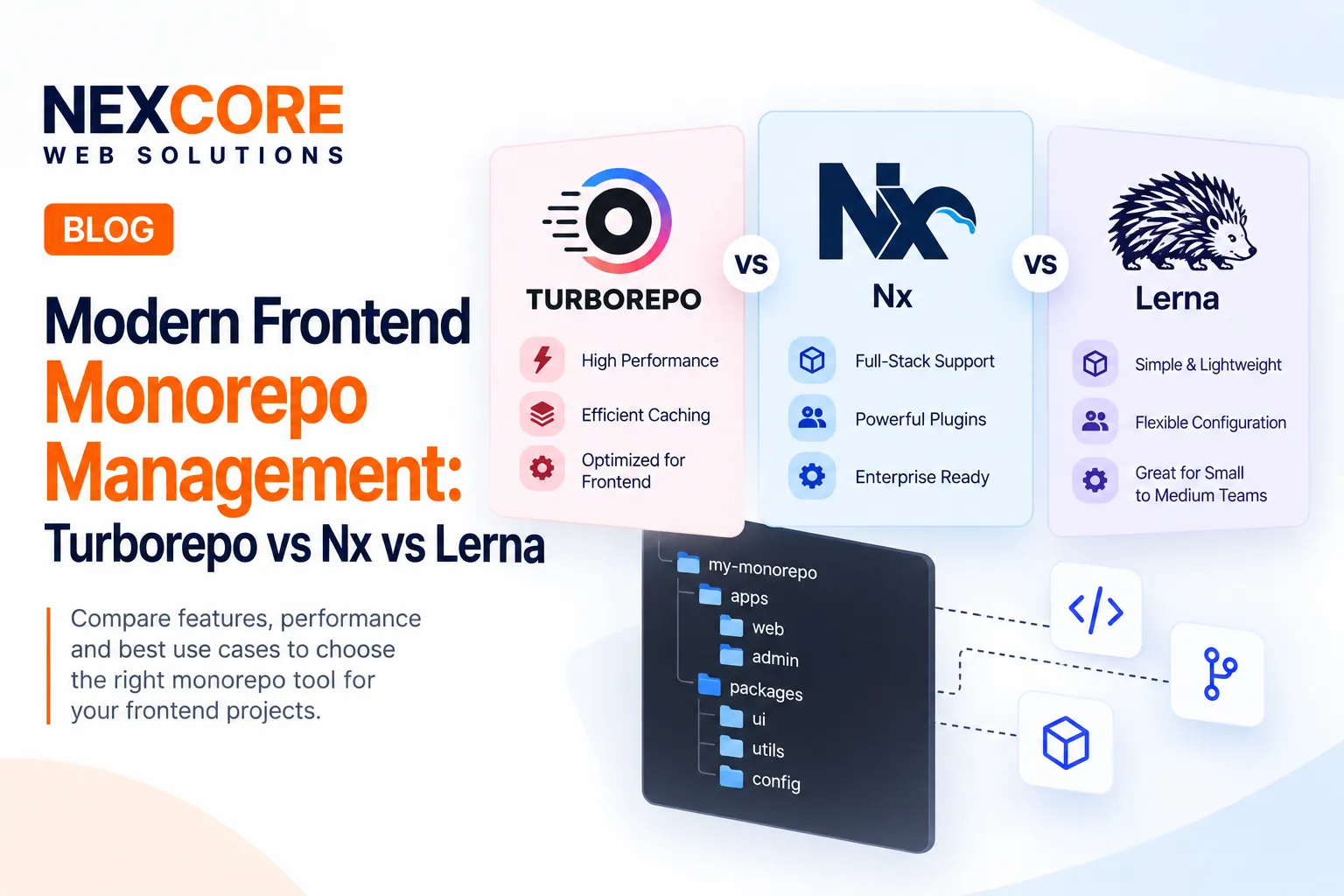
Modern frontend applications often grow into collections of web apps, shared components, design systems, utilities, and internal packages. Managing these projects separately can lead to duplicated dependencies, inconsistent tooling, and difficult release processes. A monorepo brings related codebases into one repository, making shared development and coordinated changes easier to manage. However, the benefits depend heavily on the tools used to build, test, cache, and organize the workspace. Turborepo, Nx, and Lerna are three well-known options, but they solve monorepo problems in different ways. Understanding their architecture, strengths, and trade-offs helps teams choose a setup that fits their application size and development workflow.
What Is a Frontend Monorepo?
A frontend monorepo stores multiple applications and packages within a single version-controlled repository. A typical structure might contain a Next.js application, an administration dashboard, a shared UI library, and several utility packages. Developers can update a shared component and test its impact across multiple applications without managing separate repositories. This setup also makes dependency management and cross-project collaboration more centralized.
Why Monorepos Need Specialized Tools
A basic package manager can create workspaces, but large repositories require more than dependency linking. Build systems need to understand which projects are affected by a change and avoid repeating work unnecessarily. Caching can prevent unchanged packages from being rebuilt or retested, while task orchestration can run independent operations concurrently. Tools such as Turborepo, Nx, and Lerna add these capabilities at different levels of complexity.
Turborepo: Fast and Focused
Turborepo is designed around high-performance task execution and caching for JavaScript and TypeScript monorepos. It works well with package-manager workspaces and fits naturally into modern frontend stacks such as Next.js, React, and similar frameworks. Its task pipeline allows teams to define relationships between operations such as linting, testing, and building. Remote caching can also allow developers and CI systems to reuse previously generated results.
When Turborepo Makes Sense
Turborepo is a strong choice when a team wants a relatively lightweight build orchestration layer without adopting a large collection of framework-specific features. It is particularly useful when the repository already has a clear package structure and the main concern is making development and CI faster. Teams can gradually introduce caching and task dependencies instead of redesigning the entire project. This simplicity can reduce the learning curve for frontend-focused teams.
Nx: A Broader Development Platform
Nx takes a more comprehensive approach to monorepo management. It provides project graphs, task orchestration, caching, generators, dependency analysis, and tooling integrations across many technologies. Its project graph helps developers understand relationships between applications and libraries and can identify projects affected by a code change. Nx can therefore become valuable as repositories grow more complex and teams need stronger architectural visibility.
When Nx Is the Better Fit
Nx is often attractive for organizations managing many applications, shared libraries, or different technology stacks within one workspace. Its generators and conventions can help standardize how new projects and libraries are created. The additional capabilities, however, mean there is more tooling and configuration to understand. Teams should adopt Nx because its broader feature set solves real organizational problems, not simply because a repository happens to be large.
Lerna: Package and Release Management
Lerna has a long history in the JavaScript monorepo ecosystem and is particularly associated with managing multiple packages and coordinated releases. Modern Lerna can work alongside other tooling, including Nx capabilities, which allows teams to combine package management workflows with more advanced task execution. This makes Lerna relevant when publishing and versioning packages is a major requirement. Its role is somewhat different from using a build-focused tool alone.
Where Lerna Fits Today
Lerna can be useful for libraries that need coordinated versioning, changelog generation, and publishing workflows. For example, an organization maintaining several public UI packages may need to release related packages together after a shared change. Teams should evaluate whether package publishing is their primary monorepo challenge before choosing Lerna. If build orchestration and affected-project analysis are more important, another tool may provide a better foundation.
Turborepo vs Nx vs Lerna
The three tools overlap, but their priorities differ. Turborepo emphasizes fast task execution and caching with a comparatively focused approach, while Nx provides a broader development platform with deeper workspace analysis and automation. Lerna is especially relevant when package versioning and publishing are central to the workflow. The right choice depends less on popularity and more on repository structure, team size, CI requirements, and release strategy.
Practical Selection Guide
Consider these factors before making a decision:
- Choose Turborepo when speed, caching, and straightforward task orchestration are the main priorities.
- Choose Nx when the repository needs dependency graphs, generators, affected-project workflows, and broader tooling support.
- Choose Lerna when coordinated package versioning and publishing are important parts of the architecture.
The decision should also account for existing tooling and developer familiarity. Migrating a mature monorepo simply to adopt a fashionable tool can introduce unnecessary risk. A small workspace may gain little from complex automation, while a large organization can benefit substantially from centralized project analysis. Start with measurable problems such as slow CI, duplicated builds, difficult releases, or unclear dependencies, then select the tool that addresses those problems directly.
Conclusion
Modern frontend monorepos can improve code sharing, consistency, and coordinated development, but they require thoughtful tooling as complexity increases. Turborepo is well suited to teams seeking efficient task execution and caching without excessive overhead. Nx offers a broader platform for organizations that need project graphs, generators, affected-project workflows, and extensive integrations. Lerna remains useful when package versioning and publishing are central requirements. There is no universal winner between these tools. The best architecture is the one that matches the repository’s actual needs, keeps developer workflows understandable, and provides measurable improvements in build performance, CI efficiency, and long-term maintainability.
FAQs
What is a frontend monorepo?
A frontend monorepo is a single repository containing multiple applications, libraries, and shared packages. Teams can manage related projects together while reusing components and utilities across applications. Monorepos can simplify dependency management and coordinated changes, but they also require appropriate tooling for task execution, caching, testing, and builds. The larger the workspace becomes, the more important efficient orchestration and dependency analysis become.
Is Turborepo better than Nx?
Turborepo is not universally better than Nx because the two tools emphasize different needs. Turborepo focuses strongly on fast task execution and caching with a relatively focused developer experience. Nx provides broader capabilities such as project graphs, generators, affected-project analysis, and extensive integrations. Teams should compare them based on repository complexity, CI requirements, development workflows, and the level of architectural tooling they actually need.
Is Lerna still useful for monorepos?
Yes, Lerna can still be useful, particularly for repositories containing multiple publishable packages. It provides workflows around package versioning, releases, changelogs, and publishing, which can be important for shared libraries or open-source package collections. Its role differs from a dedicated build orchestration tool. Teams should consider Lerna when coordinated package releases are a significant requirement rather than using it solely for general monorepo management.
Which monorepo tool is best for a large frontend project?
For a large frontend project, Nx can be a strong option when teams need detailed project relationships, generators, affected-project workflows, and extensive tooling support. Turborepo can be a better fit when the primary goals are fast builds, caching, and straightforward task orchestration. The best choice depends on the number of projects, team structure, CI workload, package management strategy, and existing development conventions.
Can Turborepo and Lerna be used together?
Yes, monorepo tools can sometimes be combined when their responsibilities are clearly separated. For example, a team could use a task orchestration system for builds and tests while using Lerna for package versioning and publishing. However, overlapping configuration can create unnecessary complexity. Before combining tools, define ownership for tasks such as dependency management, releases, caching, project discovery, and CI orchestration.




