
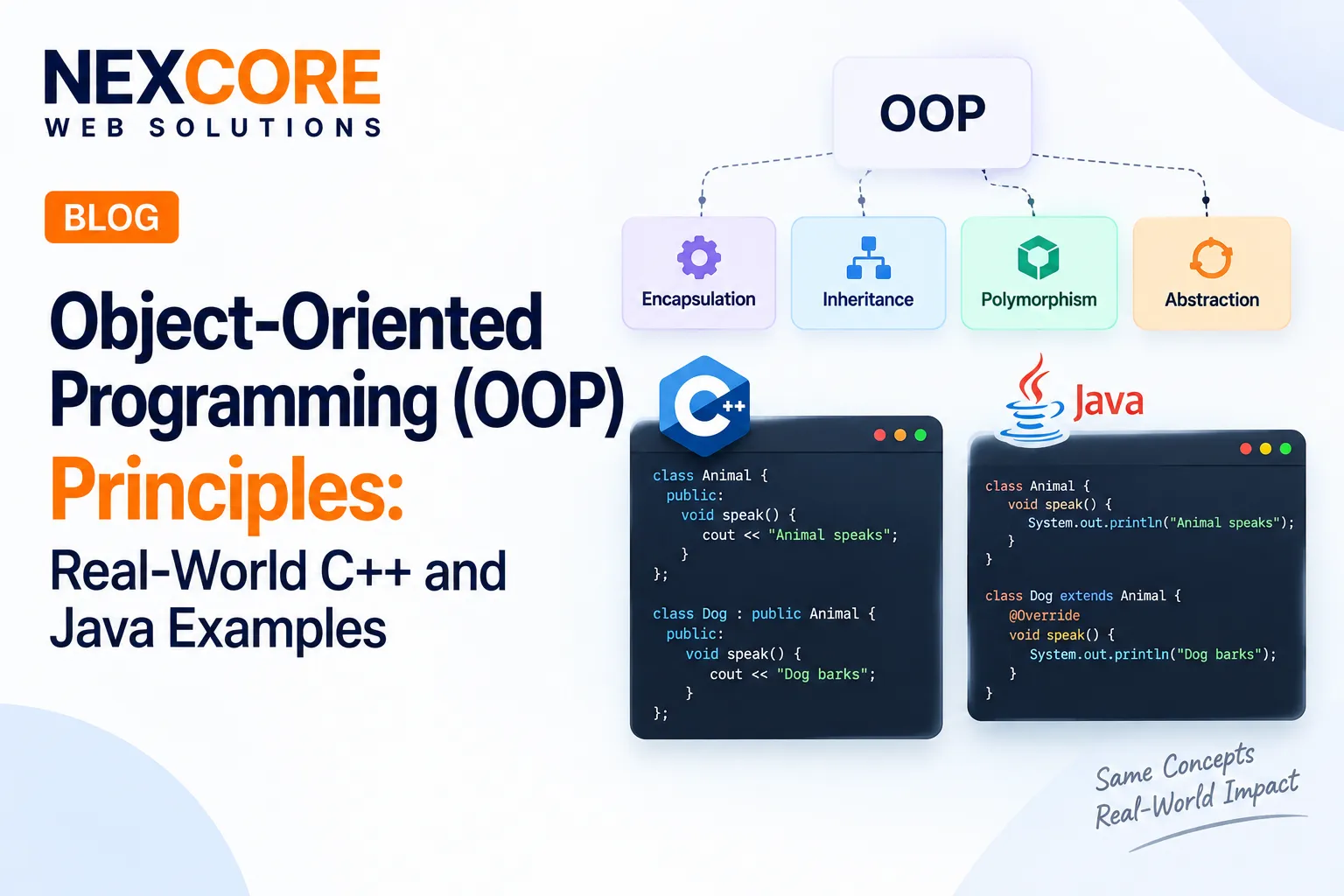
Object-Oriented Programming (OOP) is one of the most widely used approaches for building maintainable and scalable software. Instead of organizing a program only around functions and procedures, OOP models software around objects that combine data with the behavior that operates on that data. Languages such as C++ and Java use OOP extensively, making its principles important for developers working on applications, enterprise systems, games, and backend services. The four core principles—encapsulation, abstraction, inheritance, and polymorphism—help developers manage complexity as projects grow. Understanding these concepts through practical examples makes OOP much easier to apply correctly rather than treating them as definitions to memorize.
What Is Object-Oriented Programming?
Object-Oriented Programming organizes software around classes and objects. A class defines the properties and behaviors that a particular type of object can have, while an object represents an actual instance created from that class. For example, an online shopping application might have a Product class containing a product name, price, and stock quantity. Individual products such as a laptop or keyboard can then be represented as objects with their own values.
Classes and Objects in C++
In C++, a class can contain private data members and public methods that control how that data is accessed. For example, a BankAccount class might keep the account balance private while exposing deposit() and withdraw() methods. This prevents other parts of the application from directly changing the balance without following the class’s rules. The object therefore manages its own state and provides controlled operations to outside code.
Classes and Objects in Java
Java follows a similar class-based model, although its object management and runtime behavior differ from C++. A Java Employee class could contain fields such as name and salary along with methods such as calculateBonus(). Multiple employee objects can share the same structure while storing different values. This makes classes useful for representing recurring entities in real-world software.
Encapsulation
Encapsulation means keeping an object’s internal state protected and exposing controlled ways to interact with it. It reduces the risk that unrelated code will accidentally place an object into an invalid state. In Java, developers commonly use private fields with public methods or carefully designed accessors. In C++, access specifiers such as private and public provide similar control over class members.
Real-World Example
Consider a digital wallet that stores a user’s available balance. The balance should not be freely editable because code elsewhere could accidentally set it to a negative value. Instead, methods such as addMoney() and makePayment() can validate amounts before changing the balance. This design keeps business rules close to the data they protect and makes the class easier to maintain.
Abstraction
Abstraction focuses on exposing what an object does while hiding unnecessary implementation details. A developer using a payment service does not need to understand every database query, encryption operation, or network request behind the service. They only need a clear interface for performing a payment. Both C++ and Java support abstraction through classes, interfaces, abstract classes, and well-defined public methods.
Why Abstraction Matters
Good abstraction reduces the amount of knowledge that one part of an application needs about another part. For example, an application might call processPayment() without knowing whether the implementation uses a card gateway, bank transfer, or another payment provider. The internal implementation can change while the calling code remains stable. This separation becomes especially valuable in large systems where many components evolve independently.
Inheritance
Inheritance allows one class to derive characteristics and behavior from another class. A common example is an application with a general Vehicle class and specialized Car and Motorcycle classes. The derived classes can reuse common properties such as speed or registration details while adding their own functionality. C++ supports multiple inheritance, while Java deliberately limits class inheritance to a single direct superclass but allows multiple interfaces.
When to Use Inheritance
Inheritance works best when there is a genuine “is-a” relationship between types. A Car is a Vehicle, so sharing common vehicle behavior can make sense. However, inheritance should not be used simply to reuse a few methods because deep class hierarchies can become difficult to understand. Composition is often a better choice when one object needs to contain or use another object rather than represent a specialized version of it.
Polymorphism
Polymorphism allows the same interface or operation to produce different behavior depending on the object involved. For example, a draw() operation could behave differently for a circle, rectangle, or triangle. In Java, method overriding and interfaces are common ways to implement polymorphic behavior. In C++, polymorphism can be achieved through virtual functions, function overloading, templates, and other language features.
Real-World Polymorphism Example
Imagine an e-commerce system with different payment methods such as credit cards, digital wallets, and bank transfers. The application can define a common payment interface with a method such as pay(). Each payment implementation performs the operation differently while the checkout process interacts with the common interface. This allows new payment methods to be added without rewriting the core checkout workflow.
C++ vs Java OOP
C++ and Java share the major OOP principles, but their approaches have important differences. C++ provides lower-level control, including manual memory management, pointers, multiple inheritance, and deterministic object lifetime through destructors. Java uses automatic garbage collection and places stronger constraints around inheritance and memory access. C++ can therefore provide greater control and performance flexibility, while Java often offers a more managed development environment.
Choosing the Right Approach
OOP principles should be applied according to the problem rather than forced into every piece of code. Small programs may become unnecessarily complicated if developers create classes for every simple operation. Large applications, however, can benefit significantly from clear responsibilities, encapsulated state, reusable abstractions, and polymorphic interfaces. The goal is not to maximize the number of classes but to create software whose structure reflects meaningful responsibilities.
Conclusion
Object-Oriented Programming provides a practical way to organize complex software around well-defined objects and responsibilities. Encapsulation protects data, abstraction hides unnecessary implementation details, inheritance supports meaningful specialization, and polymorphism allows flexible behavior through common interfaces. C++ and Java implement these principles differently, but the underlying design ideas remain valuable across both languages. Developers should use OOP thoughtfully, combining inheritance with composition and keeping classes focused on clear responsibilities. When applied with good design judgment, OOP can make applications easier to understand, test, extend, and maintain as requirements change.
FAQs
What are the four main principles of OOP?
The four main principles of Object-Oriented Programming are encapsulation, abstraction, inheritance, and polymorphism. Encapsulation protects an object’s internal state, while abstraction hides unnecessary implementation details. Inheritance allows related classes to share behavior, and polymorphism enables different objects to respond differently through a common interface. Together, these principles help developers structure complex applications around clear responsibilities and reusable components.
Is OOP used in both C++ and Java?
Yes, both C++ and Java strongly support Object-Oriented Programming. They provide classes, objects, encapsulation, inheritance, and polymorphism, although their language features differ. C++ provides capabilities such as multiple inheritance, pointers, destructors, and manual memory control, while Java uses garbage collection and restricts class inheritance to one direct superclass. Both languages are widely used for object-oriented software development.
What is encapsulation in C++ and Java?
Encapsulation is the practice of protecting an object’s internal data and controlling how other code interacts with it. C++ and Java commonly implement encapsulation using private fields and public or controlled methods. For example, a bank account can keep its balance private and provide methods for deposits and withdrawals. This approach prevents uncontrolled changes and allows validation rules to remain inside the responsible class.
What is polymorphism with a real-world example?
Polymorphism allows different object types to be used through a common interface while providing their own implementations. A payment system is a practical example because credit card, bank transfer, and digital wallet classes can implement the same payment operation differently. The checkout process can call the common operation without knowing the internal details of each payment method. This makes systems easier to extend when new implementations are introduced.
Is inheritance better than composition in OOP?
Inheritance is not automatically better than composition. Inheritance is appropriate when one class is genuinely a specialized form of another, such as a car being a vehicle. Composition is often preferable when an object simply uses another component, such as an order containing payment and shipping services. Choosing between them should depend on the relationship, expected changes, reuse requirements, and complexity of the resulting design.




