
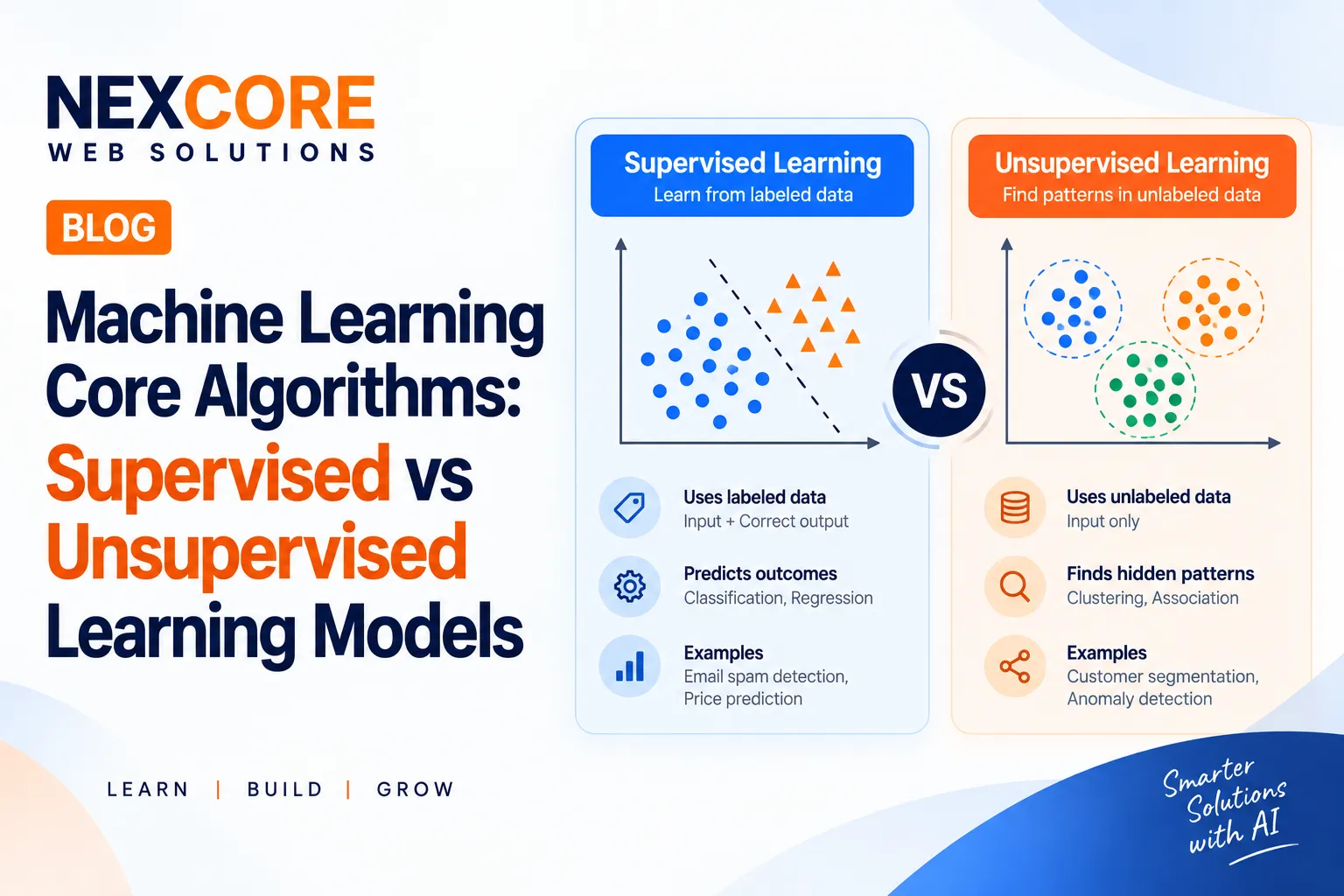
Machine learning algorithms allow software to identify patterns in data and use those patterns to make predictions, classifications, or other decisions. Two of the most important approaches are supervised learning and unsupervised learning, which differ mainly in how training data is structured. Supervised models learn from examples that include known outcomes, while unsupervised models search for useful patterns without predefined labels. Understanding this distinction helps developers and data teams select algorithms that match the problem, available data, and desired result. From fraud detection and sales forecasting to customer segmentation and anomaly discovery, these methods support many practical applications. Choosing the right approach can significantly affect model accuracy, interpretability, and business value.
What Is Supervised Learning?
Supervised learning trains a model using labeled examples, where input data is paired with a known target value. The algorithm studies relationships between inputs and outputs and uses those relationships to make predictions on previously unseen data. For example, a bank could train a model using historical transactions labeled as legitimate or fraudulent. During training, the model learns patterns associated with each outcome and later estimates whether new transactions are likely to be fraudulent.
Classification Algorithms
Classification is used when the prediction belongs to a defined category. Common algorithms include logistic regression, decision trees, random forests, support vector machines, and neural networks. An email filtering system, for example, can classify incoming messages as spam or legitimate based on characteristics learned from previously labeled emails. Model selection depends on factors such as dataset size, feature relationships, interpretability requirements, and computational resources.
Regression Algorithms
Regression predicts continuous numerical values rather than categories. Linear regression is a straightforward example, while decision-tree-based regression, random forests, and gradient boosting can model more complex relationships. A retailer might use regression to estimate future product demand using historical sales, prices, promotions, and seasonal patterns. The quality of the result depends heavily on data quality, relevant features, and how well the training examples represent future conditions.
What Is Unsupervised Learning?
Unsupervised learning works with data that does not contain predefined target labels. Instead of learning to predict a known answer, the algorithm attempts to discover structure, relationships, or unusual observations within the dataset. This approach is useful when organizations have large amounts of raw data but do not have reliable labels. Customer segmentation is a common example, where purchasing behavior can be grouped into meaningful clusters without manually assigning each customer to a category.
Clustering Algorithms
Clustering algorithms group data points according to their similarities. K-means clustering is widely used because it is relatively simple and efficient for suitable datasets. Hierarchical clustering creates a tree-like structure that can reveal relationships between groups at different levels. For example, an e-commerce company could cluster customers based on purchase frequency, average order value, and product preferences to identify distinct behavioral segments.
Dimensionality Reduction
Dimensionality reduction reduces the number of features while attempting to preserve important information. Principal Component Analysis (PCA) is a traditional technique used to transform many correlated variables into a smaller set of components. This can make high-dimensional datasets easier to visualize, process, or analyze. Techniques such as t-SNE and UMAP are also commonly used for exploring complex datasets, particularly when visualizing relationships between high-dimensional observations.
Supervised vs Unsupervised Learning
The biggest difference between supervised and unsupervised learning is the presence of labeled outcomes. Supervised learning has a specific prediction target, while unsupervised learning explores the underlying structure of the available data. Supervised models can be evaluated using metrics such as accuracy, precision, recall, F1 score, mean absolute error, or root mean squared error, depending on the task. Unsupervised models often require different evaluation methods because there may be no predefined correct answer.
Choosing the Right Approach
Teams should start by defining the actual business or technical problem rather than choosing an algorithm first. If historical examples contain reliable outcomes and the goal is prediction, supervised learning is usually appropriate. If labels are unavailable and the goal is discovering groups, patterns, or anomalies, unsupervised learning may be more suitable. In some projects, both approaches can work together, such as using clustering to explore customer behavior before creating labeled datasets for a supervised prediction model.
Common Machine Learning Algorithms
Several algorithms appear frequently in real-world machine learning projects:
- Linear and logistic regression: Useful for relatively interpretable prediction and classification problems.
- Decision trees: Easy to understand and suitable for nonlinear relationships.
- Random forests: Combine multiple trees to improve robustness and reduce overfitting.
- K-means: Groups observations into a selected number of clusters.
- Support vector machines: Useful for classification and certain high-dimensional datasets.
- Principal Component Analysis: Reduces feature dimensions while preserving important variation.
The best algorithm is rarely determined by theory alone. Developers should compare candidates using representative validation data, appropriate metrics, computational constraints, and the practical consequences of incorrect predictions. A highly accurate model may still be unsuitable if it is too expensive to run, impossible to explain to stakeholders, or unreliable when data distributions change. Model performance should therefore be evaluated in the context of the complete application.
Practical Considerations
Data preparation often has a larger effect on results than switching between similar algorithms. Missing values, inconsistent measurements, duplicate records, outliers, irrelevant features, and data leakage can all produce misleading results. Teams should separate training, validation, and test data carefully and ensure that information from the future does not accidentally enter the training process. Monitoring is also important after deployment because real-world data can change over time.
Conclusion
Supervised and unsupervised learning represent two foundational approaches to machine learning, but they address different types of problems. Supervised algorithms learn from labeled examples to predict categories or numerical outcomes, while unsupervised algorithms discover patterns and structure in unlabeled data. Understanding algorithms such as regression, decision trees, random forests, K-means, and PCA gives developers a practical starting point for model selection. However, successful machine learning depends on more than selecting an algorithm. Reliable data, meaningful evaluation, careful validation, appropriate features, and continuous monitoring are equally important. The strongest approach is to match the learning method to the problem and measure its performance against real-world requirements.
FAQs
What is the difference between supervised and unsupervised learning?
Supervised learning uses labeled training data where the expected outcome is known, allowing a model to learn how inputs relate to specific predictions. Unsupervised learning uses data without predefined outcomes and attempts to discover patterns, groups, or relationships. Classification and regression are common supervised tasks, while clustering and dimensionality reduction are common unsupervised techniques. The choice depends on the problem and available data.
Which algorithms are commonly used in supervised learning?
Common supervised learning algorithms include linear regression, logistic regression, decision trees, random forests, support vector machines, gradient boosting methods, and neural networks. The appropriate choice depends on whether the task involves classification or regression, along with factors such as dataset size, feature complexity, interpretability, and available computing resources. Developers should compare algorithms using suitable validation data and task-specific performance metrics.
What is K-means clustering used for?
K-means clustering is an unsupervised learning algorithm that groups observations into a predefined number of clusters based on their feature similarity. It can be useful for customer segmentation, behavioral analysis, document grouping, and exploratory data analysis. For example, an online retailer could group customers according to purchase frequency and spending patterns. Results should be evaluated carefully because the selected number of clusters can influence the outcome.
Is unsupervised learning harder than supervised learning?
Unsupervised learning is not necessarily harder to implement, but its results can be more difficult to evaluate because there may be no known correct labels. In supervised learning, metrics can directly compare predictions with expected outcomes. Unsupervised methods require measures such as cluster quality, stability, visualization, or domain-specific usefulness. Interpretation also often requires subject-matter knowledge to determine whether discovered patterns are meaningful.
Can supervised and unsupervised learning be used together?
Yes, combining supervised and unsupervised learning can be useful in practical machine learning workflows. Unsupervised methods can identify groups, unusual records, or hidden patterns that help teams understand a dataset and create better features or labels. Those insights can then support supervised models for prediction. This combination is particularly useful when labeled data is limited but large amounts of unlabeled data are available.




