
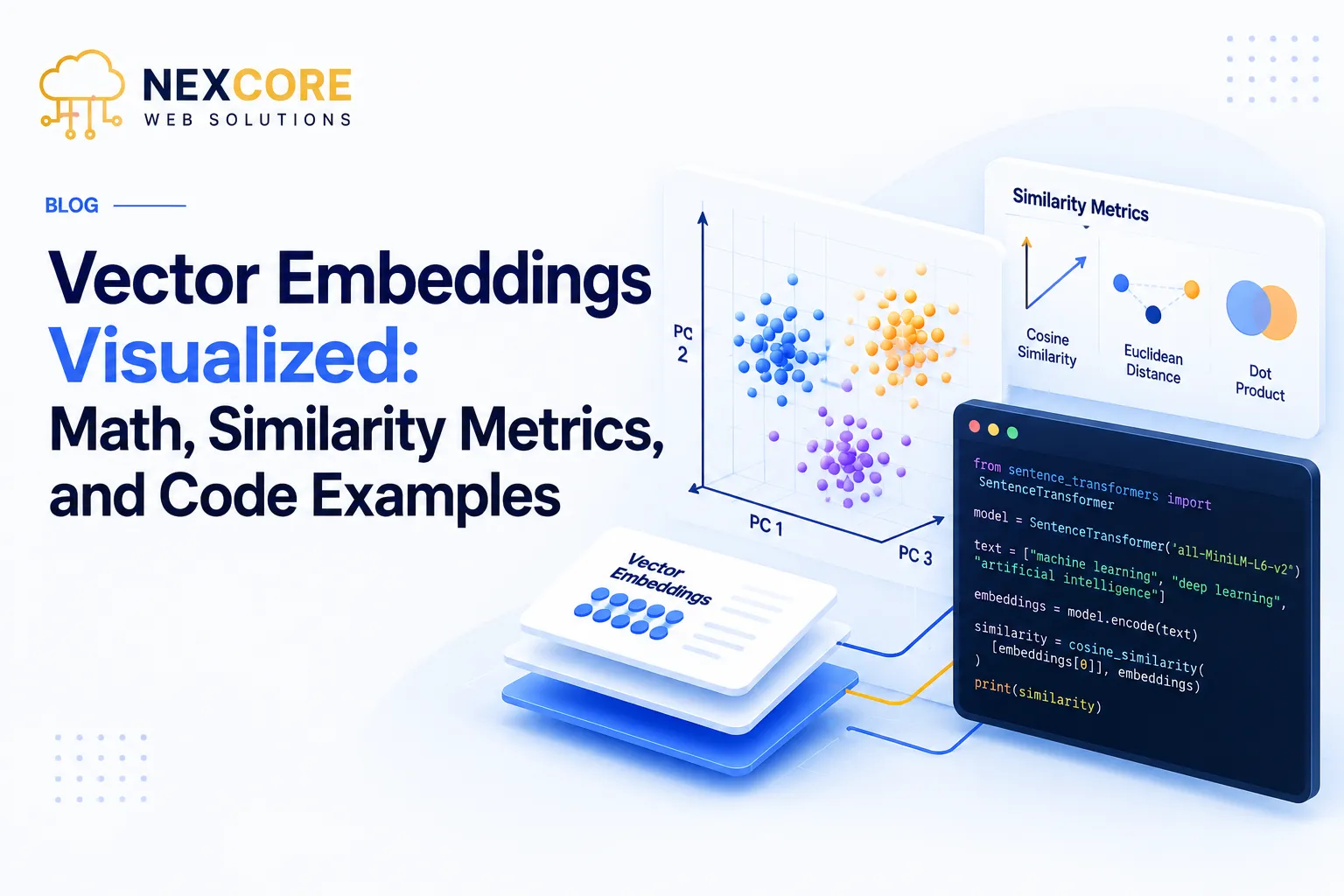
Vector embeddings are a foundation of many modern machine learning and artificial intelligence systems. They transform information such as text, images, products, or documents into numerical representations that algorithms can compare and process. Instead of treating two sentences as completely unrelated strings, an embedding model can represent their meanings as points in a high-dimensional vector space. Similar concepts tend to appear closer together, making embeddings useful for semantic search, recommendation systems, clustering, retrieval-augmented generation, and classification. Understanding the mathematics behind vectors and similarity metrics helps developers build these systems more reliably. It also makes debugging easier because developers can understand what a similarity score actually represents instead of treating embeddings as mysterious numbers returned by an API.
What Are Vector Embeddings?
A vector embedding is a sequence of numerical values representing information in a mathematical space. For example, a simplified embedding might look like [0.21, -0.45, 0.73, 0.11], although real models commonly produce hundreds or thousands of dimensions. Each dimension contributes to the representation learned by the model, but individual dimensions usually do not have simple human-readable meanings. The important property is that relationships between vectors can encode useful semantic or structural information.
Imagine representing the sentences “The cat is sleeping” and “A kitten is resting” as vectors. Their individual words differ, but a well-trained embedding model may place their vectors relatively close because their meanings are related. In contrast, a sentence about database indexing would typically occupy a different region of the embedding space. This makes vector representations valuable when exact keyword matching is insufficient.
The Mathematics Behind Embeddings
A vector can be represented mathematically as:
v = [v₁, v₂, v₃, ..., vₙ]
Here, each v represents a numerical coordinate and n represents the number of dimensions. If an embedding contains 768 values, the model represents the input as a point in a 768-dimensional space. Humans cannot directly visualize such spaces, but dimensionality-reduction techniques can project them into two or three dimensions for analysis.
Vector Magnitude
The magnitude, or length, of a vector is calculated using the Euclidean norm:
||v|| = √(v₁² + v₂² + ... + vₙ²)
Magnitude matters because some similarity calculations consider both direction and length. In many semantic-search applications, however, the direction of the vector is more informative than its absolute size. Normalizing vectors can therefore make comparisons more consistent when cosine similarity is used.
Cosine Similarity
Cosine similarity measures the angle between two vectors rather than simply comparing their raw coordinate differences. The formula is:
cos(θ) = (A · B) / (||A|| ||B||)
The dot product appears in the numerator, while the vector magnitudes appear in the denominator. Values closer to 1 generally indicate vectors pointing in similar directions, while values near 0 indicate little directional similarity. Negative values indicate opposing directions, although the practical interpretation depends on the embedding model and application.
Python Example
A simple implementation can be written with NumPy:
import numpy as np

a = np.array([0.2, 0.4, 0.8])
b = np.array([0.3, 0.5, 0.7])

similarity = np.dot(a, b) / (
    np.linalg.norm(a) * np.linalg.norm(b)
)

print(similarity)
This calculation demonstrates the underlying operation used by many vector-search systems. Production applications typically rely on optimized libraries or vector databases rather than calculating every comparison manually.
Euclidean Distance
Euclidean distance measures the straight-line distance between two points. Its formula is:
d(A, B) = √Σ(Aᵢ - Bᵢ)²
A smaller distance means the points are physically closer in the vector space. Euclidean distance can be useful when the geometry and magnitude of embeddings matter, but it may behave differently from cosine similarity when vector lengths vary significantly.
The choice between cosine similarity and Euclidean distance should therefore be based on the embedding model and retrieval requirements. Developers should avoid assuming that one metric is universally appropriate. Testing several metrics on representative data can reveal which one produces useful retrieval results for a particular application.
Dot Product Similarity
The dot product is another common comparison method:
A · B = ΣAᵢBᵢ
It multiplies corresponding coordinates and adds the results. When vectors are normalized, dot product and cosine similarity become closely related because the vector magnitudes are equal to one. Some vector databases and machine learning systems use dot-product search because it can be computationally efficient.
Understanding normalization is important when interpreting search scores. A raw dot product can be affected by vector magnitude, while cosine similarity focuses on direction. If an application switches similarity metrics without considering how embeddings are normalized, retrieval behavior may change unexpectedly.
Visualizing Embedding Spaces
High-dimensional embeddings cannot be displayed directly on a normal two-dimensional chart. Developers can use techniques such as Principal Component Analysis (PCA), t-SNE, or UMAP to project vectors into fewer dimensions. These visualizations can reveal clusters, outliers, and broad relationships between data points.
For example, a dataset containing product descriptions might produce clusters representing electronics, clothing, furniture, and books. Such visualization does not prove that the model understands those categories perfectly, but it can help developers investigate whether related records appear near one another. Visualization is therefore useful as a diagnostic tool rather than a complete evaluation method.
Embeddings in Semantic Search
Semantic search converts a query and documents into embeddings and compares their vectors. Instead of searching only for exact words, the system can retrieve content with related meanings. A user searching for “ways to improve website loading speed” could potentially retrieve a document discussing Core Web Vitals even when the exact wording differs.
A typical pipeline includes document preparation, chunking, embedding generation, vector storage, query embedding, similarity calculation, and ranking. The quality of the final search experience depends on every stage, not only the embedding model. Poor chunking, irrelevant metadata, duplicate documents, or weak evaluation can reduce retrieval quality even when the embeddings themselves are strong.
Practical Evaluation and Common Mistakes
Developers should evaluate embeddings using real examples from the intended application. Useful tests include semantically related queries, unrelated queries, ambiguous terms, short inputs, long documents, and domain-specific terminology. Comparing top-k retrieval results manually can reveal problems that a single similarity score cannot explain.
Common mistakes include comparing vectors from incompatible embedding models, ignoring normalization requirements, using inappropriate chunk sizes, and assuming high similarity always means factual relevance. Another mistake is treating visualization as proof of model quality. Embeddings are representations, not guarantees of correct reasoning or factual accuracy.
Conclusion
Vector embeddings convert complex information into numerical representations that can be compared mathematically. Cosine similarity, Euclidean distance, and dot product provide different ways to measure relationships between vectors, while normalization influences how those metrics behave. Visualization techniques such as PCA and UMAP can make high-dimensional structures easier to inspect, and semantic search demonstrates how embeddings can support practical applications. Developers should focus not only on generating vectors but also on choosing appropriate similarity metrics, preparing data carefully, evaluating retrieval quality, and monitoring real-world performance. A strong understanding of the underlying mathematics makes embedding-based systems easier to design, troubleshoot, and improve.
FAQs
1. What are vector embeddings used for?
Vector embeddings are used to represent information numerically so that systems can compare semantic or structural relationships. Common applications include semantic search, recommendation engines, document retrieval, clustering, classification, duplicate detection, and retrieval-augmented generation. By representing related information as vectors, applications can compare concepts based on learned relationships rather than relying exclusively on exact keyword matches.
2. What is cosine similarity in vector embeddings?
Cosine similarity measures the angle between two vectors. It calculates the dot product of the vectors and divides it by their magnitudes. A value closer to one generally indicates stronger directional similarity, while values closer to zero indicate weaker similarity. It is widely used with embeddings because it focuses on vector direction rather than treating magnitude as the primary comparison factor.
3. What is the difference between cosine similarity and Euclidean distance?
Cosine similarity measures the directional relationship between two vectors, while Euclidean distance measures the straight-line distance between their coordinates. Cosine similarity can be useful when vector direction carries the main semantic information. Euclidean distance also considers magnitude and physical position. The appropriate metric depends on the embedding model, normalization strategy, and requirements of the retrieval or comparison task.
4. How can embedding vectors be visualized?
High-dimensional embeddings can be projected into two or three dimensions using techniques such as PCA, t-SNE, or UMAP. These methods make it possible to create visual plots showing clusters, outliers, and broad relationships among data points. However, the resulting visualization is a simplified projection and should not be treated as a complete representation of the original embedding space or definitive evidence of model quality.
5. How are embeddings used in semantic search?
In semantic search, both the user’s query and stored documents are converted into vectors using an embedding model. The system then compares the query vector with document vectors using a similarity metric such as cosine similarity or dot product. The highest-scoring results can be returned as relevant candidates. Retrieval quality also depends on document chunking, metadata, indexing, ranking, and evaluation.




