
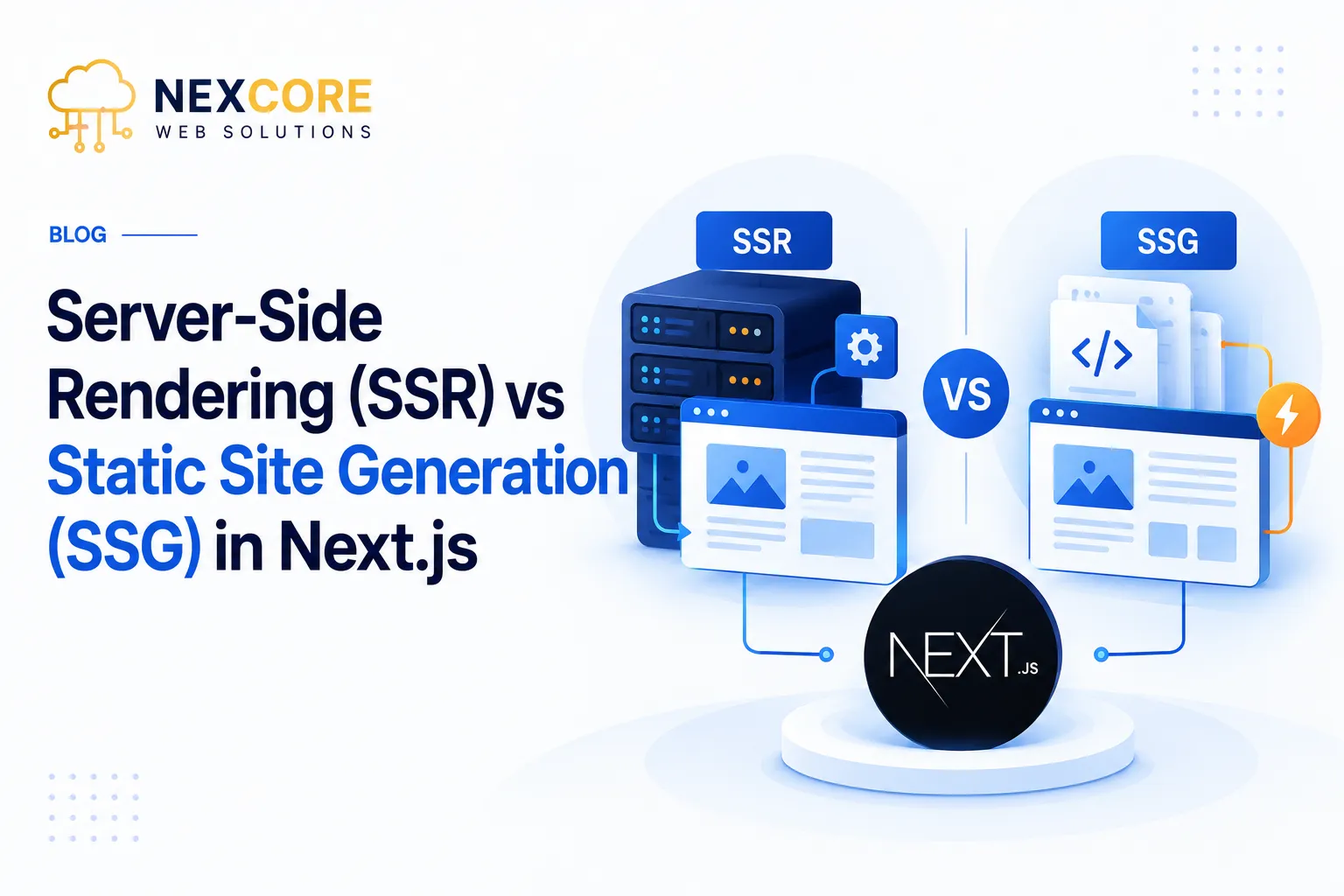
Next.js gives developers several ways to deliver web pages, and two of the most important approaches are Server-Side Rendering (SSR) and Static Site Generation (SSG). Both can produce fast, SEO-friendly pages, but they generate content at different stages of the application lifecycle. SSR generates a page when a request reaches the server, while SSG generates pages ahead of time so they can be served as static files. This difference affects performance, hosting requirements, caching, scalability, and how quickly content can reflect changes. Choosing between SSR and SSG therefore requires more than simply asking which method is faster. Developers need to consider how frequently content changes, whether each request needs fresh data, how much traffic the application receives, and what user experience the project requires.
What Is Server-Side Rendering in Next.js?
Server-Side Rendering means that a page is generated on the server when a user requests it. The server retrieves the required data, creates the HTML response, and sends it to the browser. This approach is useful when information needs to be current for each request, such as account dashboards, personalized pages, inventory information, or frequently changing content. Because the server produces the HTML before it reaches the browser, users and search engines can receive meaningful page content without depending entirely on client-side JavaScript.
SSR Advantages
SSR is particularly useful when data changes frequently or depends on the individual visitor. For example, an authenticated dashboard may need to display information specific to the logged-in user. Generating that page on demand allows the server to use the latest available information and request-specific context. The trade-off is that every request can require server processing, database queries, API calls, or other backend operations.
What Is Static Site Generation in Next.js?
Static Site Generation creates page output before users request the page. The generated files can then be delivered through a CDN or static hosting infrastructure without running application logic for every visitor. This makes SSG highly suitable for content that does not change on every request, including documentation, blogs, marketing pages, portfolios, and product information pages.
SSG Advantages
Because the page is already generated, the delivery path can be extremely efficient. A CDN can cache and distribute static assets across geographic locations, reducing the distance between users and the content they request. Static generation can also reduce server workload because repeated visitors can receive the same generated page rather than triggering a new server-rendering process each time. However, developers need a strategy for updating pages when the underlying content changes.
SSR vs SSG: Key Differences
The biggest difference between SSR and SSG is when the HTML is generated. SSR performs rendering at request time, while SSG performs rendering ahead of time. This creates different performance and infrastructure characteristics even though both can produce server-generated HTML.
SSG generally works well when many visitors can receive the same content. A company blog with hundreds of articles is a good example because the pages may remain unchanged for long periods. SSR becomes more useful when each request requires fresh or personalized information. An application can also combine rendering strategies rather than forcing every page to follow one approach.
Performance and Scalability
Performance depends on several factors, including page complexity, data-fetching time, caching, hosting infrastructure, and asset optimization. Static pages generally have a simpler delivery path because the server does not need to generate HTML for each request. SSR can still perform well when caching, database queries, APIs, and server resources are designed efficiently.
Scalability also differs between the approaches. With SSG, static assets can be distributed through a CDN and handle large numbers of requests efficiently. SSR requires compute resources whenever pages need to be generated, although caching can reduce repeated work. Developers should therefore evaluate expected traffic patterns rather than assuming that one rendering strategy automatically solves every performance problem.
SEO Considerations
Both SSR and SSG can support strong search engine optimization because both can deliver meaningful HTML content to crawlers. The more important factors include page accessibility, content quality, metadata, internal linking, structured data, performance, and technical implementation. SSR can be valuable when search-visible information changes frequently and needs to be generated from current data.
SSG is especially useful for stable content where developers want predictable, fast page delivery. Documentation sites, service pages, educational resources, and blog articles can benefit from this approach. Regardless of rendering strategy, developers should ensure that important content is available in the rendered page and that routing, canonical URLs, metadata, and indexing directives are correctly configured.
Choosing Between SSR and SSG
The right choice begins with the content rather than the framework feature. If a page requires fresh information for every visitor, SSR may be appropriate. If the same content can be generated ahead of time and served repeatedly, SSG can provide a simpler and efficient architecture.
Practical Examples
Consider a news website where article pages need frequent updates. Depending on the publishing workflow, server rendering or a suitable revalidation strategy may be appropriate. A documentation website, however, often contains pages that change only when developers publish a new version, making static generation a natural fit.
An e-commerce website may require a mixture of approaches. Product information could be generated or cached efficiently, while account pages and personalized checkout experiences require request-specific data. Next.js allows developers to design different parts of an application around their actual data requirements instead of treating the entire website as one rendering problem.
Combining Rendering Strategies
Modern Next.js applications do not need to choose a single rendering strategy for every route. Different pages can use different approaches depending on their data requirements and user interactions. This can produce a more efficient architecture because stable content can be delivered efficiently while dynamic pages can access request-specific information.
The key is to define clear boundaries between static and dynamic responsibilities. Developers should identify which data changes frequently, which content can be cached, and which pages depend on authentication or request-specific information. This analysis often produces a more practical solution than applying SSR or SSG uniformly across the entire application.
Conclusion
SSR and SSG represent different approaches to generating HTML in Next.js, and each is suited to specific application requirements. SSR generates pages when requests occur, making it useful for dynamic or personalized content that requires current information. SSG generates pages ahead of time, making it well suited to stable content that can be distributed efficiently through static hosting and CDNs. The decision should consider data freshness, personalization, traffic patterns, caching, infrastructure, and maintenance requirements. Developers should also remember that a modern Next.js application can use different rendering approaches for different routes. Instead of choosing a strategy based solely on performance claims, analyze how each page works and select the rendering model that matches its actual content and data lifecycle.
FAQs
1. What is the main difference between SSR and SSG in Next.js?
The main difference is when the page is generated. Server-Side Rendering generates HTML when a request is received, allowing the server to use current or request-specific information. Static Site Generation creates the page ahead of time and serves the generated output to users. This makes SSG particularly suitable for stable content, while SSR is useful when pages require dynamic data.
2. Is SSG faster than SSR in Next.js?
SSG can provide very fast delivery because pages are generated before users request them and can often be served directly through a CDN. SSR can also be fast when the application uses effective caching and efficient backend operations. Actual performance depends on hosting, data-fetching time, page complexity, caching, and asset optimization. Therefore, the rendering method alone does not determine complete page performance.
3. Is SSR better for SEO than SSG?
Both SSR and SSG can provide search-engine-friendly HTML because content can be rendered before being delivered to crawlers. SEO performance depends on factors such as content quality, metadata, internal links, structured data, accessibility, performance, and indexability. SSR can help with frequently changing content, while SSG works well for stable pages. Correct technical implementation matters more than choosing one method universally.
4. When should I use SSG in a Next.js project?
SSG is a strong fit when page content can be generated ahead of time and does not need to change for every request. Typical examples include blogs, documentation, portfolios, marketing pages, educational resources, and relatively stable product information. Static pages can be efficiently distributed through CDNs and reduce repeated server processing. Developers should still plan how regenerated pages will receive content updates.
5. Can a Next.js application use both SSR and SSG?
Yes, a Next.js application can use different rendering approaches according to the requirements of individual pages or data sources. For example, a documentation section can use static generation while authenticated dashboards rely on dynamic server rendering. This approach allows developers to match rendering behavior with data freshness, personalization, and caching needs. Separating these responsibilities can produce a more practical application architecture.




