
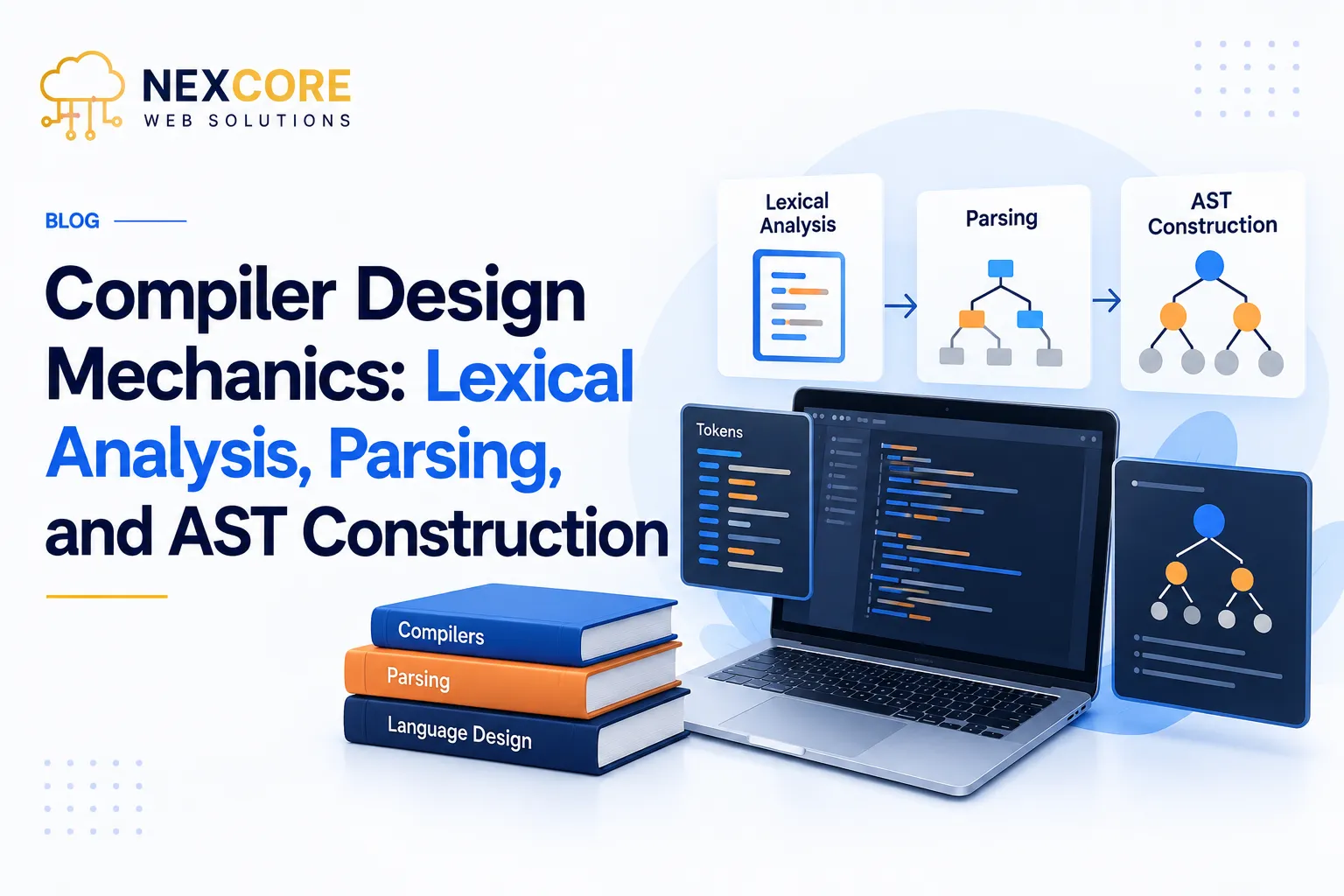
A compiler transforms human-readable source code into a form that a computer can execute, but the process involves far more than simply converting one language into another. Before generating machine code or another target representation, a compiler must understand the structure and meaning of the program. Three foundational stages are lexical analysis, parsing, and Abstract Syntax Tree (AST) construction. Lexical analysis converts raw characters into meaningful tokens, parsing checks how those tokens fit the language grammar, and AST construction creates a structured representation that later compiler stages can process. Understanding these mechanics is valuable for computer science students, language-tool developers, and programmers who want to understand how programming languages actually work. These stages also explain why syntax errors are detected and reported before code reaches execution.
What Is Lexical Analysis?
Lexical analysis is the first major stage of compiler processing. A lexical analyzer, commonly called a lexer or scanner, reads the source code character by character and groups characters into meaningful units called tokens. For example, the statement total = price + tax; contains identifiers, an assignment operator, another identifier, an arithmetic operator, and a statement terminator. The lexer identifies these components and usually ignores irrelevant whitespace and comments.
Tokenization in Practice
Consider the expression result = a + 10;. A lexer could produce tokens such as IDENTIFIER(result), ASSIGN, IDENTIFIER(a), PLUS, NUMBER(10), and SEMICOLON. Each token normally contains information about its type and sometimes its value or source location. This information allows later compiler stages to work with structured units instead of individual characters. Lexers commonly use techniques such as regular expressions, finite automata, or manually written scanning logic to recognize token patterns.
Lexical errors occur when the scanner encounters characters or sequences that are not valid according to the language’s lexical rules. An unsupported symbol, malformed numeric literal, or invalid character sequence can trigger such an error. Good error reporting should identify the approximate location and explain what the compiler expected. Accurate token positions also help later stages produce useful syntax diagnostics.
Parsing and Grammar
After tokenization, the parser receives the token stream and determines whether those tokens follow the grammar of the programming language. Grammar rules describe how valid statements and expressions can be constructed. For example, an arithmetic expression might contain a number, identifier, or parenthesized expression combined with operators. Parsing therefore moves the compiler from individual tokens toward relationships between language constructs.
Syntax Trees and Grammar Rules
Parsers can use different strategies, including recursive descent, LL parsing, LR parsing, and other techniques. A recursive-descent parser often represents grammar rules through functions, making it relatively approachable for educational compilers and small domain-specific languages. More complex languages may use parser generators or carefully engineered parsing frameworks. Regardless of implementation, the parser must correctly handle precedence, associativity, nesting, and syntax errors.
For example, the expression a + b * c should normally interpret multiplication before addition. A parser must therefore understand the precedence rules rather than simply processing operators from left to right. Parentheses can explicitly change the structure, as in (a + b) * c. Correct parsing ensures that later compiler stages receive a representation matching the intended language grammar.
Building an Abstract Syntax Tree
An Abstract Syntax Tree represents the logical structure of source code while removing unnecessary syntactic details. Instead of storing every punctuation symbol, an AST focuses on meaningful constructs such as declarations, assignments, operators, function calls, and control-flow statements. For a + b * c, the tree can represent addition as the root operation with a on one side and multiplication of b and c on the other. This structure makes operator precedence explicit.
AST Nodes
An AST typically contains different node types for different language constructs. Common nodes include binary expressions, literals, identifiers, variable declarations, function calls, conditional statements, and loops. Each node can contain references to its child nodes and additional information such as names, values, or source locations. The exact structure depends on the language and what later compiler stages need.
AST construction can happen during parsing or as a separate transformation after a concrete syntax tree has been created. A well-designed AST removes unnecessary grammar details while preserving the information required for semantic analysis and code generation. This separation makes compiler architecture easier to maintain because later stages can operate on meaningful program structures rather than raw tokens.
From AST to Later Compiler Stages
Once the AST has been constructed, the compiler can perform semantic analysis. This stage can check whether variables are declared, types are compatible, functions receive valid arguments, and language-specific rules are respected. The compiler may also build symbol tables containing information about identifiers and their scopes. These checks require structural information that is difficult to obtain directly from raw source text.
The AST can then support optimization and code generation. Compiler passes may simplify expressions, remove unnecessary operations, or transform the program into an intermediate representation. Eventually, the compiler can generate machine code, bytecode, or another target format. Because the AST preserves relationships between program elements, it provides a useful foundation for these transformations.
Error Handling Across the Pipeline
Error handling is an important part of compiler design because failures can occur at different stages. Lexical errors usually involve invalid characters or malformed tokens, while parser errors involve tokens that do not satisfy grammatical rules. Semantic errors occur when the syntax is valid but the program violates language rules, such as assigning an incompatible type. Separating these error categories helps developers understand what went wrong.
Good compilers also try to recover from errors rather than stopping immediately after the first problem. A parser might skip certain tokens and continue looking for another statement boundary, allowing multiple syntax errors to be reported in one compilation attempt. Error recovery must be carefully designed so that it does not produce misleading follow-up messages. Clear diagnostics and accurate source locations can significantly improve the developer experience.
Conclusion
Compiler design becomes easier to understand when the transformation from source code is viewed as a sequence of structured stages. Lexical analysis converts characters into tokens, parsing verifies grammatical relationships, and AST construction represents the program as a meaningful hierarchy. These stages provide the foundation for semantic analysis, optimization, and code generation. Learning how they work also improves practical programming skills because concepts such as grammar, precedence, syntax errors, and structured representations appear in interpreters, linters, formatters, static analyzers, and language servers. Whether building a small educational compiler or studying production language tooling, understanding the path from source characters to an AST provides a strong foundation for exploring programming language implementation.
FAQs
1. What is lexical analysis in compiler design?
Lexical analysis is the process of reading source code and converting character sequences into tokens. A lexer identifies elements such as keywords, identifiers, numbers, operators, and punctuation while usually ignoring whitespace and comments. These tokens are passed to the parser for grammatical analysis. Lexical analysis also detects invalid character sequences and can attach source positions to tokens for accurate error reporting.
2. What does a parser do in a compiler?
A parser receives tokens from the lexer and determines whether they follow the grammar of the programming language. It analyzes relationships between tokens, handles structures such as expressions and statements, and detects syntax errors. Depending on the compiler design, the parser may directly construct an AST or create another syntax representation first. Parsing is essential because later stages need structured program information.
3. What is an Abstract Syntax Tree?
An Abstract Syntax Tree is a hierarchical representation of a program’s meaningful structure. Unlike a raw token stream, an AST focuses on constructs such as expressions, declarations, function calls, and control-flow statements. It removes unnecessary syntactic details while preserving relationships needed by later compiler stages. Semantic analysis, optimization, code generation, and many developer tools can operate on this structured representation.
4. What is the difference between a lexer and a parser?
A lexer works primarily at the character level and groups characters into tokens. A parser works with those tokens and determines whether they form valid structures according to the language grammar. For example, a lexer can identify identifiers and operators in an expression, while the parser determines how those operators and identifiers are related. Their responsibilities are different but closely connected within the compiler pipeline.
5. Why is AST construction important?
AST construction gives later compiler stages a structured representation of the source program. Instead of repeatedly interpreting raw text or token sequences, semantic analysis and code-generation stages can traverse meaningful nodes and relationships. ASTs also support tools such as linters, formatters, refactoring systems, and language servers. A well-designed AST can therefore make both compiler implementation and language tooling easier to maintain.




