
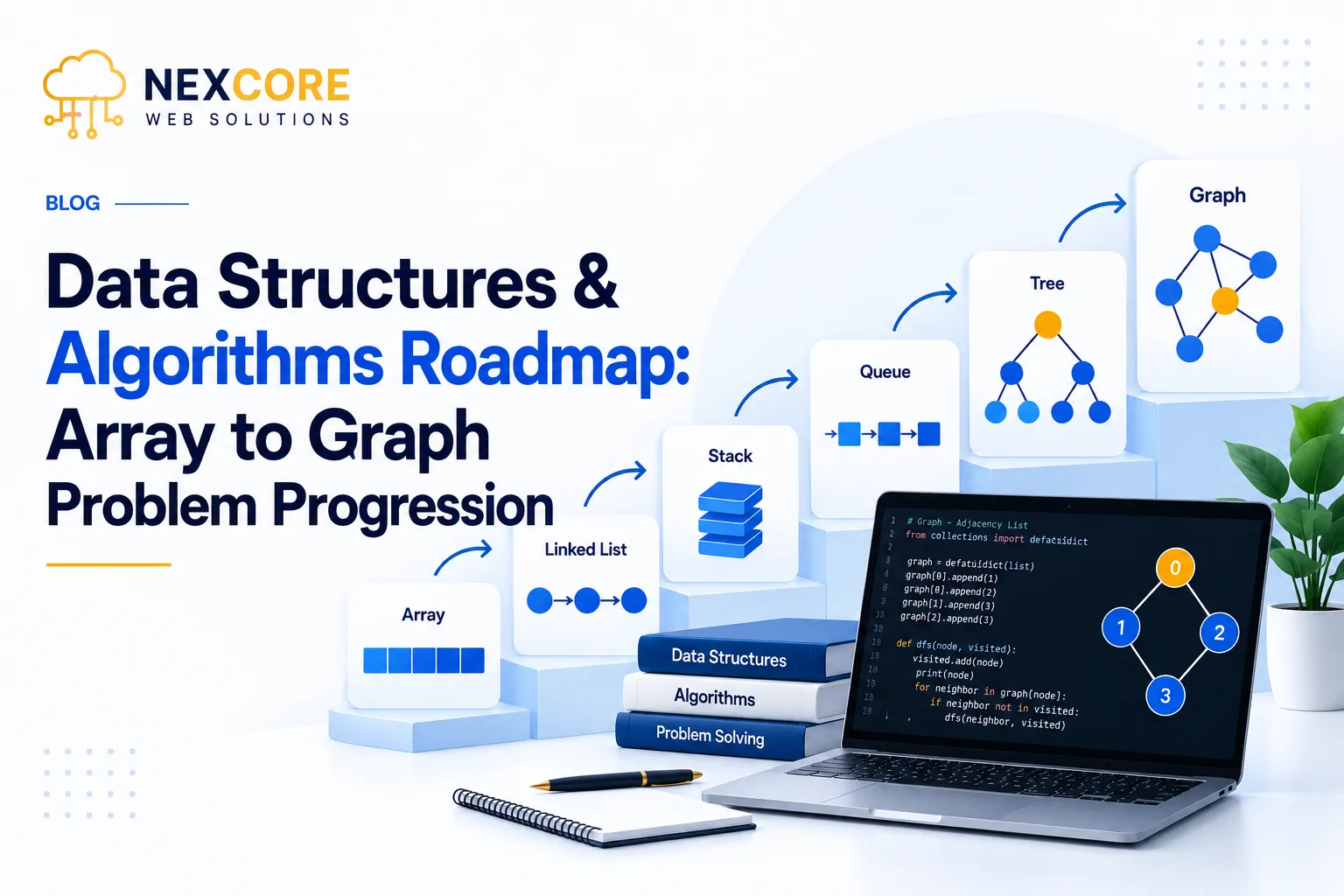
Learning Data Structures and Algorithms (DSA) is not about memorizing hundreds of solutions. It is about developing a structured way to understand problems, identify patterns, choose appropriate data structures, and build efficient solutions. Many students struggle because they jump directly into advanced topics such as graphs, dynamic programming, or complex recursion without mastering the foundations. A progressive roadmap makes the learning process easier by introducing concepts in an order where each topic supports the next one. Starting with arrays and gradually moving through strings, linked lists, stacks, queues, trees, heaps, and graphs creates a strong problem-solving foundation. This progression is useful for coding interviews, competitive programming, college assessments, and practical software development because it builds both algorithmic thinking and implementation confidence.
Start With Arrays and Basic Problem Solving
Arrays should be the first major topic because they introduce indexing, iteration, searching, sorting, and memory organization. Begin with simple operations such as finding maximum and minimum values, reversing arrays, calculating frequencies, removing duplicates, and checking whether elements satisfy a condition. Once these problems become comfortable, move toward techniques such as two pointers, sliding windows, prefix sums, and binary search. These patterns appear repeatedly in interview questions and provide the foundation for solving more complicated problems efficiently.
Build Pattern Recognition
The goal at this stage is not simply to solve individual questions but to recognize recurring approaches. For example, a nested loop may produce an O(n²) solution, while a frequency map or two-pointer technique can often reduce the work to O(n). Students should practice explaining why an algorithm works and what its time and space complexity are. This habit becomes increasingly important when problems involve larger inputs.
Move to Strings and Hashing
Strings introduce many of the same ideas as arrays while adding character-specific operations. Practice palindrome checks, character frequency counting, anagram detection, substring processing, and pattern comparisons. Hashing becomes especially useful here because hash maps and sets allow efficient lookup, counting, and duplicate detection. Problems such as finding the first non-repeating character or identifying repeated elements can teach how additional memory can reduce computational time.
Hashing also introduces an important problem-solving trade-off. A developer may choose to store information in a map to avoid repeatedly scanning an array. This often changes an O(n²) approach into O(n), although it requires additional space. Understanding these trade-offs prepares students for more advanced algorithmic decisions.
Learn Linked Lists, Stacks, and Queues
Linked lists teach a different way of organizing data because elements are connected through references rather than stored in contiguous positions. Learn traversal, insertion, deletion, reversing a linked list, finding the middle node, and detecting cycles. These problems strengthen pointer manipulation and help students understand references, which are important in many other data structures.
Stacks and queues introduce controlled access patterns. A stack follows Last In, First Out behavior and is useful for parentheses validation, expression processing, recursion simulation, and backtracking. A queue follows First In, First Out behavior and appears in scheduling, buffering, and breadth-first traversal. Understanding these structures makes the transition toward trees and graphs much easier.
Progress to Trees and Binary Search Trees
Trees are a major step because they introduce hierarchical relationships. Start with binary trees and learn recursive traversals including preorder, inorder, and postorder. Then practice level-order traversal using a queue, followed by problems involving tree height, node counting, path calculations, and structural comparisons. Recursion becomes particularly important because many tree problems naturally divide into smaller left and right subproblems.
Binary Search Trees
After basic binary trees, study Binary Search Trees (BSTs), where values follow an ordering property. Practice searching, insertion, deletion, finding minimum and maximum values, and validating whether a tree satisfies BST rules. These exercises connect tree structure with efficient searching and reinforce recursion. Once comfortable, students can explore balanced trees conceptually to understand why tree height affects operation complexity.
Add Heaps and Priority Queues
Heaps are useful when a problem repeatedly requires the smallest or largest available element. Learn the difference between min-heaps and max-heaps and understand how priority queues use this structure. Common problems include finding the kth largest element, merging sorted sequences, scheduling tasks, and maintaining running minimum or maximum values.
Heap problems also encourage students to think beyond complete sorting. If only the top few elements are needed, maintaining a heap can sometimes be more efficient than sorting an entire dataset. This introduces another important algorithmic skill: selecting a data structure based on the exact operation the problem requires.
Reach Graphs and Traversal Algorithms
Graphs represent relationships between objects and are among the most important advanced DSA topics. Before solving complex graph problems, understand vertices, edges, directed and undirected graphs, weighted graphs, adjacency lists, and adjacency matrices. Then master Breadth-First Search (BFS) and Depth-First Search (DFS), because these traversals form the foundation for many graph algorithms.
BFS is commonly implemented with a queue and is useful for shortest paths in unweighted graphs, level-based exploration, and connectivity problems. DFS can be implemented recursively or with a stack and is useful for exploring components, detecting certain cycles, and solving traversal-based problems. Practice converting real-world scenarios such as social connections, routes, and dependency relationships into graph representations.
Build Toward Advanced Graph Problems
After BFS and DFS, progress to topics such as cycle detection, topological sorting, shortest-path algorithms, minimum spanning trees, and disjoint-set union. Algorithms such as Dijkstra’s algorithm become easier to understand once priority queues and graph traversal are already familiar. Similarly, topological sorting becomes more intuitive after understanding directed graphs and dependency relationships.
Do not rush into advanced graph problems simply because they appear frequently in interviews. Solve several variations of each fundamental pattern and learn to identify which representation and traversal the problem requires. The objective is to build transferable reasoning rather than memorize implementation templates.
Practice Through Progressive Problem Solving
A good DSA roadmap should combine learning with deliberate practice. After completing each topic, solve problems in increasing difficulty rather than immediately attempting the hardest questions. Keep track of mistakes, especially incorrect complexity analysis, missed edge cases, and inefficient approaches. Revisiting previously solved problems after several days is also useful because it tests whether the underlying pattern has actually been understood.
Conclusion
A structured DSA progression from arrays to graphs creates a practical foundation for solving increasingly difficult programming problems. Arrays establish basic iteration and optimization patterns, while strings and hashing develop efficient lookup techniques. Linked lists, stacks, and queues strengthen reference handling and controlled data access, followed by trees and heaps for hierarchical and priority-based problems. Graphs then bring these concepts together through traversal, connectivity, and optimization algorithms. The most effective approach is consistent practice combined with complexity analysis and pattern recognition. Instead of measuring progress by the number of problems completed, focus on whether you can explain the approach, identify alternatives, handle edge cases, and independently apply the same concept to an unfamiliar problem.
FAQs
1. What should I learn first in DSA?
Arrays are a practical starting point because they teach fundamental concepts such as indexing, traversal, searching, sorting, and complexity analysis. After arrays, learners can progress to strings, hashing, linked lists, stacks, and queues. This sequence gradually introduces new problem-solving techniques while reinforcing previously learned concepts. Once these foundations are comfortable, trees, heaps, and graphs become easier to approach.
2. How long does it take to learn DSA?
The learning time depends on previous programming experience, daily practice, and the depth of problems being studied. A beginner may need several months of consistent practice to become comfortable with core topics. Studying for one or two focused hours each day can provide steady progress. Solving problems regularly and reviewing mistakes is generally more useful than completing large numbers of questions without understanding them.
3. Should I learn graphs before dynamic programming?
Most learners benefit from developing strong fundamentals before moving deeply into dynamic programming. Arrays, recursion, hashing, trees, and graph traversal can provide useful problem-solving experience that transfers to DP. However, there is no strict requirement that every learner follow exactly the same order. A roadmap should prioritize prerequisite concepts while allowing practice to adapt to individual strengths and weaknesses.
4. How many DSA problems should I solve?
There is no universal number of problems that guarantees proficiency. A smaller collection of carefully selected problems can be more valuable when each solution is understood, optimized, and revisited. Focus on covering different patterns such as two pointers, sliding windows, recursion, binary search, BFS, and DFS. As your understanding improves, gradually increase problem difficulty and work on unfamiliar variations.
5. Why is time complexity important in DSA?
Time complexity helps developers understand how an algorithm’s execution cost changes as the input becomes larger. Two solutions may produce the same result while having very different performance characteristics. For example, replacing repeated linear searches with hashing can significantly reduce the amount of work required. Learning complexity analysis helps programmers select practical algorithms and recognize when a seemingly correct solution will not scale.




