
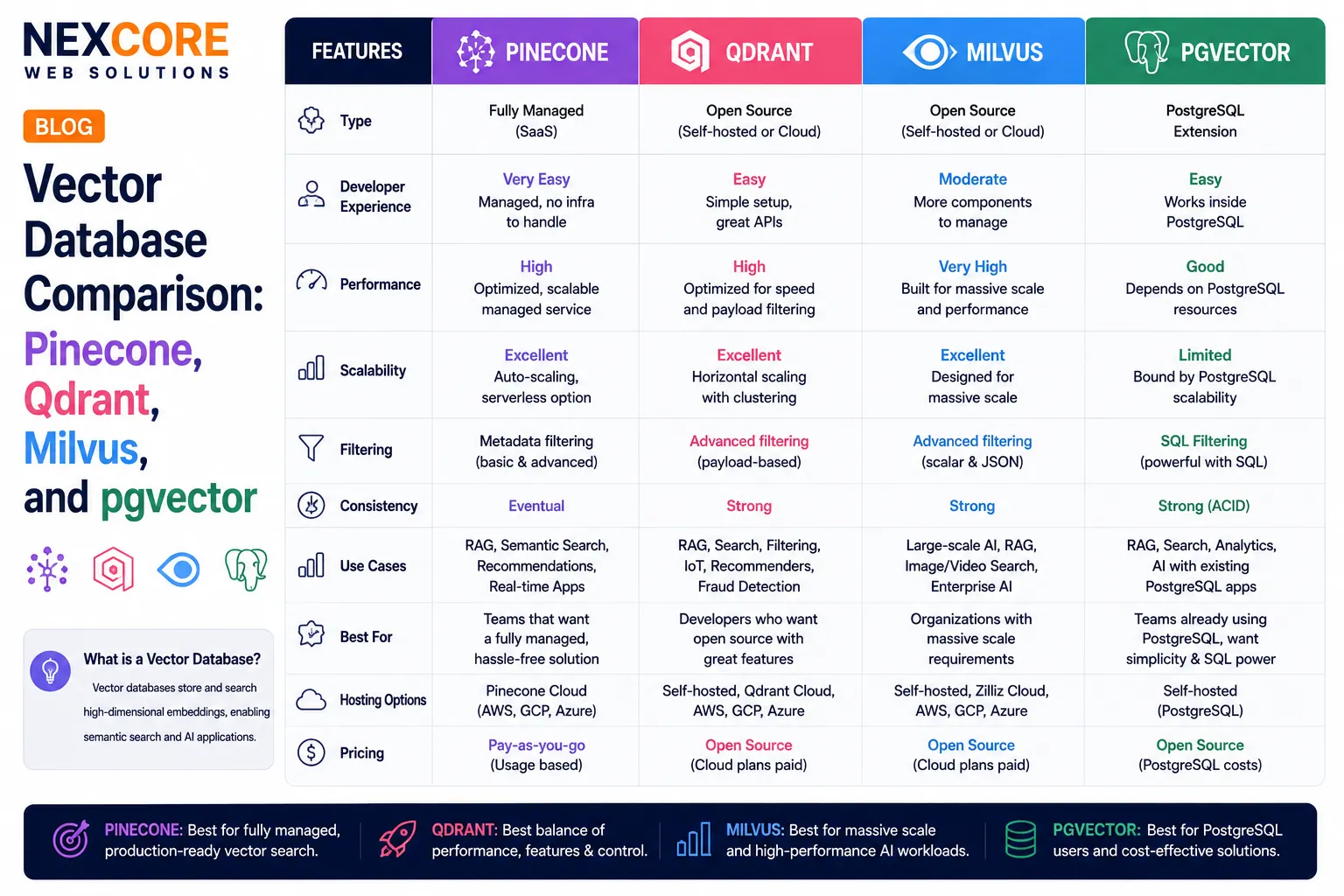
Vector databases have become an important part of modern AI applications because they allow systems to search information based on semantic similarity rather than exact keywords. They are commonly used for retrieval-augmented generation, recommendation systems, image search, document discovery, and personalization. However, choosing a vector database can be difficult because different platforms make different trade-offs around deployment, scalability, filtering, operational complexity, and integration. Pinecone, Qdrant, Milvus, and pgvector are four widely used options, but they target somewhat different architectural needs. Pinecone is strongly oriented toward managed vector infrastructure, while Qdrant and Milvus provide dedicated vector-search capabilities with deployment flexibility. pgvector takes another approach by bringing vector search directly into PostgreSQL. Understanding these differences helps engineering teams choose technology based on workload requirements instead of popularity alone.
What Makes a Vector Database Different?
A vector database stores numerical representations called embeddings and provides mechanisms for finding vectors that are similar to a query vector. Similarity can be calculated using metrics such as cosine similarity, Euclidean distance, or inner product. Traditional databases primarily excel at exact lookups and structured relationships, while vector systems are designed for approximate nearest-neighbor searches across high-dimensional data. Many applications also require metadata filtering so that semantic search can be combined with business rules.
Important Selection Criteria
When comparing vector databases, consider indexing performance, query latency, filtering capabilities, durability, scaling behavior, deployment options, monitoring, backup strategy, and ecosystem support. Cost also matters because storage and query volume can grow rapidly in AI applications. The best database for a prototype may not be the best choice for a large production platform. Teams should benchmark representative embeddings, query patterns, metadata filters, and concurrency levels before making a long-term decision.
Pinecone
Pinecone is a managed vector database designed to simplify the deployment and operation of vector search infrastructure. Because the service is managed, teams do not need to operate database servers, configure clusters manually, or manage many infrastructure tasks themselves. This can be attractive for organizations that want to move quickly from an AI prototype to production. Pinecone is particularly relevant for retrieval systems where vector search is a core infrastructure requirement.
Strengths and Trade-Offs
Pinecone’s managed model can reduce operational overhead and make scaling easier for teams without dedicated database infrastructure expertise. Its trade-off is reduced control compared with running an open-source system yourself. Pricing also needs to be evaluated against expected storage, query volume, and scaling patterns. For teams prioritizing operational simplicity, managed infrastructure can be worth the additional service cost.
Qdrant
Qdrant is an open-source vector database focused on similarity search and efficient metadata filtering. It supports self-hosted deployments as well as managed options, giving teams flexibility over infrastructure. Its data model is well suited to applications where vectors need to be associated with structured payload information. This makes Qdrant useful for recommendation systems, semantic search, and RAG applications that frequently combine vector similarity with filters.
Where Qdrant Fits
Qdrant is a strong option when developers want a dedicated vector engine without giving up the ability to control deployment. Teams can run it in their own infrastructure or use a managed service depending on operational requirements. Its filtering capabilities are particularly useful when retrieval needs conditions such as tenant ID, document category, language, permissions, or timestamps.
Milvus
Milvus is an open-source vector database designed for large-scale similarity search. It is particularly relevant for organizations expecting substantial vector collections and demanding search workloads. Milvus uses a distributed architecture and supports multiple indexing approaches, making it suitable for systems where scale and performance are major considerations. The trade-off is greater operational complexity compared with simpler deployments.
Milvus for Large Workloads
Organizations with large datasets may choose Milvus when they need distributed infrastructure and extensive control over vector indexing. Its architecture can support workloads that would be unnecessarily complex for a small application. However, running a distributed database introduces responsibilities around cluster management, capacity planning, monitoring, upgrades, and failure recovery. Teams should evaluate whether that operational burden matches their actual requirements.
pgvector
pgvector extends PostgreSQL with vector data types and similarity-search capabilities. Its biggest advantage is architectural simplicity for teams that already use PostgreSQL. Instead of introducing a separate vector database, developers can keep relational records, metadata, application data, and embeddings within the same database system. This can simplify transactions, permissions, backups, and application development.
When pgvector Makes Sense
pgvector is particularly attractive when vector search is an important feature but not the entire database workload. For example, an application may store customers, documents, permissions, and embeddings together while using SQL to combine structured filtering with similarity search. The main limitation is that PostgreSQL-based vector workloads may require careful indexing and capacity planning as the dataset and query volume grow. At very large specialized workloads, a dedicated vector architecture may offer more flexibility.
Comparison at a Glance
| Feature | Pinecone | Qdrant | Milvus | pgvector |
|---|---|---|---|---|
| Deployment | Managed | Self-hosted/managed | Self-hosted/managed | PostgreSQL |
| Vector specialization | High | High | High | Moderate |
| SQL integration | Limited | No | No | Excellent |
| Operational simplicity | High | Moderate | Lower | High if using PostgreSQL |
| Large-scale focus | Strong | Strong | Very strong | Workload dependent |
| Best fit | Managed AI search | Flexible vector workloads | Large distributed systems | PostgreSQL applications |
This table is a general architectural comparison rather than a performance benchmark. Actual results depend heavily on vector dimensions, index configuration, hardware, filters, query concurrency, and dataset size.
RAG and Metadata Filtering
RAG applications often retrieve documents using both semantic similarity and metadata constraints. A support application, for example, may need to search only documents belonging to a specific customer or permission group. Qdrant, Milvus, Pinecone, and pgvector can all participate in architectures where metadata influences retrieval, but implementation details differ. Teams should benchmark filtered searches rather than testing only pure nearest-neighbor queries.
Cost and Operational Complexity
Managed services can reduce engineering effort but introduce ongoing platform costs. Self-hosted systems may provide greater infrastructure control but require engineers to handle upgrades, backups, monitoring, scaling, and incident response. pgvector can be economically attractive when an organization already operates PostgreSQL and does not want another database layer. The correct cost comparison should include engineering time, infrastructure, storage, query volume, and operational responsibilities.
Choosing the Right Vector Database
Pinecone is compelling when managed infrastructure and operational simplicity are priorities. Qdrant fits teams wanting a focused vector database with flexible deployment and strong filtering capabilities. Milvus is worth considering for large-scale distributed vector workloads where infrastructure control is important. pgvector is especially attractive when PostgreSQL is already central to the application’s architecture and vector search can remain within that ecosystem.
Conclusion
There is no universally best vector database among Pinecone, Qdrant, Milvus, and pgvector. Each represents a different architectural trade-off between managed convenience, dedicated vector capabilities, distributed scalability, and integration with existing relational infrastructure. Pinecone can reduce operational work, Qdrant offers flexible dedicated vector search, Milvus targets demanding large-scale deployments, and pgvector provides an efficient way to combine semantic search with PostgreSQL data. The best choice should come from realistic benchmarks using the application’s actual embeddings, filters, concurrency, and data volume. Starting with the simplest architecture that satisfies current requirements can also prevent unnecessary operational complexity while leaving room for future growth.
FAQs
1. Which is better, Pinecone or pgvector?
The choice depends on the application architecture. Pinecone is designed specifically as managed vector infrastructure and can reduce operational responsibilities. pgvector is attractive when PostgreSQL already stores the application’s primary data and vector search does not justify another database system. For smaller or moderately sized applications with strong SQL requirements, pgvector can be convenient. For specialized vector workloads, a managed vector service may provide more focused capabilities.
2. Is Qdrant suitable for RAG applications?
Yes, Qdrant can be used effectively for retrieval-augmented generation systems. RAG applications commonly need vector similarity search combined with metadata filtering, and Qdrant is designed around these types of workloads. It can store embeddings alongside associated payload data and retrieve relevant records based on similarity and conditions. Developers should still benchmark retrieval quality and latency using their actual document sizes, embedding model, filters, and concurrency.
3. When should I use Milvus?
Milvus is worth considering when an application requires large-scale vector search and a distributed architecture is justified. It provides dedicated infrastructure for vector workloads and supports multiple indexing approaches. However, operating a distributed system introduces additional responsibilities, including cluster management, monitoring, scaling, and recovery. Teams should choose Milvus when the expected workload benefits from that capability rather than adding complexity before it is necessary.
4. Can pgvector replace a dedicated vector database?
For many applications, pgvector can provide sufficient vector-search functionality without introducing a separate database. It is particularly useful when structured application data and embeddings need to be queried together using PostgreSQL. However, dedicated vector systems may be more appropriate for extremely large or specialized workloads. The decision should be based on actual performance, scale, filtering requirements, operational constraints, and expected growth.
5. How should I benchmark vector databases?
Use representative embeddings, realistic dataset sizes, expected query concurrency, and the metadata filters used by the application. Measure search latency at p50, p95, and p99 levels, throughput, indexing time, memory consumption, storage requirements, and filtered-search performance. Test both warm and cold conditions where relevant. Cost and operational effort should also be evaluated because raw query speed alone does not determine the best production choice.




