
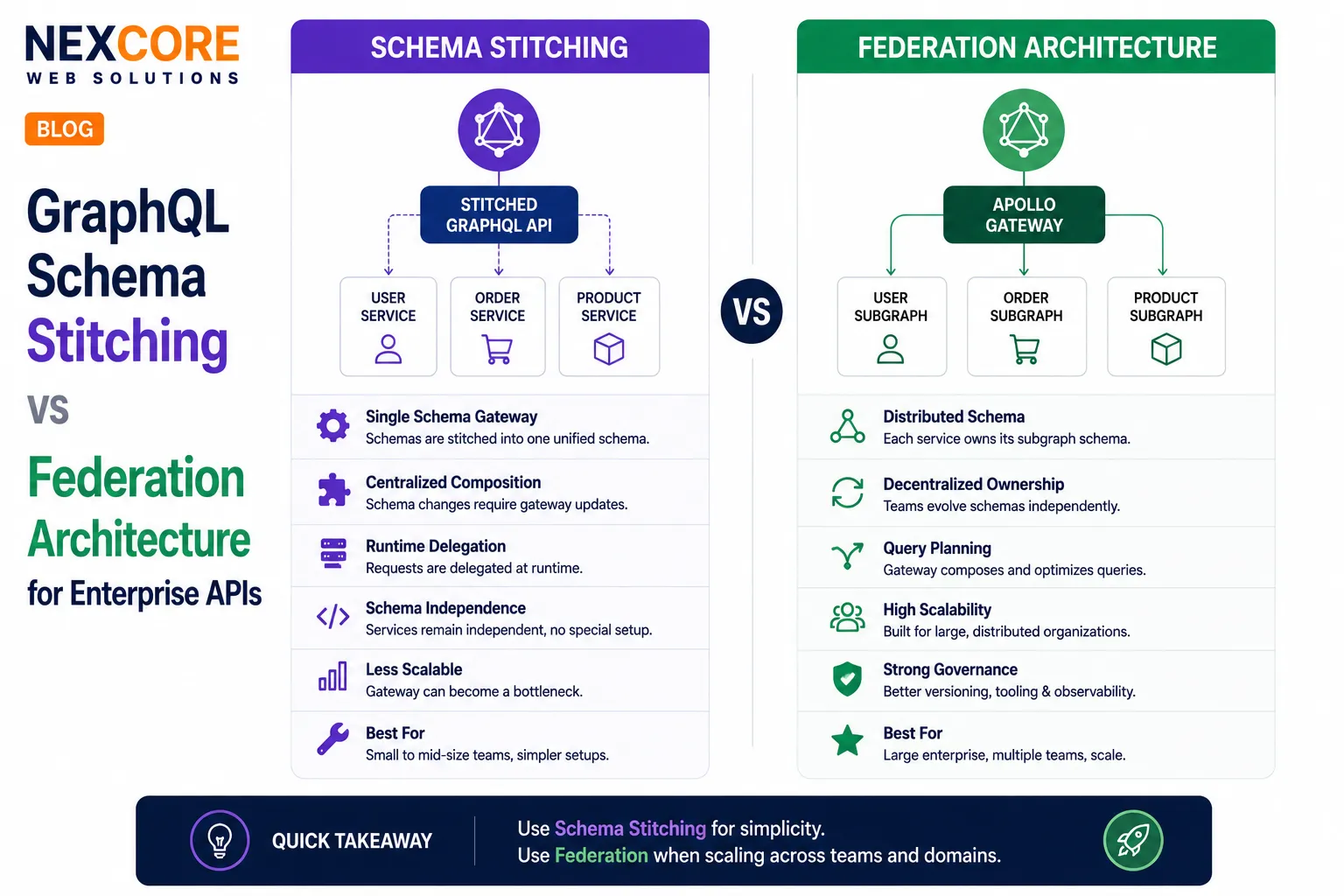
Enterprise applications rarely depend on a single backend service. Large organizations often have separate systems for customers, payments, products, orders, identity, analytics, and internal operations, each owned by different teams. GraphQL can provide a unified API experience over these distributed systems, but the architecture used to combine schemas has a major impact on ownership, deployment, governance, and long-term maintenance. Two important approaches are schema stitching and federation. Schema stitching combines multiple GraphQL schemas into a unified schema through a gateway or composition layer, while federation allows independently owned services to contribute to a shared graph using federation-specific conventions. Both can solve API composition problems, but they encourage different organizational and technical models. Choosing correctly requires understanding how each approach behaves as an enterprise platform grows.
What Is GraphQL Schema Stitching?
Schema stitching combines schemas from multiple GraphQL services into a single executable schema. A gateway or composition service retrieves the individual schemas and combines them according to configured rules. It can also transform types, merge fields, and connect related data across services. This approach gives the gateway significant control over how the final API appears to clients.
How Stitching Works
Suppose an organization has separate customer and order services. The customer service might expose customer information, while the order service owns order records. The gateway can stitch these schemas together and create relationships that allow clients to request customer and order information through one GraphQL endpoint. The gateway becomes responsible for understanding how those services fit together.
Stitching can be particularly useful when existing GraphQL APIs were developed independently. Teams do not necessarily need to redesign every service around a federation model before combining them. Instead, the composition layer can provide transformations and integration logic around the existing schemas.
What Is GraphQL Federation?
Federation takes a more distributed approach to schema composition. Individual services, commonly called subgraphs, own portions of a larger graph and expose metadata describing how their types and relationships participate in that graph. A gateway or router composes these subgraphs into a unified API. Instead of centralizing most integration logic in the gateway, federation encourages domain teams to own their graph responsibilities.
Domain Ownership
Consider a company with product, customer, and review domains. The product team can own product-related fields, while the review team owns review information associated with products. Federation allows those teams to contribute to the overall graph without requiring one central team to manually define every relationship. This model can improve organizational scalability when many independent teams are responsible for different business capabilities.
Schema Stitching vs Federation
The biggest architectural distinction is where composition knowledge lives. With stitching, the gateway often contains significant configuration describing how schemas should be merged and connected. Federation distributes more of that knowledge into the participating services through federation conventions. This difference affects team autonomy, gateway complexity, schema governance, and deployment workflows.
| Feature | Schema Stitching | Federation |
|---|---|---|
| Composition model | Centralized integration | Distributed ownership |
| Gateway responsibility | Often higher | More focused on routing |
| Existing schemas | Easy to integrate | May require adaptation |
| Team autonomy | Moderate | High |
| Cross-service relationships | Gateway configuration | Federation metadata |
| Migration flexibility | Strong | Strong with planning |
| Enterprise governance | Centralized | Federated with shared rules |
Neither approach is automatically superior because enterprise environments differ significantly in team structure and technical maturity.
When Schema Stitching Makes Sense
Schema stitching is attractive when an organization already operates multiple GraphQL APIs that were not designed as one federated graph. It can also be useful during gradual modernization, where teams need to combine legacy and modern services without immediately changing service contracts. Centralized composition gives platform teams strong control over naming, transformations, and integration behavior. This can be valuable when governance requirements are strict or when domain teams have limited GraphQL expertise.
Stitching Challenges
The central gateway can become complicated as more services and relationships are added. Integration rules may accumulate in one place, making the gateway difficult to understand and test. A change in one underlying schema can also require coordination with centralized stitching configuration. Without strong ownership and automated validation, the gateway can become a bottleneck for development.
When Federation Makes Sense
Federation is well suited to organizations where independent domain teams need to evolve their APIs without relying on one central schema team for every change. Each team can own its subgraph and deploy it according to its own release cycle. This model aligns GraphQL architecture with domain-driven organizational structures. It can also reduce the amount of custom composition logic that must live in a central gateway.
Federation Challenges
Federation introduces its own learning curve because teams must understand entity relationships, ownership boundaries, composition rules, and federation-specific schema conventions. Poorly defined domain boundaries can create complicated cross-service dependencies. Teams also need strong governance around naming, ownership, security, deprecation, and schema compatibility. Federation decentralizes responsibility, but it does not eliminate the need for platform standards.
Performance and Query Planning
Both architectures can introduce additional network calls because a single GraphQL query may require data from several backend services. Federation commonly uses a query planner to determine how a client operation should be distributed across subgraphs. Stitching gateways also need to coordinate execution across underlying schemas. Performance depends heavily on network latency, resolver implementation, batching, caching, and the number of services involved rather than simply on the composition technology.
Avoiding Excessive Fan-Out
Enterprise GraphQL systems should monitor query fan-out carefully. A seemingly simple client query can trigger many backend requests if relationships are poorly designed. Techniques such as batching, caching, persisted queries, and carefully designed entity boundaries can reduce unnecessary traffic. Query complexity limits and timeouts can also protect backend services from unexpectedly expensive operations.
Governance and Security
Enterprise GraphQL architecture requires consistent governance regardless of the chosen model. Teams should establish rules for authentication, authorization, field ownership, naming, deprecation, documentation, rate limiting, and observability. Centralized stitching may simplify some governance responsibilities because the gateway controls much of the final schema. Federation distributes ownership but requires stronger organizational coordination to prevent conflicting design decisions.
Migration Strategy
Organizations do not necessarily need to choose a single approach permanently. A practical migration can begin with schema stitching around existing services and gradually introduce federation principles as domain ownership becomes clearer. Teams can first identify business boundaries, standardize schema conventions, and establish automated composition checks. This reduces the risk of attempting a large-scale GraphQL migration without understanding service dependencies.
Choosing the Right Architecture
Schema stitching is often a practical choice when integration flexibility and centralized control are the primary requirements. Federation becomes more compelling when multiple mature teams need independent ownership of a shared enterprise graph. The decision should consider organizational structure as much as technical requirements. If one platform team controls most APIs, stitching may be easier to operate, while a large organization with autonomous domain teams may benefit more from federation.
Conclusion
GraphQL schema stitching and federation both provide ways to expose multiple backend services through a unified API, but their architectural philosophies differ. Stitching places more integration responsibility in a central composition layer, making it flexible for existing and heterogeneous GraphQL services. Federation distributes schema ownership across domain teams and can scale better organizationally when many teams independently develop services. Neither approach should be selected purely because it is technically fashionable. Enterprise teams should evaluate ownership, existing APIs, governance, deployment independence, query performance, and operational maturity. Starting with clear domain boundaries and automated schema validation is often more important than the specific composition model. A well-governed architecture can make either approach successful.
FAQs
1. What is the main difference between GraphQL stitching and federation?
Schema stitching generally places more responsibility for combining schemas and relationships in a centralized gateway. Federation distributes ownership across independently managed subgraphs that contribute to a shared graph. Stitching can be convenient when existing GraphQL services need to be integrated without major redesign. Federation is often better suited to organizations where multiple domain teams need independent control over their API areas.
2. Is GraphQL federation better for large enterprises?
Federation can be a strong fit for large enterprises because it supports distributed ownership across domain teams. Teams can develop and deploy their subgraphs independently while contributing to a unified API. However, federation also requires strong governance, clear ownership boundaries, automated schema checks, and platform expertise. Without those practices, a federated graph can become difficult to manage despite its decentralized architecture.
3. When should a company use schema stitching?
Schema stitching is useful when an organization already has several independent GraphQL schemas or needs to integrate legacy services gradually. It provides a central layer where teams can define transformations and relationships without immediately redesigning backend APIs. Stitching can also be appropriate when one platform team manages the API gateway and needs centralized control over the final GraphQL schema.
4. Does federation improve GraphQL performance?
Federation does not automatically make GraphQL queries faster. A federated query may still require requests to several backend services, and network communication can become a significant part of total latency. Query planning, batching, caching, efficient resolvers, and sensible entity boundaries are important for performance. Organizations should benchmark real queries and monitor fan-out rather than assuming federation alone provides a performance advantage.
5. Can an enterprise migrate from stitching to federation?
Yes, migration can be performed incrementally when the architecture is planned carefully. Teams can identify domain boundaries, establish ownership, standardize schemas, and gradually move appropriate services into independently managed subgraphs. Existing stitching infrastructure can sometimes remain during the transition. Automated composition checks and compatibility testing are especially important because they help identify conflicts before changes reach production.




