
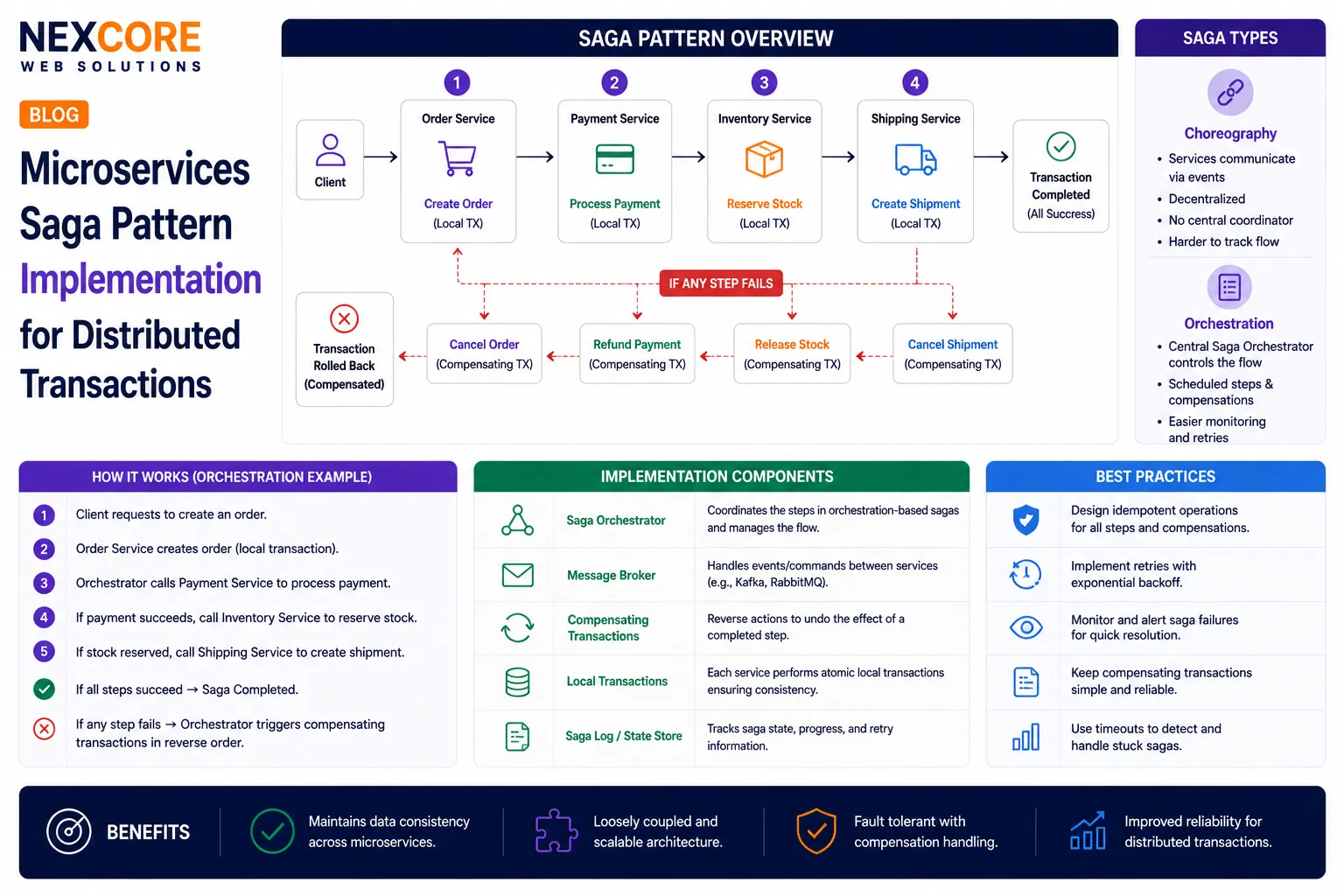
Microservices make applications easier to scale and deploy independently, but they also make distributed transactions harder to manage. One business operation may require several services to update separate databases while remaining independently owned. Traditional database transactions usually cannot span these boundaries without creating tight coupling. The Saga pattern addresses this challenge by dividing a distributed transaction into local transactions connected through commands or events. When a later step fails, compensating actions correct the business effects of earlier steps. This approach builds resilient workflows while preserving microservice independence.
Understanding the Saga Pattern
A Saga is a sequence of local transactions, with each service committing changes in its own database. Consider an online order that creates an order, reserves inventory, authorizes payment, and schedules shipping. Each successful step triggers the next, while a failure starts compensation for completed work. If payment fails after stock is reserved, the system can release that stock and mark the order as unsuccessful. Saga therefore provides business-level consistency instead of the immediate atomicity associated with one ACID transaction.
Choreography and Orchestration
Saga implementations generally use choreography or orchestration. Choreography relies on services publishing events and reacting to them, while orchestration uses a dedicated coordinator to control the workflow. Choreography can suit short processes, but complex workflows may become difficult to trace because the logic is spread across many services. Orchestration often provides clearer control, especially when a transaction has many dependent steps and compensation rules.
Implementing a Reliable Saga
Start by mapping every local transaction, dependency, failure condition, and compensation before choosing a framework. An order Saga might create an order, reserve stock, authorize payment, and arrange delivery, with compensation releasing stock when payment fails. Not every action can be perfectly reversed, particularly when external systems or physical processes are involved, so some failures require refunds, cancellations, or manual review. Each step should also be idempotent because duplicate messages and retries are normal in distributed systems, and unique transaction IDs or idempotency keys can prevent repeated business effects.
State, Messaging, and Recovery
A Saga needs durable state so it can survive crashes, deployments, and service restarts. An orchestrator may store the workflow ID, current step, completed actions, pending commands, and compensation status, while event-driven systems need reliable message delivery. The transactional outbox pattern can help ensure that a database change and its outgoing event are stored reliably before publication. Teams should also define retry limits, backoff, timeout policies, and recovery procedures because compensation itself can fail.
Handling Distributed Failures
Timeouts are especially challenging because an operation may succeed even when its response never reaches the requesting service. A payment provider could complete a transaction while the application believes it timed out, making a blind retry potentially dangerous. Correlation IDs, idempotency, status checks, and reconciliation processes can help establish the real outcome, while compensation can move the workflow toward a valid business state. Compensation should not be treated as a database rollback because audit records may need to remain intact and some actions cannot be undone literally.
Observability and Testing
A production Saga needs strong observability because one transaction can cross several services and message queues. Correlation IDs should connect logs, traces, events, and workflow records, while metrics can track workflow duration, failed steps, retries, compensation frequency, and stuck transactions. Testing should include duplicate messages, delayed events, service crashes, dependency failures, timeouts, and failed compensations instead of testing only successful scenarios. Integration testing and controlled fault injection are particularly useful for finding problems at service boundaries.
Conclusion
The Saga pattern provides a practical way to manage distributed transactions while preserving microservice independence. It replaces a global transaction with local commits, reliable communication, and compensating business actions. A dependable implementation requires idempotency, durable state, clear failure handling, observability, and recovery procedures. Teams should remember that compensation is not always a perfect rollback, particularly when external systems or irreversible actions are involved. The strongest approach is to model the business workflow first, define failure paths explicitly, and test partial failures before production. Saga can make complex distributed workflows more resilient and manageable.
FAQs
What is the Saga pattern in microservices?
The Saga pattern divides a distributed business transaction into local transactions owned by individual services. Each successful step starts another step, while a failure triggers compensation for completed work. This avoids a global database transaction and keeps services independent. The trade-off is eventual consistency and additional workflow logic.
When should a microservices system use Saga?
Saga is useful when one business operation crosses several independently owned services and cannot use one database transaction. Common examples include orders, payments, inventory, reservations, and fulfillment. It should not be introduced automatically for every workflow. If the operation can remain inside one service and database, a local transaction is usually simpler and easier to maintain.
What is the difference between choreography and orchestration?
Choreography coordinates a Saga through events, with services reacting to events published by other services. It can be lightweight for simple workflows but may become difficult to understand as dependencies increase. Orchestration uses a coordinator to manage the sequence and compensations. It often provides better visibility for complex workflows, while choreography can suit smaller processes.
Why is idempotency important in Saga implementation?
Idempotency prevents retries or duplicate messages from producing unintended business effects. A payment service should recognize an already processed request instead of charging the customer again. Transaction IDs, command IDs, and idempotency keys are common ways to provide protection. It is especially important for financial, inventory, booking, and reservation operations.
Can Saga provide the same consistency as an ACID transaction?
No, Saga normally does not provide the same immediate atomic consistency as a single ACID transaction. Each service commits locally, so intermediate states can temporarily exist across the system. The workflow eventually reaches a consistent business state through completion or compensation. If strict atomicity is mandatory within one database boundary, a conventional transaction may be better.




