
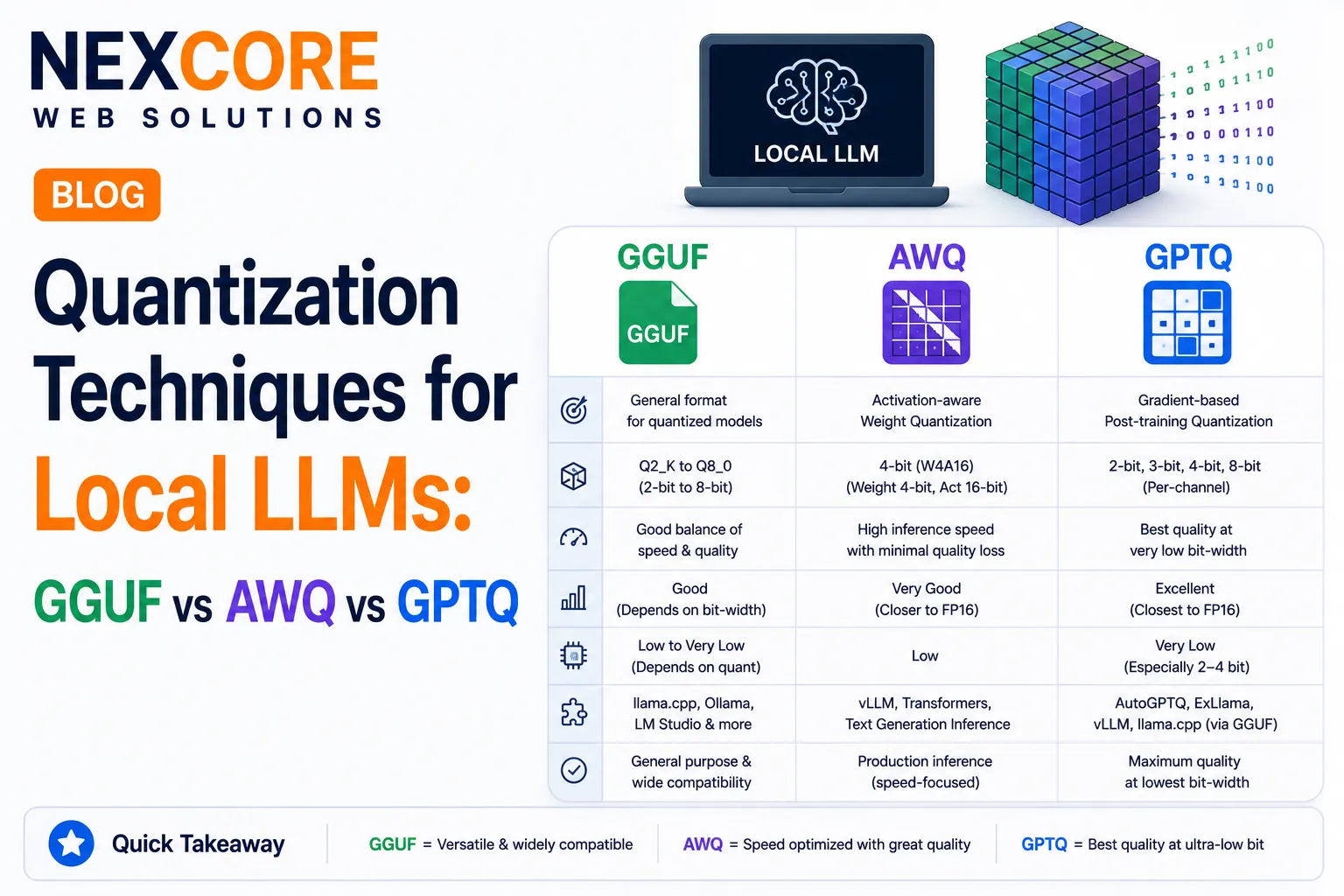
Running large language models locally can provide better privacy, lower recurring costs, and more control over data and infrastructure, but model size remains a practical limitation. A model containing billions of parameters can require substantial RAM or VRAM, making full-precision inference difficult on ordinary computers. Quantization reduces the numerical precision used to represent model weights, allowing models to consume less memory and often run faster. Among the most widely encountered formats and methods are GGUF, AWQ, and GPTQ. Although they all aim to make LLM inference more efficient, they are designed around different tools, hardware targets, and quantization approaches. Understanding these differences helps developers choose a model that fits their hardware without unnecessarily sacrificing output quality.
What Is LLM Quantization?
Quantization converts model values from higher-precision numerical representations into smaller formats. For example, a model stored using 16-bit values can often be reduced to 8-bit or 4-bit representations, dramatically lowering memory requirements. The challenge is preserving enough information for the model to generate useful responses after compression. Good quantization therefore balances memory savings, inference performance, and accuracy rather than simply choosing the smallest possible file.
Why Quantization Matters for Local Inference
Memory is frequently the biggest barrier when running LLMs locally. A smaller quantized model may fit into consumer GPUs, laptops, or systems using CPU-based inference, while the original model may require expensive server hardware. Quantization can also reduce memory bandwidth requirements, which can improve generation speed on compatible hardware. However, performance depends heavily on the inference engine, processor, GPU architecture, context length, and quantization configuration.
GGUF: Flexible Local LLM Inference
GGUF is a model file format commonly associated with llama.cpp and applications built around its ecosystem. It supports quantized models and stores model metadata alongside the weights, making distribution and loading more convenient. GGUF is particularly popular for CPU inference and mixed CPU/GPU workloads, which makes it attractive for users running models on desktops and laptops. Quantization levels such as Q4_K_M, Q5_K_M, and Q8_0 provide different trade-offs between file size and quality.
When GGUF Makes Sense
GGUF is often the easiest choice when the goal is straightforward local inference across different hardware configurations. Tools such as desktop LLM applications can load GGUF files without requiring a specialized CUDA-only environment. Users can select a quantization level based on available memory, with moderate 4-bit variants often providing a useful balance. For example, someone with limited RAM may choose a smaller 4-bit model, while a workstation with more memory can use a higher-precision variant for better quality.
AWQ: Efficient Weight-Only Quantization
AWQ, or Activation-aware Weight Quantization, focuses on identifying important weights that should receive greater protection during low-bit compression. Rather than treating every weight equally, AWQ uses activation information to determine which portions of the model are more sensitive to quantization. This approach can maintain strong model quality at low precision while supporting efficient GPU inference. AWQ is commonly used with inference frameworks designed for modern GPU deployment.
AWQ Performance Considerations
AWQ is especially appealing when GPU inference speed and memory efficiency are priorities. A compatible inference engine can take advantage of optimized low-bit kernels, potentially delivering strong throughput while reducing VRAM consumption. However, the benefit depends on hardware and software support, so a quantized model should be benchmarked in the environment where it will actually run. AWQ is generally more attractive for dedicated GPU servers or powerful local GPUs than for simple CPU-only setups.
GPTQ: Post-Training Quantization
GPTQ is a post-training quantization technique designed to compress model weights while attempting to minimize the resulting error. It became widely adopted for generating low-bit versions of transformer models, particularly for GPU-based inference. GPTQ can produce compact 4-bit models that significantly reduce VRAM requirements compared with half-precision weights. Its effectiveness depends on the model, calibration process, quantization settings, and inference software.
Choosing GPTQ
GPTQ can be a strong option when using GPU-focused tools that have mature support for GPTQ models. It is particularly useful when VRAM is constrained and a model needs to fit comfortably on a specific GPU. Developers should compare actual tokens-per-second performance rather than assuming one quantization format is universally faster. Different kernels, GPU generations, batch sizes, and context lengths can produce very different results.
GGUF vs AWQ vs GPTQ
The biggest difference is that GGUF is primarily a flexible model file format used extensively in the llama.cpp ecosystem, while AWQ and GPTQ describe quantization approaches commonly consumed by GPU-oriented inference stacks. GGUF offers broad hardware flexibility and is particularly convenient for CPU or hybrid inference. AWQ emphasizes activation-aware compression and efficient low-bit GPU execution, while GPTQ provides a well-established post-training approach for reducing model weight precision. Therefore, the best option depends more on the intended inference environment than on the format name alone.
How to Choose the Right Quantization
Start with hardware rather than choosing a quantization method based solely on popularity. For CPU-heavy local inference, GGUF is usually the most practical starting point because of its ecosystem and hardware flexibility. For modern GPU inference, AWQ or GPTQ may be preferable when the selected serving framework provides optimized support. Always consider available RAM or VRAM, expected context length, batch size, latency requirements, and whether the application needs maximum throughput.
Conclusion
Quantization makes local LLM deployment considerably more accessible by reducing model memory requirements while retaining much of the original model’s usefulness. GGUF is a practical choice for flexible local inference, especially across CPU and mixed hardware environments. AWQ is compelling for efficient low-bit GPU execution, while GPTQ remains a mature option for post-training model compression and GPU deployment. There is no universally superior format because real-world performance depends on the model, hardware, inference engine, and workload. The most reliable approach is to test representative workloads using several suitable quantizations and compare memory usage, speed, and output quality before making a final choice.
FAQs
Is GGUF better than GPTQ for local LLMs?
GGUF is often better for users who want flexible local inference across CPUs, GPUs, and mixed hardware. It is strongly supported by llama.cpp-based applications and makes model distribution straightforward. GPTQ can be preferable when a compatible GPU inference framework provides optimized kernels. The better choice therefore depends on your hardware, software stack, and whether CPU flexibility or specialized GPU performance matters more.
Which quantization is best for a 4-bit local LLM?
There is no single best 4-bit quantization for every system. GGUF 4-bit variants can work well for CPU and hybrid inference, while AWQ and GPTQ can provide strong results on supported GPUs. Model architecture and quantization implementation also affect quality and speed. Benchmarking the exact model and quantization on your target hardware is more reliable than comparing theoretical specifications.
Does quantization reduce LLM quality?
Quantization can reduce model accuracy because numerical precision is lost during compression, but the impact varies considerably. Well-designed 4-bit methods can preserve surprisingly strong performance for many everyday workloads. Higher-bit quantization generally provides more room for preserving model behavior. The effect should be evaluated using representative prompts, especially when the model is intended for coding, reasoning, multilingual work, or other demanding tasks.
Can I run a quantized LLM without a powerful GPU?
Yes, many quantized LLMs can run effectively without a powerful GPU. GGUF models are particularly popular for CPU-based inference because they work well with llama.cpp and related software. Performance will depend on processor speed, available RAM, model size, context length, and quantization level. A smaller quantized model can therefore make local inference practical on hardware that cannot run the full-precision model.
Should I choose AWQ or GPTQ for GPU inference?
AWQ and GPTQ can both be effective choices for GPU inference, but compatibility should be the first consideration. Check which format your chosen inference engine supports efficiently and whether optimized kernels are available for your GPU. AWQ can offer strong low-bit performance through activation-aware quantization, while GPTQ has broad adoption in GPU-focused ecosystems. Benchmark both when practical before selecting one for production.




