
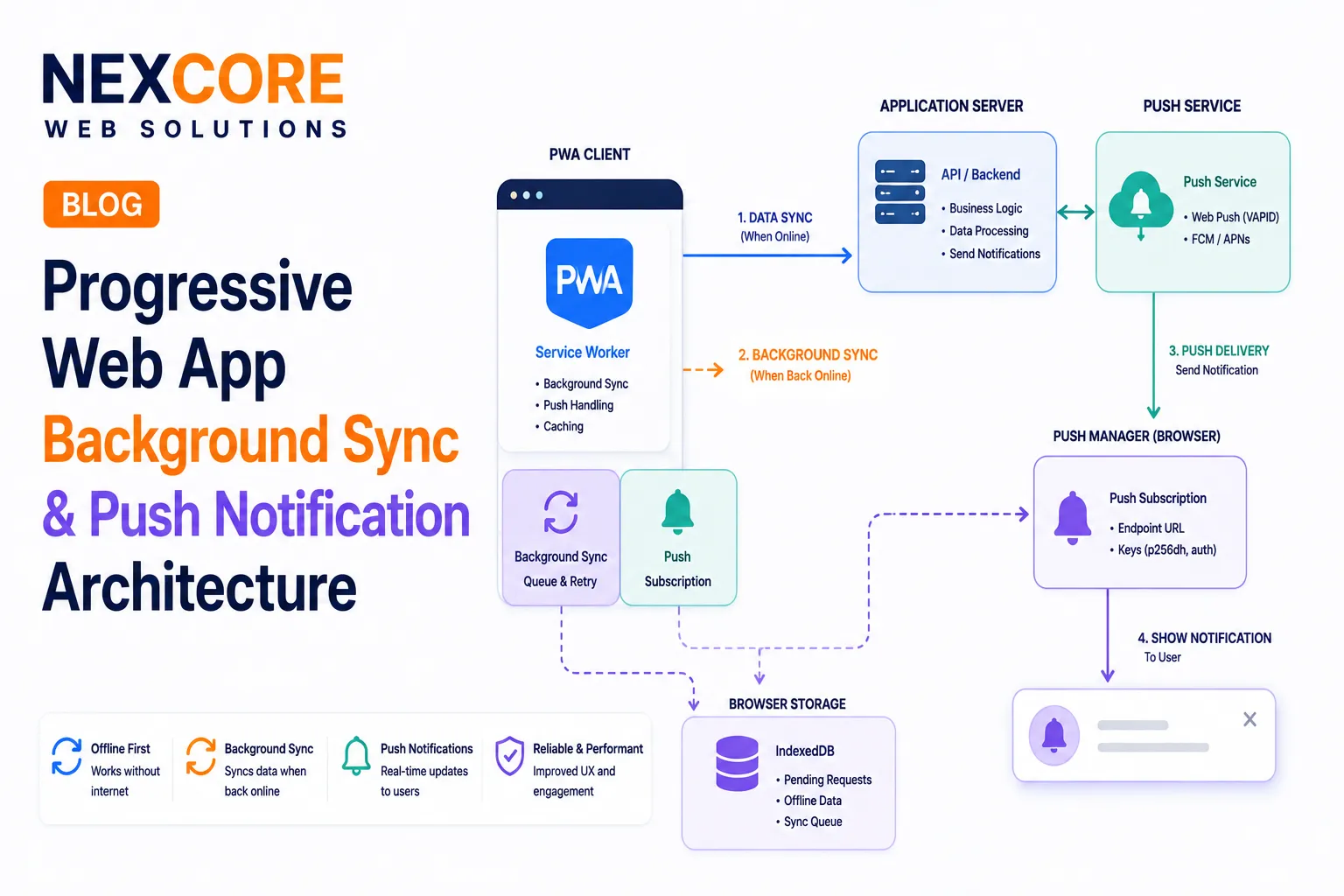
Progressive Web Apps (PWAs) combine the reach of the web with capabilities traditionally associated with native applications. Two features are particularly valuable for reliable user experiences: background synchronization and push notifications. Background sync allows a PWA to defer network-dependent work until connectivity is available, while push notifications let a server communicate with users even when the application is not actively open. Together, they can support offline actions, timely updates, order alerts, reminders, and other asynchronous workflows. Building these features correctly requires more than registering a service worker. Developers must design reliable queues, handle connectivity changes, protect user privacy, and account for browser and operating-system limitations.
Understanding the PWA Architecture
A PWA typically relies on a web app, service worker, browser storage, and backend services working together. The service worker operates separately from the main page and can intercept requests, manage caches, and respond to certain background events. IndexedDB is commonly used when an application needs to store structured offline data or pending operations locally. The backend remains responsible for processing durable business operations, while the service worker acts as an intermediary between the browser and network.
Why Service Workers Matter
The service worker is the central component connecting background functionality with the web application. It can receive push events, display notifications, and coordinate deferred synchronization without requiring the page to remain open. Because service workers can be terminated and restarted by the browser, developers should never rely on in-memory state for important tasks. Persistent storage and repeatable operations are essential when designing reliable background workflows.
Background Sync Architecture
Background Sync allows a PWA to postpone network operations when connectivity is temporarily unavailable. A common example is an offline form submission that is stored locally and transmitted when the browser determines that network access has returned. The application can place the request details into IndexedDB and register a synchronization task with the service worker. When the sync event occurs, the worker retrieves the pending operation and attempts to send it to the backend.
Designing an Offline Queue
A reliable queue should store enough information to safely retry an operation. Useful fields can include a unique operation ID, endpoint, request payload, creation timestamp, retry count, and processing status. The backend should also recognize the operation ID so that repeated delivery does not accidentally create duplicate orders, payments, or records. This idempotency requirement is particularly important because background work may be interrupted or repeated.
Push Notification Architecture
Push notifications use a different flow because they are generally initiated by a backend rather than by an offline action. The browser creates a push subscription containing endpoint and cryptographic information, which the application sends securely to its server. When an event needs to be delivered, the backend sends a push message through the appropriate push service. The browser wakes the service worker, which processes the event and can display a notification.
Push Subscription Management
Subscriptions should be treated as changeable resources rather than permanent user identifiers. Browsers or operating systems may invalidate subscriptions, and users can change notification permissions at any time. The backend should therefore detect failed deliveries and remove obsolete subscription records. Applications should also provide a clear way for users to control notification preferences instead of sending every possible event.
Combining Sync and Push Notifications
Background sync and push notifications become particularly powerful when they are designed as complementary systems. For example, an e-commerce PWA can queue an order-related action while the customer is offline and synchronize it after connectivity returns. Once the backend successfully processes the operation, it can trigger a push notification confirming the result. This creates a complete asynchronous workflow in which local storage handles temporary offline state and server-side events communicate the final outcome.
Handling Failures and Retries
Network availability does not guarantee that a request will succeed, so retry logic should distinguish temporary failures from permanent ones. A temporary server error may justify another attempt, while an invalid request should usually be marked as failed instead of retried indefinitely. Exponential backoff can reduce unnecessary network traffic when a service is unavailable for an extended period. Applications should also provide a recovery path when synchronization ultimately fails, particularly for actions that affect important user data.
Security and Privacy Considerations
Background operations can involve sensitive information, so local storage should contain only data that is genuinely required for deferred processing. Authentication credentials, tokens, and personally sensitive payloads require careful handling and should follow the application’s security model. Push notification content should avoid exposing confidential information on a locked device because notification previews may be visible to other people. Developers should also use HTTPS, validate server-side requests, protect push subscription data, and request notification permission only when there is a clear user benefit.
Testing PWA Background Features
Testing should cover more than a normal online browser session. Developers should test airplane mode, intermittent connectivity, browser restarts, duplicate events, expired subscriptions, denied permissions, server failures, and long periods between synchronization attempts. Different browsers and operating systems may impose different background execution rules, so behavior should be validated on the platforms the application actually supports. Monitoring synchronization failures and push delivery errors after deployment can reveal problems that are difficult to reproduce during development.
Conclusion
A strong PWA background architecture treats offline synchronization and push messaging as separate but connected responsibilities. Service workers provide the execution layer, IndexedDB can maintain durable client-side queues, background sync can retry network-dependent work, and push notifications can communicate server-side results. Reliability depends on idempotent operations, sensible retry policies, secure data handling, and realistic platform testing. Developers should also avoid assuming that a browser will provide unrestricted background execution because operating systems can limit it to conserve resources. When these constraints are designed into the architecture from the beginning, PWAs can deliver responsive experiences even when connectivity is unreliable.
FAQs
What is Background Sync in a PWA?
Background Sync allows a Progressive Web App to defer certain network operations until connectivity becomes available. A service worker can coordinate the process while the page is no longer active, allowing queued actions to be retried later. It is useful for offline forms, content submissions, and other operations that do not need an immediate network response.
How do push notifications work in a PWA?
A PWA requests notification permission and creates a push subscription through the browser. The subscription information is sent to the application’s backend, which can later send a push message through the browser’s push infrastructure. The service worker receives the event and can display a notification. The exact behavior depends on browser and operating-system support.
Should offline requests be stored in IndexedDB?
IndexedDB is commonly suitable for storing structured offline data and pending operations because it provides persistent browser storage. Instead of storing only raw requests, applications should maintain queue records containing identifiers, payloads, timestamps, and processing information. Sensitive data should be minimized and protected according to the application’s security requirements and privacy expectations.
How can a PWA prevent duplicate background requests?
The most reliable approach is to make important operations idempotent. Each queued operation should have a unique identifier that is sent to the backend, allowing the server to recognize a request that has already been processed. This prevents retries from creating duplicate records or transactions. Client-side checks can help, but server-side idempotency should remain the primary protection.
Can PWA background sync work when the device is completely offline?
Background Sync cannot successfully transmit data while the device has no network connection. Instead, the PWA can retain pending work locally and attempt synchronization when the browser detects suitable connectivity. Developers should not assume that synchronization happens immediately after a connection returns, because browser scheduling and operating-system policies can influence when background work runs.




