
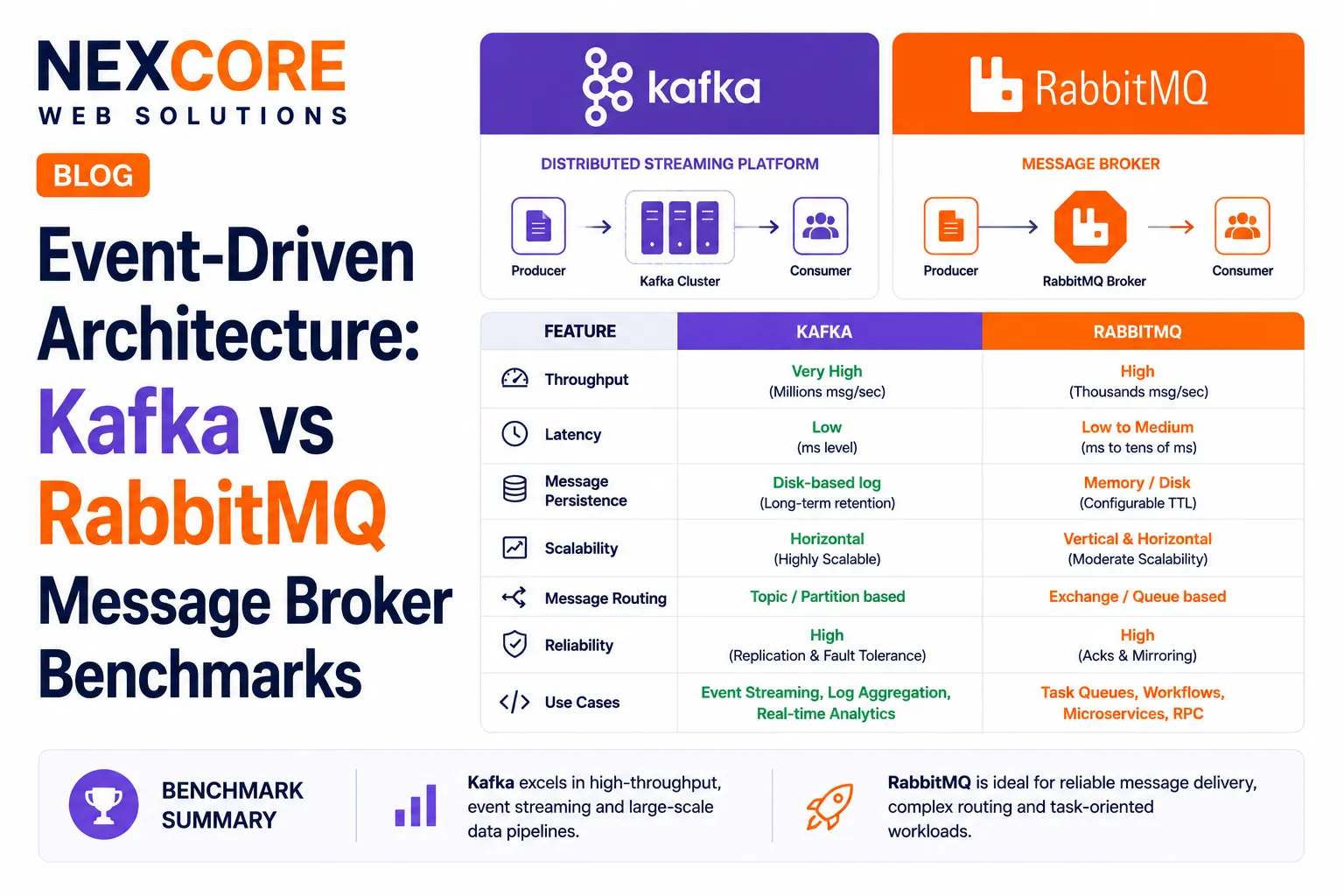
Event-driven architecture allows applications to communicate through events rather than relying entirely on direct, synchronous service calls. Message brokers sit at the center of this model, accepting messages from producers and delivering them to consumers reliably. Apache Kafka and RabbitMQ are two widely used technologies, but they solve messaging problems in different ways. Kafka is designed around durable event streams, high throughput, partitioned storage, and replayable data, while RabbitMQ focuses strongly on flexible routing, queues, acknowledgments, and traditional messaging patterns. Comparing their benchmarks therefore requires more than looking at messages per second. Latency, message size, persistence, consumer behavior, hardware, network conditions, and workload design can significantly change the results.
Understanding Kafka and RabbitMQ
Kafka works as a distributed event streaming platform where records are written to ordered partitions and retained according to configured policies. Consumers read those records independently, allowing multiple applications to process the same event stream without requiring producers to send separate copies. This architecture makes Kafka particularly suitable for analytics pipelines, activity streams, large-scale integration, and systems that need event replay. Its performance generally improves by distributing partitions across brokers and consumers.
RabbitMQ uses exchanges, queues, bindings, and routing rules to deliver messages to consumers. Producers publish messages to exchanges, which determine where those messages should go based on routing configuration. RabbitMQ supports several messaging patterns, including direct, topic, fanout, and work queues, making it highly adaptable for application-level communication. Its acknowledgment model also gives developers precise control over when a message is considered successfully processed.
Kafka vs RabbitMQ Performance Benchmarks
Benchmarking Kafka and RabbitMQ fairly requires identical workloads and infrastructure. A useful test should control CPU, memory, storage, network bandwidth, message size, producer count, consumer count, replication, persistence settings, and acknowledgment behavior. Measuring only peak throughput can produce misleading conclusions because a system optimized for millions of sequential events may not behave similarly when applications require low-latency individual message delivery. Production-oriented benchmarks should therefore measure throughput, latency percentiles, resource consumption, and recovery behavior.
Throughput and Latency
Kafka is generally strong when workloads involve sustained, high-volume event ingestion. Its sequential log-oriented storage and partitioning model allow producers and consumers to process large streams efficiently, particularly when workloads can be distributed across multiple partitions. RabbitMQ can also deliver high throughput, but its architecture is optimized more around message delivery and routing than large-scale persistent event streaming. For low-volume transactional workflows, RabbitMQ may provide excellent responsiveness without requiring Kafka’s distributed streaming model.
Latency measurements need careful interpretation because averages can hide temporary delays. A benchmark should report values such as p50, p95, and p99 latency so operators can understand typical and worst-case behavior. Persistence, replication, acknowledgments, network congestion, and consumer backpressure can all increase latency. In practical systems, predictable tail latency may be more important than achieving the highest possible average throughput.
Persistence and Reliability
Kafka stores events on disk and retains them according to configured policies, allowing consumers to replay historical records. This capability is valuable when a new service needs to process existing events or when an analytics pipeline must recover from an interruption. Kafka replication also helps maintain availability when brokers fail, although replication introduces additional resource and network requirements. The result is a platform well suited to durable event streams rather than simple transient message delivery.
RabbitMQ can provide durable queues and persistent messages, with acknowledgments allowing applications to control successful processing. Its design works particularly well when a message should be delivered to a consumer and removed after successful handling. High availability configurations can provide resilience, but administrators must carefully configure queues, replication, storage, and recovery policies. Neither broker eliminates the need for application-level idempotency and failure handling.
Choosing the Right Broker
Kafka is often a better fit when the system needs large-scale event ingestion, multiple independent consumers, long retention, or event replay. It works well for clickstream processing, operational analytics, data integration, and architectures where events become a durable source of information. RabbitMQ is often preferable when applications need sophisticated routing, request-response messaging, task queues, or straightforward workload distribution. The decision should be based on communication requirements rather than simply selecting the broker with a higher benchmark number.
Benchmarking for Production
Before adopting either platform, run tests using realistic application behavior. Measure different message sizes, producer rates, consumer speeds, failure scenarios, and persistence configurations rather than relying on a single synthetic workload. Track CPU, memory, disk I/O, network traffic, queue or partition growth, and consumer lag during every test. Repeat the benchmark after changing hardware or configuration because results from one environment should not be treated as universal performance guarantees.
Conclusion
Kafka and RabbitMQ are both capable message technologies, but their architectures lead them toward different strengths. Kafka is particularly effective for durable, high-throughput event streams where retention, partitioning, and replay are important. RabbitMQ provides flexible routing and queue-based delivery that fits many application workflows, especially task distribution and transactional messaging. A meaningful benchmark must measure the workload that the production system will actually run, including persistence, acknowledgments, replication, message size, and consumer behavior. Instead of asking which broker is universally faster, engineering teams should ask which architecture best matches their delivery guarantees, scalability requirements, operational capabilities, and recovery strategy.
FAQs
Is Kafka faster than RabbitMQ?
Kafka can achieve very high throughput for sustained event-streaming workloads, especially when data is distributed across partitions. RabbitMQ can perform extremely well for lower-volume messaging and routing-heavy workloads. A simple statement that one is always faster is misleading because performance depends on message size, persistence, acknowledgments, hardware, replication, and consumer behavior. Benchmarking the actual workload provides a more useful comparison.
Which is better for microservices, Kafka or RabbitMQ?
Both can work effectively with microservices, but their strengths differ. RabbitMQ is often convenient for command messages, task queues, and flexible routing between services. Kafka is attractive when services need durable event streams, multiple independent consumers, or replayable historical events. Teams should choose based on communication patterns, delivery requirements, operational expertise, and expected growth rather than treating one broker as universally superior.
Does Kafka replace RabbitMQ?
Kafka does not necessarily replace RabbitMQ because the two technologies were designed around different messaging models. Kafka emphasizes durable distributed event streams and consumer-controlled processing, while RabbitMQ emphasizes broker-managed queues and flexible message routing. Some organizations use both, assigning each platform to workloads where its architecture fits best. The right choice depends on whether the application primarily needs streaming or traditional message delivery.
What should a Kafka vs RabbitMQ benchmark measure?
A meaningful benchmark should measure throughput, p50 and p99 latency, resource usage, persistence behavior, replication overhead, and recovery performance. Tests should also vary message size, producer and consumer counts, acknowledgment settings, and workload intensity. Consumer lag or queue depth is important when applications process messages at different speeds. These measurements provide a much clearer production picture than peak messages per second alone.
Is RabbitMQ suitable for high-throughput systems?
Yes, RabbitMQ can support high-throughput workloads when it is properly configured and the messaging pattern matches its architecture. It is particularly effective for task distribution, application messaging, and routing scenarios where reliable delivery and acknowledgments matter. However, systems requiring massive event retention, replay, and horizontally distributed stream processing may benefit more from Kafka’s log-based architecture. Actual capacity should always be validated with representative benchmarks.




