
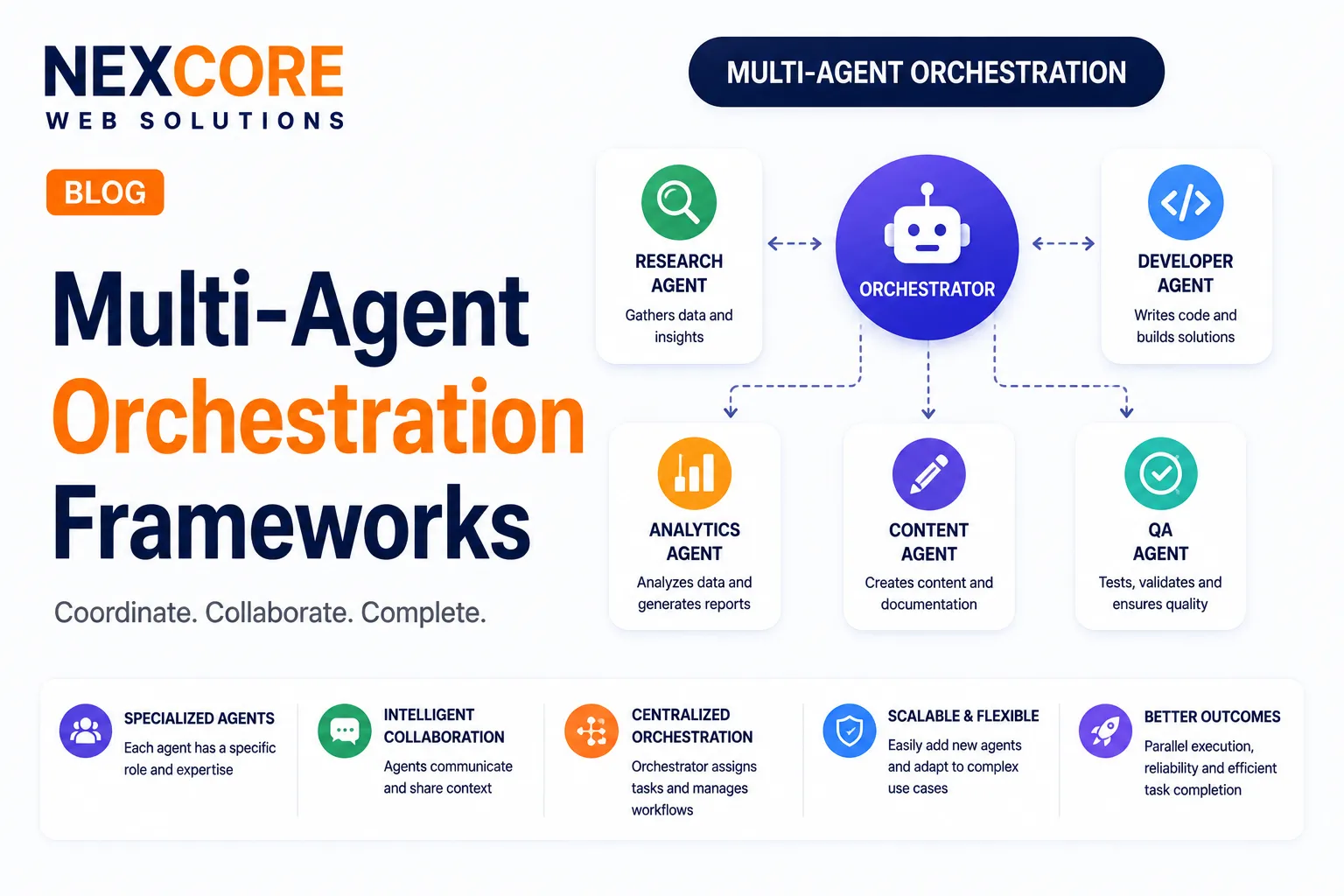
Multi-agent AI systems divide complex tasks among several specialized agents instead of relying on one model to handle every responsibility. One agent might research information, another might write code, and a third could review the result before delivery. This approach can improve task specialization, but coordination introduces new challenges around state, communication, retries, latency, and cost. LangGraph and AutoGen are two prominent frameworks for building such workflows, yet their design philosophies differ considerably. Comparing them through benchmarks requires more than measuring response speed because orchestration overhead, model calls, tool usage, and workflow structure can strongly affect results. A useful evaluation therefore examines reliability, execution time, token consumption, observability, and how easily each framework handles real-world multi-step workloads.
Understanding LangGraph and AutoGen
LangGraph focuses on graph-based orchestration, where developers define agents and workflow states as nodes connected by explicit transitions. This structure makes it possible to represent conditional paths, loops, checkpoints, and human intervention clearly. State can be persisted so long-running workflows can pause and resume without losing important context. The approach is especially useful when an application requires predictable control over how agents interact and how failures are handled.
AutoGen emphasizes agent conversations and collaborative interaction. Agents can exchange messages, delegate tasks, call tools, and work together through defined conversation patterns. This model can make experimentation with collaborative agent teams relatively intuitive, particularly for workflows where agents need to communicate dynamically. Developers can create specialized roles such as planner, programmer, researcher, and reviewer and coordinate them around a shared objective.
Designing a Fair Benchmark
A meaningful LangGraph versus AutoGen benchmark should use the same language model, tools, prompts, hardware, and workload for both frameworks. Testing only one simple conversation can hide the orchestration overhead that appears in larger workflows. Useful scenarios include research pipelines, coding tasks, document analysis, customer-support simulations, and agent workflows involving retries or human approval. Each test should be repeated enough times to reduce the impact of model-response variability.
Metrics That Matter
Performance should be evaluated using several measurements rather than a single speed score. Important metrics include total execution time, model-call count, input and output tokens, tool-call latency, failure rate, memory consumption, and successful task completion. For production systems, p95 latency can be more informative than average latency because occasional slow workflows can significantly affect user experience. Cost should also be calculated from actual model usage because an apparently fast framework can become expensive if its agents repeatedly exchange large prompts.
LangGraph Benchmark Characteristics
LangGraph can perform well when workflows have explicit states and predictable transitions. Its graph structure allows developers to avoid unnecessary agent conversations by routing work directly between appropriate nodes. For example, a research workflow could send collected sources to a writer and then route the draft to a reviewer only when a quality condition is met. This control can reduce redundant model calls and make execution easier to optimize.
Reliability and Debugging
State management is one of LangGraph’s important strengths for complex workflows. Checkpoints can support recovery when a workflow pauses, fails, or requires human input before continuing. Developers can inspect the path taken through the graph and identify where a task produced an unexpected result. This can be particularly valuable in production applications where reproducibility and operational visibility matter as much as raw latency.
AutoGen Benchmark Characteristics
AutoGen can be effective for workflows centered around agent-to-agent collaboration. Its conversational model allows agents to exchange information naturally, which can be useful when the final solution emerges through discussion rather than a rigid sequence. However, additional communication can increase token usage and latency, particularly when multiple agents repeatedly respond to one another. A benchmark should therefore measure the number and size of inter-agent messages instead of focusing only on total wall-clock time.
Collaboration and Flexibility
AutoGen’s conversational approach can make certain multi-agent experiments easier to express. A developer might configure a planner to assign work to a coding agent, allow a reviewer to inspect the output, and then let the planner request another revision. This pattern can be productive when the workflow needs flexible collaboration. The trade-off is that less constrained conversations may become difficult to control if agents generate unnecessary turns or fail to converge on a decision.
LangGraph vs AutoGen: Practical Comparison
The better framework depends heavily on workflow requirements. LangGraph is generally attractive when developers need explicit orchestration, durable state, conditional routing, and fine-grained control over execution. AutoGen can be compelling when the core requirement is collaborative agent interaction and rapid experimentation with conversational teams. Neither framework should be judged solely by benchmark throughput because agent quality and model behavior can dominate the final outcome.
A production benchmark should also measure failure recovery and operational complexity. Test what happens when an agent times out, a tool returns invalid data, a model produces malformed output, or a workflow is interrupted halfway through execution. The framework that completes a task slightly faster may not be the better choice if it requires significantly more engineering effort to recover from failures. Long-term maintainability, tracing, state persistence, testing, and deployment requirements should therefore be part of the evaluation.
Conclusion
LangGraph and AutoGen approach multi-agent orchestration from different directions. LangGraph emphasizes explicit graph-based control, state management, and reliable workflow execution, while AutoGen centers more strongly on agent conversations and collaborative behavior. Benchmarks should measure task completion, latency, token usage, model calls, failures, recovery, and operational overhead under realistic workloads. A framework that wins a synthetic benchmark may not provide the best production experience if its workflow model does not match the application’s requirements. The strongest evaluation combines quantitative measurements with practical engineering tests. Start with representative tasks, keep the model and infrastructure consistent, and optimize the framework that provides the right balance of control, flexibility, reliability, and cost.
FAQs
Is LangGraph faster than AutoGen?
There is no universal winner because execution speed depends on workflow design, model calls, tool usage, and agent communication. LangGraph can reduce unnecessary interactions when a workflow has clearly defined graph transitions. AutoGen may require additional conversational turns in collaborative workflows. A fair comparison should measure the same task, model, infrastructure, and agent configuration while reporting latency alongside successful task completion.
Which framework is better for multi-agent applications?
LangGraph is often a strong choice for applications requiring explicit workflow control, persistent state, conditional routing, and predictable execution. AutoGen can be attractive when agent-to-agent conversation and collaborative problem solving are central to the design. The better option depends on the application’s requirements rather than benchmark scores alone. Teams should evaluate both against their actual workflow and operational constraints.
Does LangGraph use multiple AI agents?
Yes, LangGraph can coordinate multiple agents within a graph-based workflow. Each agent or processing component can have a defined responsibility, while graph edges determine how information and control move between them. Developers can create sequential, conditional, or looping workflows and maintain shared state where appropriate. This makes LangGraph suitable for complex multi-agent systems that require structured orchestration.
What should I measure when benchmarking multi-agent frameworks?
Important measurements include end-to-end latency, p95 latency, token consumption, model-call count, tool-call duration, task success rate, failure frequency, and infrastructure resource usage. You should also test recovery from timeouts, malformed outputs, unavailable tools, and interrupted workflows. Cost is another important metric because repeated agent communication can increase token usage significantly even when individual responses appear inexpensive.
Is AutoGen suitable for production multi-agent systems?
AutoGen can be used for production-oriented multi-agent applications when its conversational model fits the workflow and the surrounding system provides appropriate reliability controls. Developers should carefully manage agent termination, message growth, tool failures, permissions, and observability. Production readiness depends on the complete architecture rather than the framework alone. Thorough testing with realistic workloads is essential before deploying autonomous agent workflows.




