
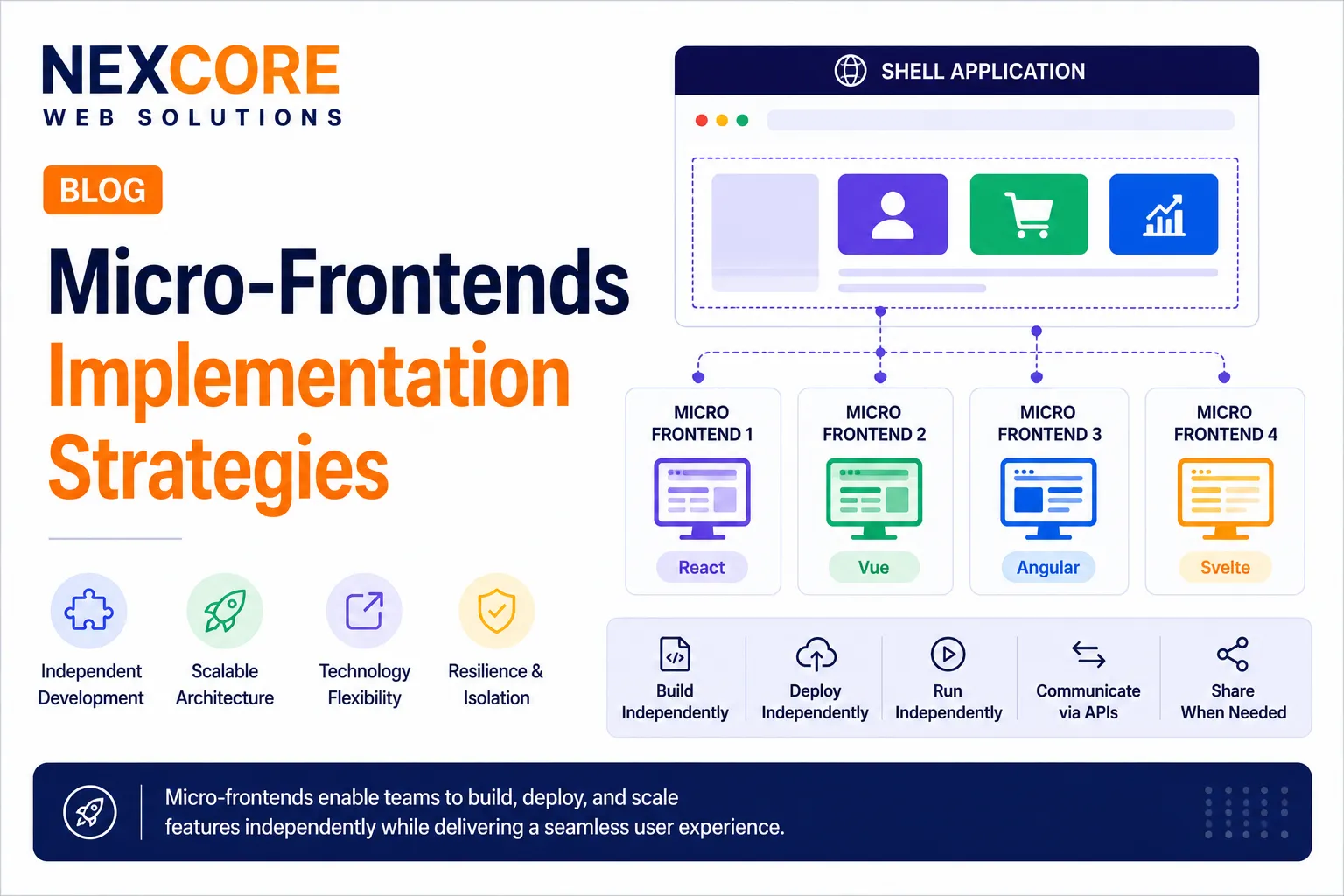
Modern frontend applications can become difficult to maintain when dozens of developers work inside one large codebase. Micro-frontends address this problem by dividing a user interface into independently developed and deployable applications that combine into one customer experience. Webpack 5 Module Federation provides a practical way to implement this architecture by allowing separate builds to expose and consume JavaScript modules at runtime. Teams can share components, libraries, and entire application sections without packaging everything into one deployment. However, successful implementation requires careful decisions about application boundaries, shared dependencies, routing, state, deployment, and failure handling. Understanding these architectural concerns helps teams gain micro-frontend flexibility without replacing a manageable monolith with a complicated distributed frontend.
Understanding Micro-Frontend Architecture
A micro-frontend architecture applies principles commonly associated with backend microservices to frontend development. Instead of maintaining one application where every feature is tightly connected, teams own specific business areas such as checkout, search, account management, or reporting. Each area can have its own development workflow and release schedule while contributing to a unified interface. The strongest boundaries usually follow business capabilities rather than arbitrary technical components.
Module Federation makes these boundaries easier to connect at runtime. One application normally acts as a host, while other builds expose modules that the host can load as remotes. A remote might expose a complete product-search interface or a smaller reusable component. Because remote code can be retrieved at runtime, teams can release some frontend capabilities without rebuilding the entire host application.
How Webpack 5 Module Federation Works
Module Federation is configured through Webpack’s ModuleFederationPlugin. The configuration identifies the application’s federation name, remote entry information, exposed modules, remote applications, and shared dependencies. The remote build generates an entry point that describes modules available to other applications. The host then resolves and loads those modules when they are required by the interface.
Host and Remote Strategy
Choosing what becomes a host or remote is an important architectural decision. A host commonly owns the application shell, global navigation, authentication integration, and top-level routing, while remotes handle specific business capabilities. Teams should avoid exposing every small component because excessive federation creates unnecessary runtime dependencies. A practical boundary usually represents a feature that can evolve and be tested with meaningful independence.
Managing Shared Dependencies
Shared dependencies can significantly affect both performance and reliability. If every remote downloads its own copy of React or another large framework, users may receive unnecessary duplicate JavaScript. Module Federation allows dependencies to be configured as shared and, when appropriate, as singletons so participating applications can use a compatible instance. This is particularly important for libraries where multiple runtime copies could create unexpected behavior.
Version compatibility still needs deliberate management. Independent teams may upgrade libraries at different times, creating conflicts when the host and remotes expect incompatible versions. Organizations should define policies for important shared packages and test combinations before releases. Dependency sharing should reduce duplication without turning independent applications into components that can only operate with one exact host configuration.
Routing and Application State
Routing can be handled centrally or distributed between the shell and individual micro-frontends. A common approach lets the host control top-level routes while each remote manages navigation inside its own business area. This keeps application-wide navigation predictable without forcing the shell to understand every internal screen. Deep links and browser navigation should be tested carefully because routing problems can appear when independently developed applications are combined.
Sharing State Without Tight Coupling
Global state can quickly undermine micro-frontend independence. Instead of exposing one large shared store, teams can communicate through stable interfaces, browser events, URLs, or narrowly defined shared services. Authentication information may need application-wide availability, while temporary form state should usually remain inside the responsible micro-frontend. Keeping state ownership explicit makes applications easier to test and deploy independently.
Deployment and Runtime Reliability
Independent deployment is one of the strongest reasons to adopt micro-frontends. A team can publish a new remote version without coordinating a complete release of the frontend platform, provided the remote maintains its expected contract. Deployment pipelines should validate remote entry availability, dependency compatibility, caching behavior, and integration with the production host. Versioning strategies are useful when a breaking remote change cannot safely reach every host immediately.
Runtime loading also introduces failure scenarios that do not exist in a fully bundled application. A remote server may become unavailable, a deployment may publish incompatible code, or cached assets may reference an outdated build. Hosts should implement error boundaries, loading states, timeouts, and appropriate fallback experiences. Monitoring remote-loading failures gives teams visibility into problems before they affect a large percentage of users.
Performance and Testing Strategy
Module Federation does not automatically improve performance. Runtime requests, duplicate dependencies, oversized remote bundles, and poorly planned loading strategies can increase startup time. Teams should measure Core Web Vitals, bundle sizes, remote-loading latency, cache efficiency, and JavaScript execution time under realistic conditions. Lazy loading can help by downloading a remote only when the user reaches the relevant feature.
Testing should happen at several levels because micro-frontends introduce both isolated and integrated behavior. Each remote needs unit and feature tests, while the combined application needs integration and end-to-end coverage for critical journeys. Contract tests can verify assumptions between hosts and remotes before deployment. Production observability should then connect errors with the responsible remote and version.
Conclusion
Webpack 5 Module Federation provides a powerful foundation for building independently deployable micro-frontends, but the technology alone does not guarantee a maintainable architecture. Teams need sensible business boundaries, controlled shared dependencies, clear routing responsibilities, limited state sharing, and reliable deployment contracts. Runtime federation also requires careful attention to loading failures, caching, compatibility, and performance. For smaller applications, a well-structured frontend monolith may remain simpler and more efficient. Micro-frontends provide the greatest value when organizational scale and independent delivery genuinely justify the additional complexity. Start with clear ownership boundaries, federate complete capabilities rather than tiny components, and measure the architecture against real development and user-experience outcomes.
FAQs
What is Module Federation in Webpack 5?
Module Federation is a Webpack 5 capability that allows independently built applications to expose and consume modules at runtime. A host application can load components or features from remote builds without packaging all their code during its own build process. This capability supports micro-frontend architectures where separate teams need independent development and deployment while still producing one integrated user experience.
Is Module Federation only used for micro-frontends?
No, Module Federation is not limited exclusively to micro-frontends. Developers can also use it to share libraries, design-system components, application features, or other modules between separately deployed builds. Micro-frontends are simply one of its most common architectural use cases. Whether federation is appropriate depends on deployment independence, runtime-sharing requirements, team structure, and the complexity it introduces.
How are dependencies shared between micro-frontends?
Module Federation provides shared dependency configuration that allows hosts and remotes to coordinate the use of common packages. Libraries such as React may be configured as shared dependencies and sometimes as singletons when only one compatible runtime instance should exist. Teams must still manage version compatibility carefully. Poor dependency planning can cause duplicate downloads, runtime conflicts, or excessive coupling between independently deployed applications.
Does Module Federation improve website performance?
Module Federation can support performance improvements when teams use effective code splitting, caching, and lazy loading, but federation itself does not guarantee a faster application. Additional runtime requests and duplicated dependencies can actually increase loading costs. Developers should measure bundle size, remote latency, JavaScript execution, caching, and Core Web Vitals. Performance decisions should therefore rely on production measurements rather than architectural assumptions.
When should a team use micro-frontends?
Micro-frontends are most useful when a large frontend contains distinct business capabilities owned by teams that need meaningful deployment independence. They can reduce coordination around releases and help teams work within clearer boundaries. Smaller products may not gain enough value to justify the additional routing, integration, testing, and operational complexity. Teams should adopt the architecture when organizational and technical scaling problems genuinely require it.




