
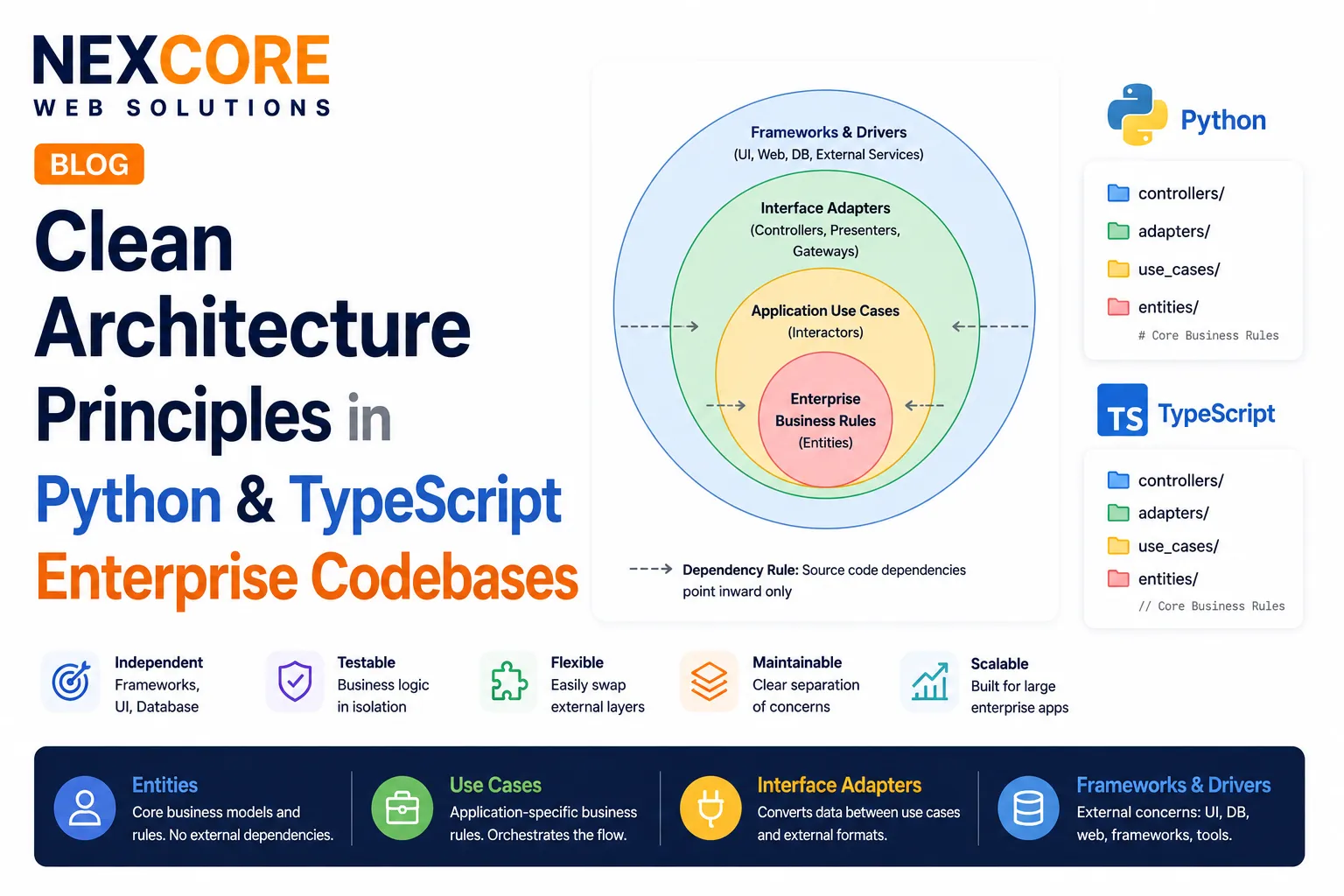
Enterprise applications rarely become difficult because of one complicated feature. They become difficult when business rules, database queries, frameworks, APIs, and infrastructure concerns become tightly connected over years of development. Clean Architecture addresses this problem by organizing software around business rules and controlling how dependencies move between layers. The approach works particularly well in Python and TypeScript because both ecosystems support modular design, interfaces, dependency injection, and automated testing. However, applying Clean Architecture successfully does not mean creating dozens of folders or abstracting every class. The goal is to make important business logic independent from technical details so teams can change databases, frameworks, APIs, or infrastructure without rewriting the core application.
Understanding Clean Architecture
Clean Architecture separates an application into layers with different responsibilities. The innermost layer contains enterprise business rules, while outer layers handle application workflows, infrastructure, frameworks, databases, and external services. Dependencies should point inward, meaning business logic should not depend directly on a database driver or web framework. Instead, the core defines the interfaces it needs, and infrastructure code provides the concrete implementations. This dependency direction makes the system easier to test, maintain, and evolve.
The Dependency Rule
The dependency rule is one of the most important principles to understand. An entity should not import an ORM model simply because the application currently uses a particular database technology. Instead, a use case can depend on an abstraction representing required persistence behavior, while a repository implementation connects that abstraction to PostgreSQL, MongoDB, or another storage system. This arrangement allows infrastructure to change without forcing business rules to change with it.
Clean Architecture in Python
Python’s flexibility makes Clean Architecture both powerful and easy to misuse. A practical Python project can separate entities, use cases, repository interfaces, infrastructure implementations, and delivery mechanisms such as FastAPI or Django. Type hints and protocols can make important boundaries explicit without requiring excessive boilerplate. The key is to keep domain code independent from framework-specific imports.
Python Example Structure
A typical enterprise Python project might organize code around business capabilities rather than technical file types. Domain entities contain business rules, application services coordinate use cases, and infrastructure adapters communicate with databases or external APIs. Dependency injection can be handled manually or through a framework when the application’s complexity justifies it. Tests for domain and application logic can then run without starting a web server or connecting to a real database.
Clean Architecture in TypeScript
TypeScript provides strong static typing that can make architectural contracts especially clear. Interfaces can describe repository behavior, service dependencies, external clients, and application boundaries while allowing infrastructure implementations to remain replaceable. Dependency injection can be implemented manually or with libraries, although explicit constructor injection is often sufficient for many systems. Frameworks such as NestJS can fit this architecture, provided framework-specific concerns do not leak deeply into domain logic.
TypeScript Example Structure
A TypeScript enterprise codebase can separate domain entities, application use cases, ports, adapters, and infrastructure services. A use case might depend on an OrderRepository interface while a PostgreSQL adapter implements that interface using an ORM. The controller translates HTTP input into an application request and returns an appropriate response without containing core business decisions. This separation makes unit testing easier because a fake repository can replace the database adapter during tests.
Python vs TypeScript Enterprise Design
Both languages support Clean Architecture, but their development characteristics differ. Python often relies more heavily on conventions, type hints, protocols, and disciplined code review because its runtime is dynamically typed. TypeScript provides compile-time contracts that can catch many dependency and interface mistakes before execution. Neither language automatically produces better architecture, because poorly designed abstractions remain problematic regardless of type system strength. Teams should therefore focus on dependency direction, business boundaries, testability, and maintainability rather than language-specific patterns.
Testing and Maintainability
Clean Architecture provides significant testing benefits because business logic can operate independently from infrastructure. A pricing use case, for example, can be tested with an in-memory repository rather than requiring a production-like database for every test. Integration tests can then verify repository adapters and external service connections separately. This division produces faster unit tests while still allowing critical infrastructure behavior to receive focused integration coverage.
Avoiding Overengineering
Clean Architecture becomes counterproductive when teams create abstractions without a genuine reason. A simple CRUD feature does not necessarily need multiple interfaces, factories, service layers, and adapters if there are no meaningful business rules to protect. Enterprise architecture should reduce long-term complexity rather than increase it for the sake of architectural purity. Start with clear boundaries, introduce abstractions where change or testing demands them, and allow the structure to evolve as the system grows.
Conclusion
Clean Architecture gives Python and TypeScript enterprise teams a practical way to protect business logic from infrastructure changes. Its central idea is straightforward: important business rules should not depend on databases, frameworks, HTTP libraries, or external services. Python can achieve this through modules, type hints, protocols, and disciplined dependency management, while TypeScript can reinforce boundaries with interfaces and compile-time checking. The architecture works best when teams apply its principles pragmatically rather than copying a rigid folder structure. Keep dependencies pointing inward, isolate infrastructure, test use cases independently, and create abstractions only where they provide real value. Done well, Clean Architecture makes large codebases easier to understand, test, refactor, and maintain over time.
FAQs
What is Clean Architecture in Python?
Clean Architecture in Python separates business rules from frameworks, databases, APIs, and other infrastructure concerns. Domain and application code remain independent from implementation details, while adapters provide the required technical integrations. Python’s modules, type hints, protocols, and dependency injection patterns can support these boundaries effectively. The objective is not a specific directory structure but controlling dependencies so important business logic remains easy to test and change.
Is Clean Architecture useful for TypeScript applications?
Yes, Clean Architecture can be valuable for TypeScript applications that contain substantial business logic or are expected to evolve over many years. TypeScript interfaces and static typing make dependency contracts easier to communicate and validate. The approach can work with frameworks such as NestJS, provided framework-specific code remains outside the core domain. Smaller applications may not need the full structure if their complexity is limited.
What are the main layers of Clean Architecture?
Clean Architecture commonly separates entities or domain rules, application use cases, interface adapters, and infrastructure or framework details. The exact naming varies between projects, but the important principle is dependency direction. Outer layers can depend on inner layers, while inner business logic should not depend on technical implementation details. This allows databases, APIs, and frameworks to change with less impact on core behavior.
Does Clean Architecture improve performance?
Clean Architecture is primarily a maintainability and design approach rather than a performance optimization technique. Additional abstractions can introduce small runtime overhead in some applications, but that is usually insignificant compared with database, network, and computation costs. Its larger benefit is reducing the cost of changing and testing software. Performance-sensitive code should still be profiled and optimized based on measured application behavior.
When should Clean Architecture be avoided?
Clean Architecture may be unnecessary for small applications with limited business logic, short lifespans, or minimal infrastructure complexity. Adding multiple abstraction layers to a simple CRUD application can increase development and maintenance costs without providing meaningful benefits. Teams should adopt the principles when dependency management, testing, and long-term change become genuine concerns. A pragmatic architecture should match the complexity and expected lifetime of the product.




