
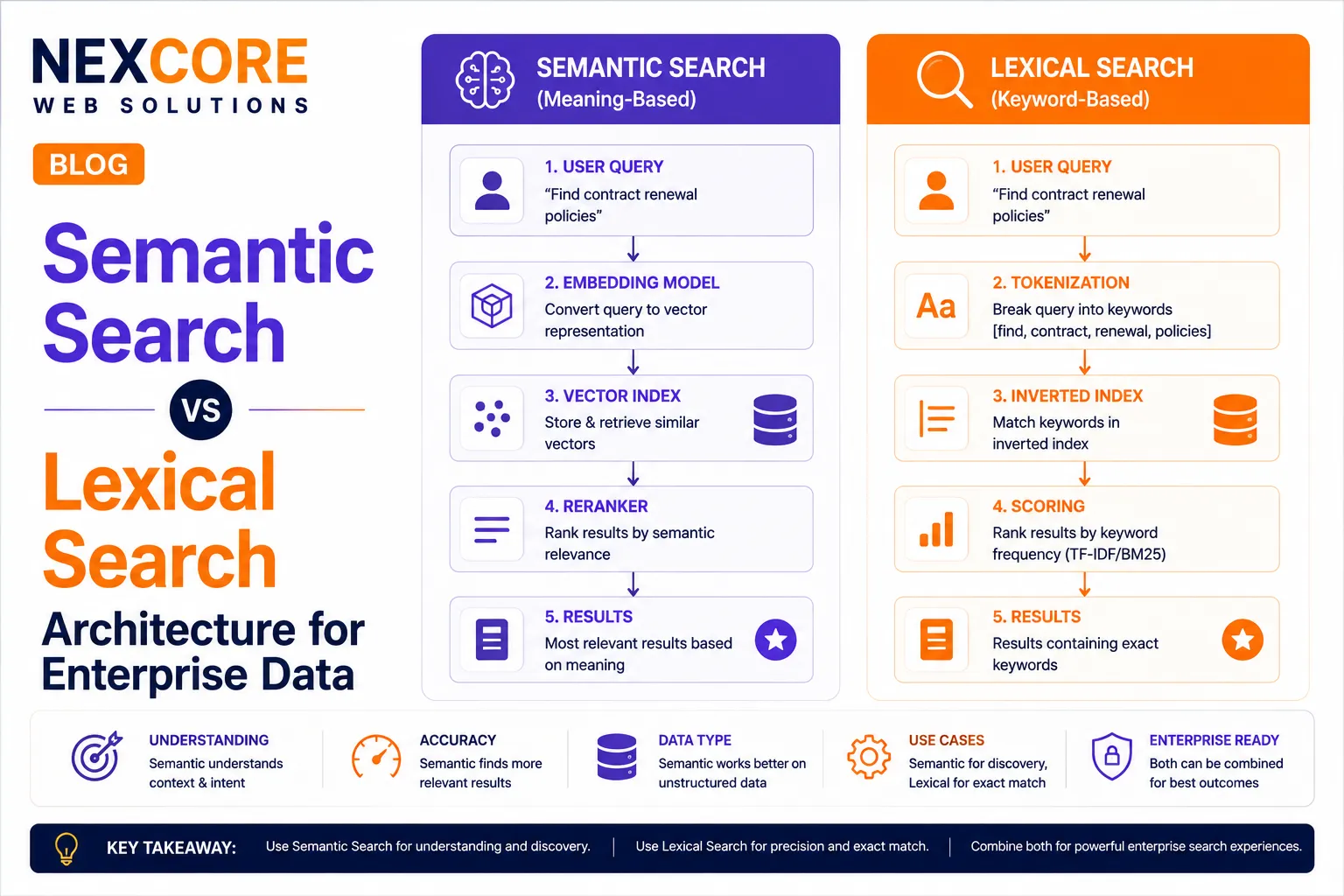
Enterprise search becomes increasingly difficult as organizations accumulate documents, support tickets, product records, contracts, emails, knowledge bases, and operational data. Traditional lexical search can retrieve information by matching words, phrases, and indexed terms, making it fast and predictable for exact queries. Semantic search takes a different approach by representing meaning through vectors, allowing systems to find conceptually related content even when the wording differs. Neither architecture is automatically better for every enterprise workload. Lexical search can excel at identifiers, exact terminology, and filtering, while semantic search can uncover relevant information when users describe an idea rather than repeat the source document’s wording. A well-designed enterprise search platform often combines both approaches to balance precision, relevance, speed, explainability, and operational cost.
Understanding Lexical Search
Lexical search evaluates relationships between the words in a query and the terms stored in an index. Techniques such as inverted indexes, tokenization, stemming, and relevance scoring allow search engines to locate documents containing important terms efficiently. A query such as “INV-48291” benefits greatly from lexical matching because the exact identifier matters more than semantic similarity. This approach is also useful for technical names, product codes, legal clauses, error messages, and other terminology where precision is essential.
Strengths of Lexical Architecture
Lexical search is generally efficient, explainable, and relatively straightforward to operate at enterprise scale. Search administrators can understand why a document matched because the system can identify matching terms and their relevance scores. Filters, facets, Boolean operators, and field-level boosting also work naturally with lexical indexes. These characteristics make lexical search especially valuable for applications where users need predictable results or must locate a precise record quickly.
Understanding Semantic Search
Semantic search converts queries and documents into numerical representations called embeddings. Instead of requiring identical words, the system compares these representations to estimate conceptual similarity. For example, a user searching for “employee reimbursement rules” might discover a document titled “Business Travel Expense Policy” even if the exact phrase never appears. This ability makes semantic retrieval valuable for knowledge bases, natural-language questions, customer support, and large collections of unstructured enterprise content.
Strengths of Semantic Architecture
Semantic search can improve discovery when users do not know the terminology used by the organization. It can connect related concepts across different writing styles, synonyms, and expressions, which is particularly useful in internal knowledge systems. However, semantic similarity can sometimes produce results that are conceptually related but not actually relevant to the user’s precise requirement. Vector search therefore benefits from strong metadata filters, relevance evaluation, and often a second-stage ranking system.
Semantic vs Lexical Search Architecture
The core architectural difference is how relevance is calculated. Lexical systems primarily compare textual terms, while semantic systems compare vector representations generated from content and queries. Lexical indexes are typically built around inverted indexes, whereas semantic architectures require an embedding pipeline and a vector index or vector-capable database. These systems also have different operational requirements because semantic search adds embedding generation, model management, vector storage, and similarity-search infrastructure.
Hybrid Search for Enterprise Data
For many enterprise systems, hybrid search provides the strongest architecture. A hybrid engine can retrieve candidates using both lexical and semantic methods, then combine or rerank the results. Suppose an employee searches for “SAML login failure,” where exact technical terminology matters but related troubleshooting documentation may use different wording. Lexical retrieval can protect the exact phrase while semantic retrieval finds conceptually related solutions, and a reranker can determine the final ordering.
Combining Precision and Recall
The main benefit of hybrid search is balancing precision and recall. Lexical search can reduce false positives when exact terms are important, while semantic retrieval can prevent relevant documents from being missed because they use different language. Enterprise systems can assign different weights depending on the query type, data domain, and user intent. This approach is often more practical than forcing every query through one retrieval method.
Enterprise Data Considerations
Search architecture should account for the nature of the underlying data. Structured records containing identifiers, timestamps, categories, and status fields often benefit heavily from lexical matching and traditional filters. Unstructured documents, policy descriptions, meeting notes, and knowledge articles can benefit more from semantic retrieval because meaning is distributed across sentences rather than concentrated in exact keywords. Access control must also be applied before presenting results, because relevance does not override enterprise authorization requirements.
Performance and Cost
Lexical search can provide low-latency retrieval with mature indexing technologies, while vector search performance depends on embedding dimensions, index configuration, dataset size, and hardware. Semantic pipelines also create ongoing costs because documents may need to be embedded during ingestion and re-embedded when models change. Large enterprises should measure query latency, indexing time, storage requirements, embedding costs, and retrieval quality. Performance testing should use realistic workloads rather than synthetic queries alone.
Choosing the Right Architecture
Organizations should begin by identifying what users actually search for. If users frequently search for ticket numbers, product codes, legal references, or exact names, lexical retrieval should remain central. If they ask conversational questions or search using concepts and descriptions, semantic retrieval becomes more important. In many cases, the best architecture is hybrid, with lexical and semantic retrieval working together and a reranking layer improving final relevance.
Conclusion
Semantic and lexical search solve different parts of the enterprise retrieval problem. Lexical search provides precision, predictable matching, filtering, and strong support for exact terminology, while semantic search improves discovery when users express concepts differently from the source content. Enterprise teams should avoid choosing between them based on trends or isolated benchmark results. Instead, evaluate real queries, access-control requirements, latency targets, data types, and operational costs. A hybrid architecture is often the most capable option because it combines exact matching with semantic understanding. The goal should not simply be to retrieve more documents, but to consistently surface the most useful authorized information with a search experience users can trust.
FAQs
What is the main difference between semantic and lexical search?
Lexical search primarily finds documents based on matching words, phrases, and indexed terms, while semantic search compares the meaning represented by queries and documents. Lexical search is strong for exact identifiers, technical terms, and precise filtering. Semantic search is better when users describe concepts using different language from the source material. Enterprise platforms often combine both approaches for broader and more accurate retrieval.
Is semantic search better than lexical search?
Semantic search is not universally better because its strengths depend on the type of query and data. It can discover conceptually related documents that lexical matching may miss, but it can also return results that are broadly similar without satisfying an exact requirement. Lexical search remains valuable for identifiers, names, codes, and precise terminology. A hybrid design often provides the best balance.
Why use hybrid search in enterprise applications?
Hybrid search combines lexical and semantic retrieval so an enterprise system can benefit from both exact matching and conceptual relevance. Lexical retrieval can protect important keywords, identifiers, and technical phrases, while semantic retrieval expands the candidate set with related content. A reranking stage can then combine these signals to improve ordering. This architecture is particularly useful when enterprise queries vary widely in specificity.
Does semantic search require a vector database?
Semantic search generally requires a way to store and retrieve vector embeddings efficiently, but that does not always mean using a dedicated vector database. Some enterprise search platforms and traditional databases now provide vector indexing capabilities alongside conventional search features. The appropriate technology depends on dataset size, query volume, filtering requirements, infrastructure, and operational constraints. Teams should evaluate the complete retrieval workload before selecting a storage engine.
How should enterprises evaluate search quality?
Enterprises should build an evaluation set containing real user queries and expected relevant results. Metrics can include precision, recall, ranking quality, latency, and successful task completion, while human reviewers can assess whether retrieved documents actually answer the intended question. Testing should also verify authorization boundaries so users never receive documents they cannot access. Continuous evaluation is important because content, terminology, and search behavior change over time.




