
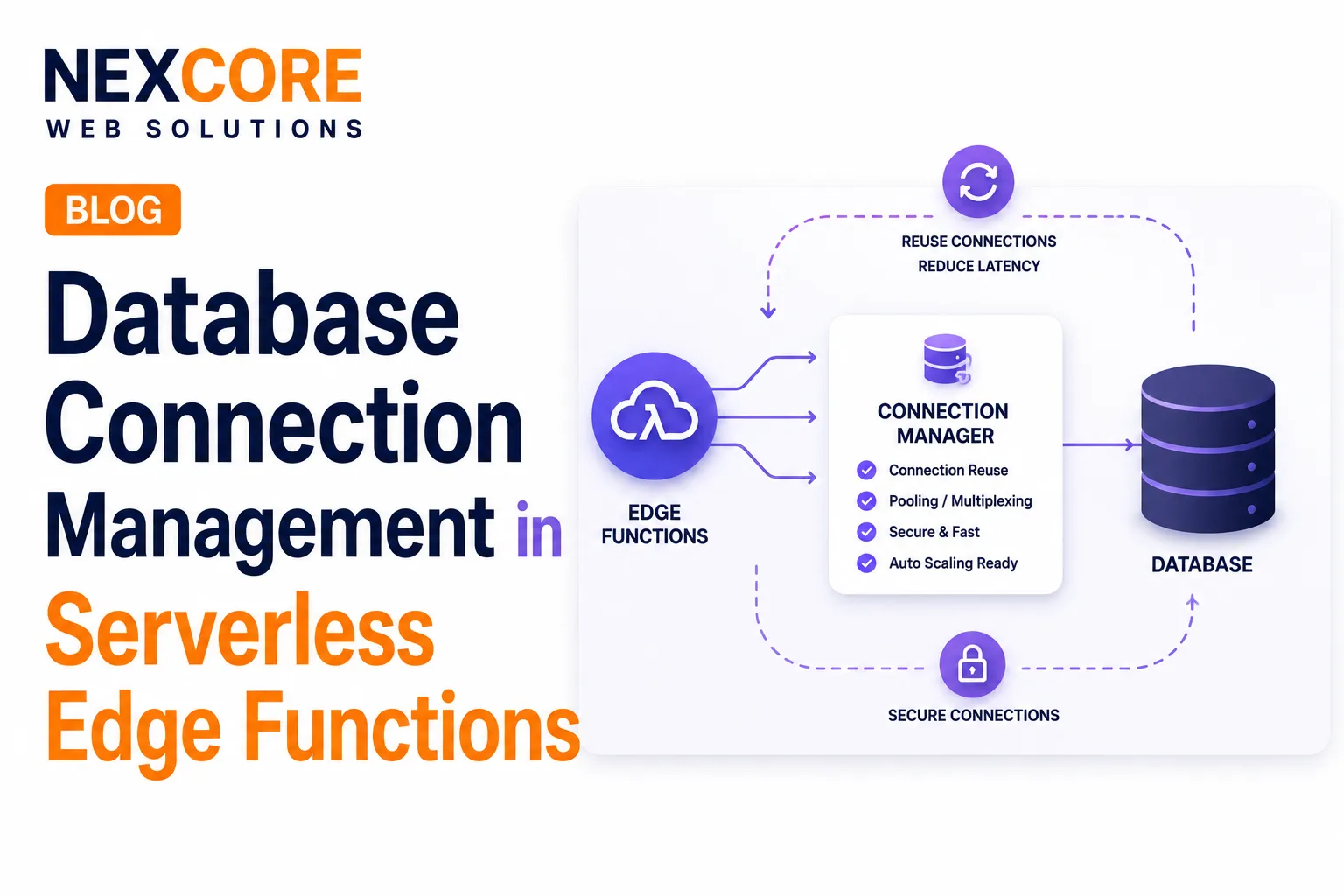
Serverless edge functions can execute application logic close to users, reducing network latency and improving responsiveness for globally distributed applications. However, connecting these functions to a database introduces challenges that are different from those found in traditional long-running servers. A conventional application can maintain a connection pool for hours, while serverless functions may start, stop, scale, and move between execution environments unpredictably. At the edge, geographic distribution adds another consideration because a database located in one region can become a latency bottleneck. Effective database connection management therefore requires careful attention to connection reuse, pooling, database placement, concurrency, and failure recovery. The goal is to gain the benefits of edge execution without overwhelming the database or creating unnecessary connection overhead.
Why Database Connections Are Different at the Edge
Traditional backend servers usually run continuously, allowing applications to establish a database connection pool during startup and reuse those connections across thousands of requests. Serverless functions operate differently because an execution environment may be created for a request and later reused, or it may disappear after a period of inactivity. Creating a fresh database connection for every invocation can introduce significant latency and consume database resources quickly. When traffic increases suddenly, many function instances may attempt to establish connections simultaneously, creating a connection storm.
Cold Starts and Warm Invocations
A cold start occurs when the platform creates a new execution environment before running the function. Database initialization performed during this phase can increase the first-request latency considerably. Warm environments may reuse initialized clients, making subsequent requests faster, but developers cannot assume that a particular instance will remain available. Connection management should therefore support reuse when possible while remaining correct when the runtime starts from scratch.
Connection Pooling Strategies
Connection pooling can reduce the cost of repeatedly opening database connections, but traditional large pools are often unsuitable for serverless workloads. If hundreds of function instances each create a pool containing several connections, the total number of database connections can quickly exceed the database’s capacity. A smaller pool or platform-managed connection service is often more appropriate. The correct configuration depends on function concurrency, database limits, query duration, and expected traffic patterns.
Reusing Database Clients
A common pattern is to create a database client outside the function handler so a warm execution environment can reuse it across invocations. This avoids unnecessary connection setup when the platform keeps the environment alive. However, the application should handle stale or broken connections rather than assuming that every reused connection remains valid indefinitely. Connection errors should trigger controlled recovery instead of allowing a failed client to break subsequent requests.
Edge Location and Database Placement
Running application logic close to users does not automatically make database operations faster. If an edge function executes in Asia while its primary database is located in North America, every database query still crosses a long network path. For read-heavy workloads, geographically distributed replicas or edge-compatible storage can reduce this latency. Write-heavy applications may require a carefully designed primary region or consistency model to avoid conflicting updates.
Choosing the Right Data Layer
Not every database is equally suitable for edge execution. Some traditional database drivers depend on runtime features or persistent TCP connections that are difficult to use efficiently in certain edge environments. HTTP-based database APIs, serverless-aware connection services, and globally distributed databases can be better suited to these constraints. Developers should evaluate protocol support, connection behavior, consistency requirements, transaction support, and regional availability before selecting a database architecture.
Managing Connection Limits
Database connection limits should be treated as a core capacity constraint. A serverless platform can scale application instances much faster than a database can accept new connections, particularly during traffic spikes. Teams should calculate a safe connection budget by considering maximum concurrency, connections per instance, background jobs, administrative connections, and other consumers. Limiting application-side concurrency can sometimes be more effective than simply increasing database connection limits.
Handling Traffic Spikes
Sudden traffic can create thousands of simultaneous function invocations, and each invocation may attempt database access. Without protection, the database can become saturated even when individual queries are efficient. Caching, request coalescing, queues, rate limits, and connection proxies can reduce pressure during spikes. Read-heavy operations should also use caching where data freshness requirements allow it, keeping repetitive queries away from the database.
Transactions and Reliability
Transactions require additional consideration in distributed edge architectures. A transaction that involves several geographically distant operations can increase latency and complicate failure recovery. Keep transactions short and perform only the database work that genuinely requires atomicity inside the transaction boundary. Applications should also use timeouts and retry policies carefully because blindly retrying a failed write can create duplicate business operations.
Observability and Monitoring
Connection management should be monitored just like application latency and error rates. Useful metrics include active connections, connection acquisition time, query duration, rejected connections, database CPU usage, pool utilization, and timeout frequency. Logs should include enough information to identify which function, region, and operation caused a failure without exposing credentials or sensitive data. Monitoring these signals helps teams identify connection exhaustion before it becomes a widespread production outage.
Security Considerations
Database credentials should never be embedded directly in function source code or client-side applications. Use the serverless platform’s secure secret-management facilities and restrict database permissions according to the function’s actual responsibilities. Network access should also be limited where the infrastructure supports private connectivity or controlled endpoints. Short-lived credentials and appropriate encryption can further reduce the impact of credential exposure.
Conclusion
Database connection management is one of the most important architectural considerations when deploying serverless functions at the edge. The combination of unpredictable scaling, short-lived runtimes, geographic execution, and database connection limits makes traditional server-side pooling strategies insufficient in many cases. Reusing clients in warm environments, controlling connection counts, selecting edge-compatible database access methods, and placing data intelligently can significantly improve reliability. Teams should also design for failures, monitor connection behavior, and avoid assuming that an edge runtime guarantees low database latency. The best architecture balances global application execution with a database strategy designed around concurrency, consistency, performance, and operational limits.
FAQs
Why are database connections difficult in serverless edge functions?
Serverless edge functions can scale rapidly and create many independent execution environments. Unlike traditional servers, these environments may not remain alive long enough to reuse connections consistently. Creating a connection for every invocation can increase latency and exhaust database connection limits. Effective designs therefore reuse clients when possible, control concurrency, and use database services or connection mechanisms designed for serverless workloads.
Should I create a database connection inside every serverless function?
Usually, repeatedly creating a new connection for every invocation is inefficient. A common approach is to initialize the database client outside the function handler so warm execution environments can reuse it. However, developers must still handle stale connections and cold starts because runtime reuse is not guaranteed. The exact implementation depends on the database driver, serverless platform, and connection protocol.
Does connection pooling work with serverless edge functions?
Connection pooling can work, but traditional large pools can cause problems because every serverless instance may create its own pool. During high traffic, the combined number of connections can exceed the database’s capacity. Small pools, managed connection proxies, HTTP-based database access, or serverless-oriented database services may be more appropriate. The correct strategy should be based on concurrency and the database’s connection limits.
How does database location affect edge function performance?
Edge functions may execute close to users, but database queries still depend on where the database is located. If an edge function and database are geographically distant, network round trips can dominate request latency. Regional replicas, distributed databases, caching, or carefully selected primary regions can help. Developers should measure real query latency from expected execution regions rather than assuming edge execution automatically makes database operations fast.
How can I prevent database connection exhaustion?
Start by calculating a connection budget based on maximum function concurrency and the number of connections each instance can create. Keep pools small, reuse clients where appropriate, and consider managed connection services when direct connections do not scale safely. Caching and rate limiting can reduce unnecessary database requests during traffic spikes. Monitoring active connections, rejected connections, and acquisition latency can also reveal capacity problems early.




