
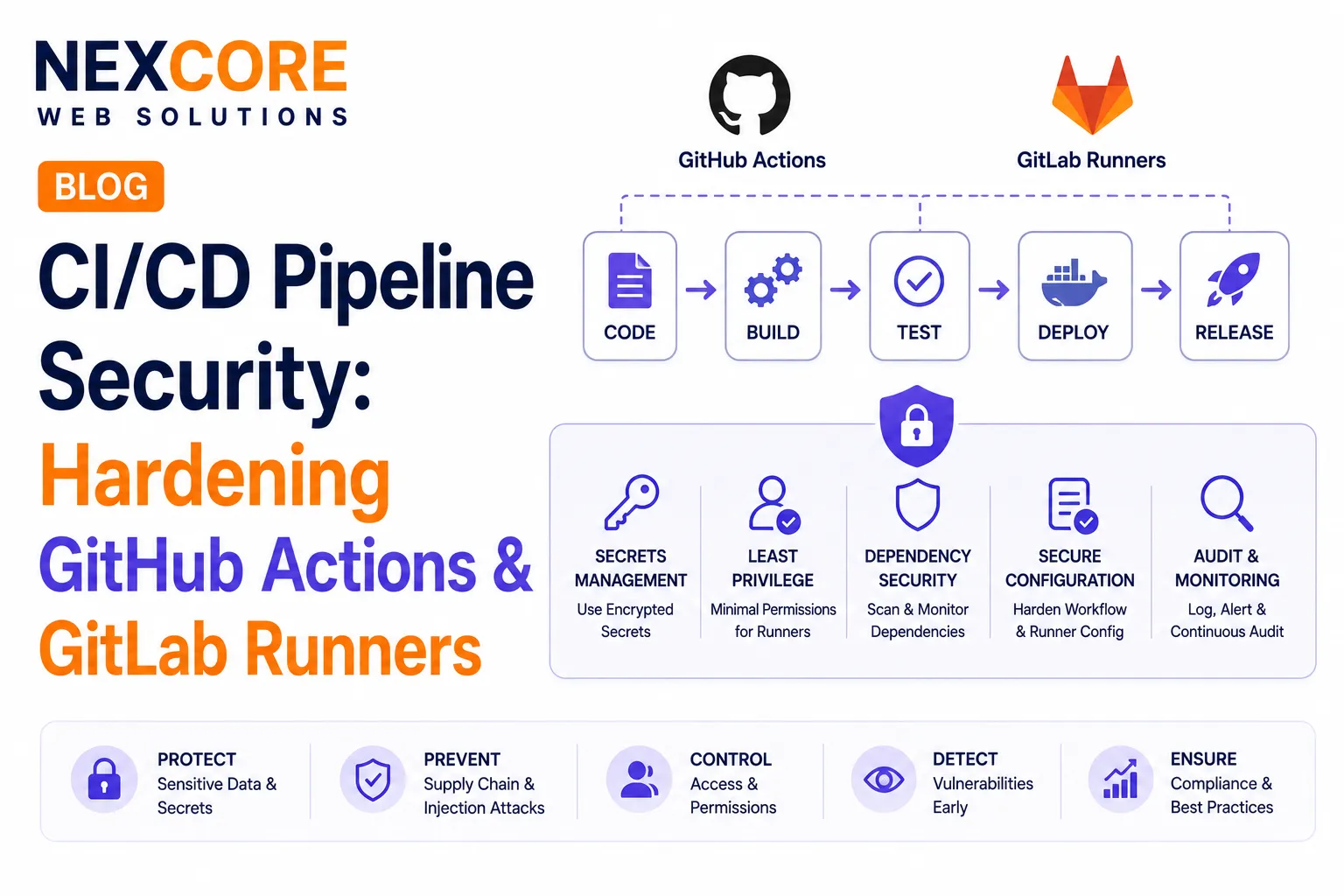
CI/CD pipelines have become a critical part of modern software delivery, but they are also attractive targets because they can access source code, cloud credentials, package registries, deployment systems, and production environments. A compromised pipeline can therefore cause damage far beyond a single application repository. GitHub Actions and GitLab runners provide powerful automation, yet their flexibility makes careful security configuration essential. Effective hardening involves controlling permissions, protecting secrets, isolating workloads, reviewing third-party actions, and preventing untrusted code from gaining access to sensitive environments. Security should be treated as part of pipeline design rather than an additional step after deployment automation is already complete.
Why CI/CD Pipelines Need Strong Security
A CI/CD runner executes commands defined by repository configuration, which means pipeline code can potentially access everything available to that execution environment. If an attacker modifies a workflow or exploits a vulnerable dependency, the runner could become a path to credentials, artifacts, or deployment infrastructure. Pull requests from untrusted contributors require particular attention because their code may execute within automated jobs. Organizations should therefore assume that every pipeline execution is potentially exposed to untrusted input and apply least-privilege controls accordingly.
Identify the Trust Boundaries
Start by mapping what each pipeline job can access and which events can trigger it. Separate build, test, security scanning, packaging, and deployment responsibilities where practical because different stages have different trust requirements. A test job handling code from an external pull request should not automatically receive production credentials. Clear trust boundaries make it easier to restrict permissions and contain a compromise if one job becomes malicious.
Hardening GitHub Actions
GitHub Actions workflows should use the minimum permissions required by each job. Instead of granting broad repository access globally, configure the GITHUB_TOKEN permissions explicitly and increase them only when a specific task needs additional capabilities. Secrets should be stored through GitHub’s protected secret mechanisms rather than committed into workflow files or source code. Production deployments should also use protected environments with appropriate approval and access controls.
Secure Third-Party Actions
Third-party actions can introduce supply-chain risk because a workflow may execute code maintained outside your organization. Pinning actions to specific commit SHAs provides stronger protection against unexpected upstream changes than relying only on mutable version tags. Teams should review action ownership, maintenance activity, requested permissions, and source code before adoption. Minimize the number of external actions used in privileged workflows and periodically reassess existing dependencies.
Hardening GitLab Runners
GitLab runners should be configured according to the sensitivity of the workloads they execute. Shared runners can be convenient, but sensitive builds may require dedicated runners with stronger isolation and restricted network access. Runner registration tokens, authentication credentials, and configuration files must be protected because unauthorized runner access can provide attackers with execution capabilities. Keep runner software and its underlying operating system updated to reduce exposure to known vulnerabilities.
Isolate Runner Workloads
Containerized execution can provide useful isolation, but containers should not automatically be treated as complete security boundaries. Avoid privileged containers unless there is a documented requirement, and restrict access to the host filesystem, Docker socket, and unnecessary network resources. Dedicated runners should have limited outbound connectivity where possible. Strong isolation becomes especially important for jobs that process untrusted pull requests, third-party code, or unverified build artifacts.
Protecting Secrets and Credentials
Secrets represent one of the highest-value targets in a CI/CD environment. Use short-lived credentials and workload identity mechanisms where supported instead of storing long-lived cloud access keys in pipeline variables. Separate credentials by environment so a development job cannot automatically deploy to production. Masking secrets in logs is useful, but it should not be treated as the only protection because commands can sometimes transform or unintentionally expose sensitive values.
Prevent Credential Leakage
Pipeline logs, artifacts, caches, and test reports can accidentally contain credentials even when the original secret is protected. Avoid printing environment variables and review scripts for commands that might expose configuration or authentication headers. Treat generated artifacts as potentially sensitive and define appropriate retention and access policies. Rotate credentials promptly when exposure is suspected, and maintain audit records showing when privileged credentials are used.
Securing Dependencies and Build Artifacts
Pipeline security extends beyond workflow configuration because applications depend on packages, containers, plugins, and build tools. Use dependency lockfiles, trusted registries, vulnerability scanning, and software composition analysis to reduce supply-chain risks. Container images should be scanned before deployment, while build artifacts should be generated through controlled and reproducible processes. Signing artifacts can provide an additional layer of assurance that deployed packages originated from an authorized pipeline.
Secure Pull Request Workflows
Pull request automation deserves special scrutiny because repository contributors may submit code specifically designed to exploit pipeline behavior. Avoid exposing privileged secrets to jobs that execute untrusted changes, and separate validation jobs from trusted deployment workflows. For GitHub Actions, carefully evaluate workflows triggered by events that run with repository write permissions. GitLab pipelines should apply similar restrictions when merge requests can execute attacker-controlled scripts.
Monitoring and Incident Response
Strong pipeline security requires continuous visibility rather than one-time configuration. Monitor authentication events, workflow changes, runner registrations, unusual pipeline executions, permission changes, and unexpected access to cloud resources. Alerts should focus on meaningful anomalies, such as a deployment job accessing resources outside its normal scope. When a compromise occurs, teams need a documented process for disabling runners, revoking credentials, preserving evidence, and rebuilding trusted environments.
Conclusion
Hardening GitHub Actions and GitLab runners requires a combination of least privilege, workload isolation, credential protection, supply-chain controls, and continuous monitoring. The most important principle is to assume that pipeline code can become untrusted and prevent any single job from receiving unnecessary authority. GitHub Actions teams should carefully control workflow permissions, environments, and third-party actions, while GitLab users should pay particular attention to runner isolation and authentication. Security improvements should be tested regularly through configuration reviews and realistic threat scenarios. A well-secured CI/CD pipeline should make the safe path the default, limiting what automation can access while preserving the speed and reliability that modern software teams depend on.
FAQs
How do you secure GitHub Actions workflows?
Secure GitHub Actions by applying least-privilege GITHUB_TOKEN permissions, protecting secrets, using environment approvals for sensitive deployments, and reviewing third-party actions carefully. Pinning external actions to immutable commit SHAs can reduce supply-chain risk. Workflows handling untrusted pull requests should not receive production credentials or unnecessary write permissions. Regularly review workflow changes and repository security settings to detect accidental privilege expansion.
How can GitLab runners be hardened?
GitLab runners should use strong authentication, current software versions, restricted permissions, and appropriate workload isolation. Sensitive workloads should generally use dedicated runners rather than broadly shared infrastructure. Avoid privileged containers unless absolutely necessary and restrict access to host resources, credentials, and unnecessary network destinations. Runner registration and authentication information should be treated as sensitive credentials and monitored for unauthorized use.
Should CI/CD pipelines use long-lived cloud credentials?
Long-lived credentials should generally be avoided when the cloud provider supports short-lived authentication or workload identity mechanisms. Temporary credentials reduce the potential impact if a pipeline environment is compromised. Permissions should also be limited to the resources required by each job and environment. Separating development, staging, and production identities prevents a compromised lower-trust workflow from automatically gaining production-level access.
Why are third-party GitHub Actions a security risk?
Third-party actions execute code inside your workflow environment and may receive the permissions and environment variables available to the job. A compromised or malicious action could potentially access source code, tokens, secrets, or other resources. Review action provenance, source code, maintenance, and requested permissions before adoption. Pinning actions to specific commit SHAs provides stronger control over exactly which code executes.
How should organizations secure CI/CD pipelines against supply-chain attacks?
Organizations should combine dependency pinning, trusted registries, vulnerability scanning, artifact signing, restricted permissions, and isolated build environments. Build inputs and third-party actions should be treated as potential supply-chain risks rather than automatically trusted. Reproducible builds and provenance records can help establish where artifacts originated. Continuous monitoring and rapid credential rotation are also important if suspicious pipeline behavior is detected.




