
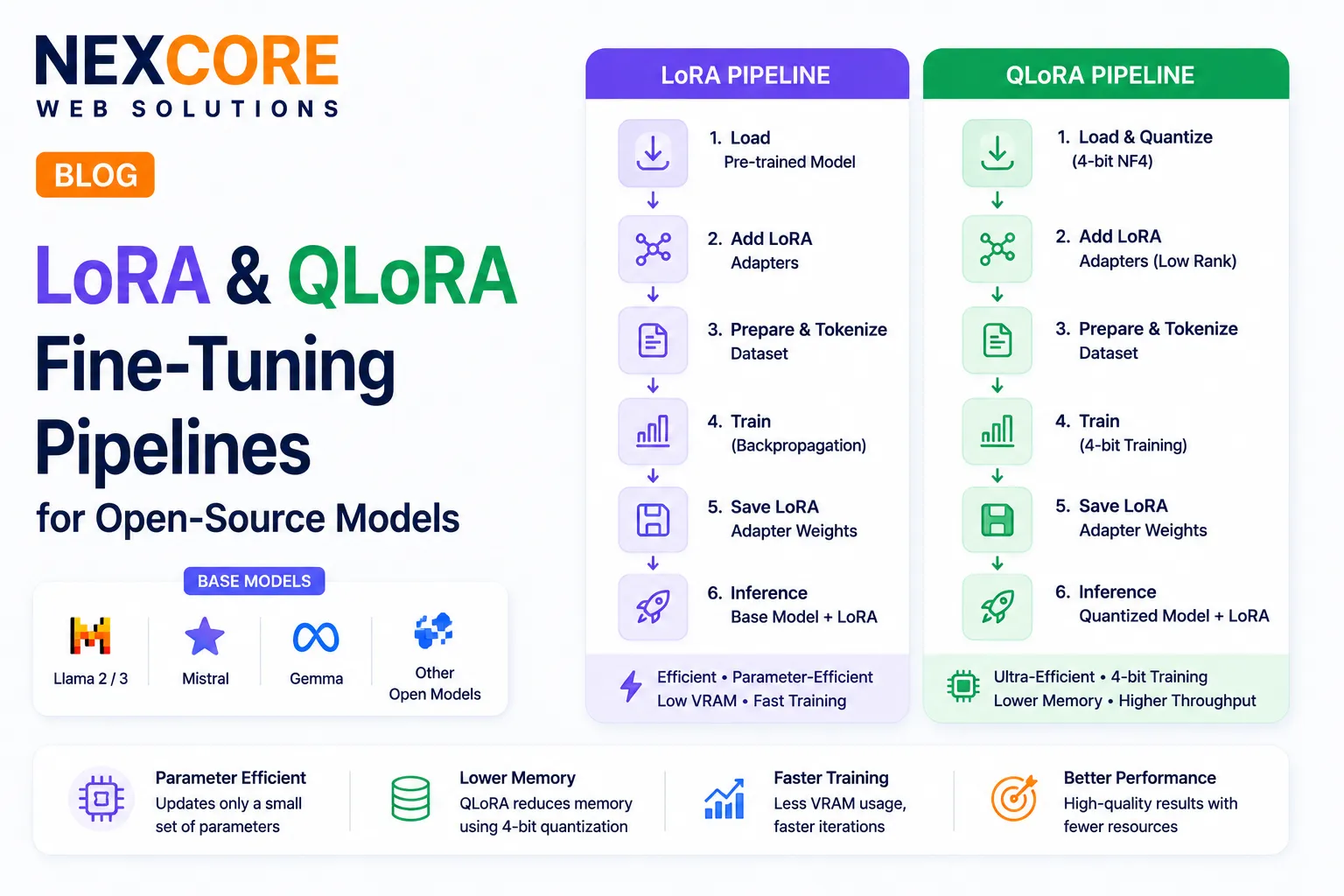
Fine-tuning an open-source language model can adapt a general-purpose model to a specific domain, writing style, workflow, or business task. Full-parameter fine-tuning, however, can require substantial GPU memory, storage, and training time, making it difficult for smaller teams to operate efficiently. LoRA and QLoRA address this challenge by reducing the number of model parameters that need to be updated during training. LoRA introduces trainable low-rank adapter matrices, while QLoRA combines this approach with quantization to make large models considerably more memory-efficient. Building a reliable fine-tuning pipeline involves more than launching a training script. Dataset quality, tokenizer configuration, quantization settings, evaluation, checkpoint management, and deployment all influence the final result.
Understanding LoRA Fine-Tuning
Low-Rank Adaptation, commonly called LoRA, freezes the original model weights and adds small trainable matrices to selected layers. Instead of updating billions of parameters, training focuses on a much smaller set of adapter parameters. This substantially reduces GPU memory requirements and produces adapter files that are far smaller than complete model checkpoints. For example, a team adapting an open-source model for customer-support responses can train a domain-specific adapter while keeping the original model unchanged.
Why LoRA Works
LoRA is effective because many fine-tuning tasks do not require changing every parameter in a pretrained model. The adapter learns task-specific adjustments while the base model continues providing its general language knowledge. Developers can also maintain multiple adapters for different use cases and load them with the same base model. This approach can simplify experimentation, storage, and deployment when several specialized behaviors are required.
Understanding QLoRA
QLoRA extends the LoRA approach by loading the base model using low-bit quantization while keeping the trainable adapters in higher precision. A commonly used configuration loads model weights in 4-bit precision, significantly reducing memory consumption during training. The technique allows practitioners to fine-tune models that might otherwise exceed the available GPU memory. Importantly, quantization changes how the frozen base model is represented, while LoRA still limits which parameters are updated.
When QLoRA Makes Sense
QLoRA is particularly useful when hardware resources are constrained or when teams want to fine-tune larger models on fewer GPUs. However, reduced memory usage does not eliminate the need for careful configuration. Quantization settings, compute precision, sequence length, batch size, and gradient accumulation all influence training behavior. Teams should validate the resulting model rather than assuming that a memory-efficient configuration will automatically produce equivalent quality.
Building the Fine-Tuning Pipeline
A production-oriented pipeline should separate data preparation, training, evaluation, artifact management, and deployment. Start by collecting examples that represent the actual behavior the model needs to learn rather than simply maximizing dataset size. Remove duplicates, corrupted records, contradictory examples, and sensitive information that should not enter the training process. Consistent formatting is also important because the model learns patterns from both the content and structure of training examples.
Dataset Preparation
Instruction-tuning datasets commonly contain an instruction, contextual information, and an expected response. The exact format should match the model’s chat template or training convention whenever applicable. Tokenize the dataset using the model’s tokenizer and inspect sequence lengths before training. Excessively long examples can consume memory quickly, while aggressive truncation can remove important context and weaken the resulting adapter.
Training Configuration
Training parameters should be selected based on the model, dataset, GPU memory, and desired behavior. Learning rate, LoRA rank, LoRA dropout, batch size, gradient accumulation, sequence length, and number of epochs all affect the outcome. Higher LoRA rank provides greater adapter capacity but also increases trainable parameters and memory use. Instead of copying a configuration from another project, establish a baseline and adjust one meaningful variable at a time.
Checkpoints and Experiment Tracking
Save checkpoints regularly so interrupted training does not require starting again from the beginning. Track the dataset version, base model revision, tokenizer, quantization configuration, LoRA parameters, training arguments, and evaluation results for every experiment. This information is essential when comparing two adapters or reproducing a model months later. A disciplined experiment record also makes it easier to identify whether a quality improvement came from data changes, hyperparameters, or model configuration.
Evaluation and Quality Control
Training loss alone does not determine whether a fine-tuned model is useful. Create a separate evaluation set containing realistic examples that were not included in training. Measure task-specific quality, factual accuracy, instruction following, formatting consistency, and undesirable behavior relevant to the application. Human review remains valuable for subjective tasks such as tone, helpfulness, and domain-specific correctness.
Avoiding Overfitting
A model can memorize training examples or become overly specialized when the dataset is small or training continues for too long. Warning signs include worsening validation performance, repetitive responses, or a noticeable decline in general capabilities. Compare the fine-tuned model with the original base model using the same evaluation prompts. If the adapter improves the target task while preserving acceptable general behavior, it is more likely to be suitable for practical deployment.
Deployment and Maintenance
LoRA adapters can be deployed alongside a compatible base model rather than distributing a complete fine-tuned checkpoint. This reduces artifact size and can make it easier to maintain several task-specific versions. Before deployment, verify compatibility between the base model, adapter, tokenizer, inference framework, and quantization format. Teams should also monitor production responses because real user inputs often expose weaknesses that controlled evaluation misses.
Conclusion
LoRA and QLoRA have made fine-tuning open-source language models considerably more accessible by reducing the computational resources required for parameter updates. LoRA is useful when teams want lightweight adapters, while QLoRA extends the approach for more memory-constrained training through quantized base models. The strongest pipelines treat fine-tuning as an engineering workflow rather than a single training command. High-quality data, reproducible configurations, careful evaluation, checkpointing, and deployment validation are essential for reliable results. Teams should begin with a small, representative dataset, establish measurable evaluation criteria, and improve the pipeline through controlled experiments. Efficient fine-tuning is ultimately about achieving useful model behavior with predictable cost and repeatable processes.
FAQs
What is the difference between LoRA and QLoRA?
LoRA freezes the original model and trains small low-rank adapter parameters instead of updating the complete network. QLoRA follows the same adapter-based strategy but loads the frozen base model using low-bit quantization, commonly 4-bit representations, to reduce memory requirements further. As a result, QLoRA can make fine-tuning larger open-source models practical on more limited GPU hardware while retaining the advantages of adapter-based training.
How much GPU memory does QLoRA require?
There is no single memory requirement because usage depends on model size, sequence length, batch size, quantization format, optimizer configuration, and training framework. QLoRA can substantially reduce memory compared with full-parameter fine-tuning, allowing some large models to run on hardware that would otherwise be insufficient. Developers should estimate memory for the model, activations, gradients, optimizer states, and temporary training operations before selecting hardware.
What dataset is best for LoRA fine-tuning?
The best dataset closely represents the tasks and responses expected after deployment. High-quality examples are generally more valuable than a large collection containing duplicates, inconsistent instructions, or irrelevant material. Training records should use consistent formatting and appropriate context while avoiding sensitive information that should not be processed. A carefully separated validation and evaluation set is also important for measuring whether the adapter actually improves the intended behavior.
Can multiple LoRA adapters use the same base model?
Yes, multiple LoRA adapters can be created for the same compatible base model and used for different tasks or domains. For example, an organization could maintain separate adapters for technical support, legal-document classification, and internal knowledge assistance. This can reduce storage requirements compared with maintaining separate full model copies. However, adapter compatibility, inference framework support, and potential interactions between adapters should be tested before production use.
How do you know whether a LoRA model is ready for production?
A fine-tuned adapter should be evaluated against realistic, previously unseen examples before deployment. Testing should cover task accuracy, instruction following, formatting, factual behavior, safety requirements, and performance against the original base model. Production readiness also requires checking inference latency, memory usage, model compatibility, and failure behavior. After release, monitor representative outputs and user feedback because real workloads can reveal issues that offline evaluation does not capture.




