
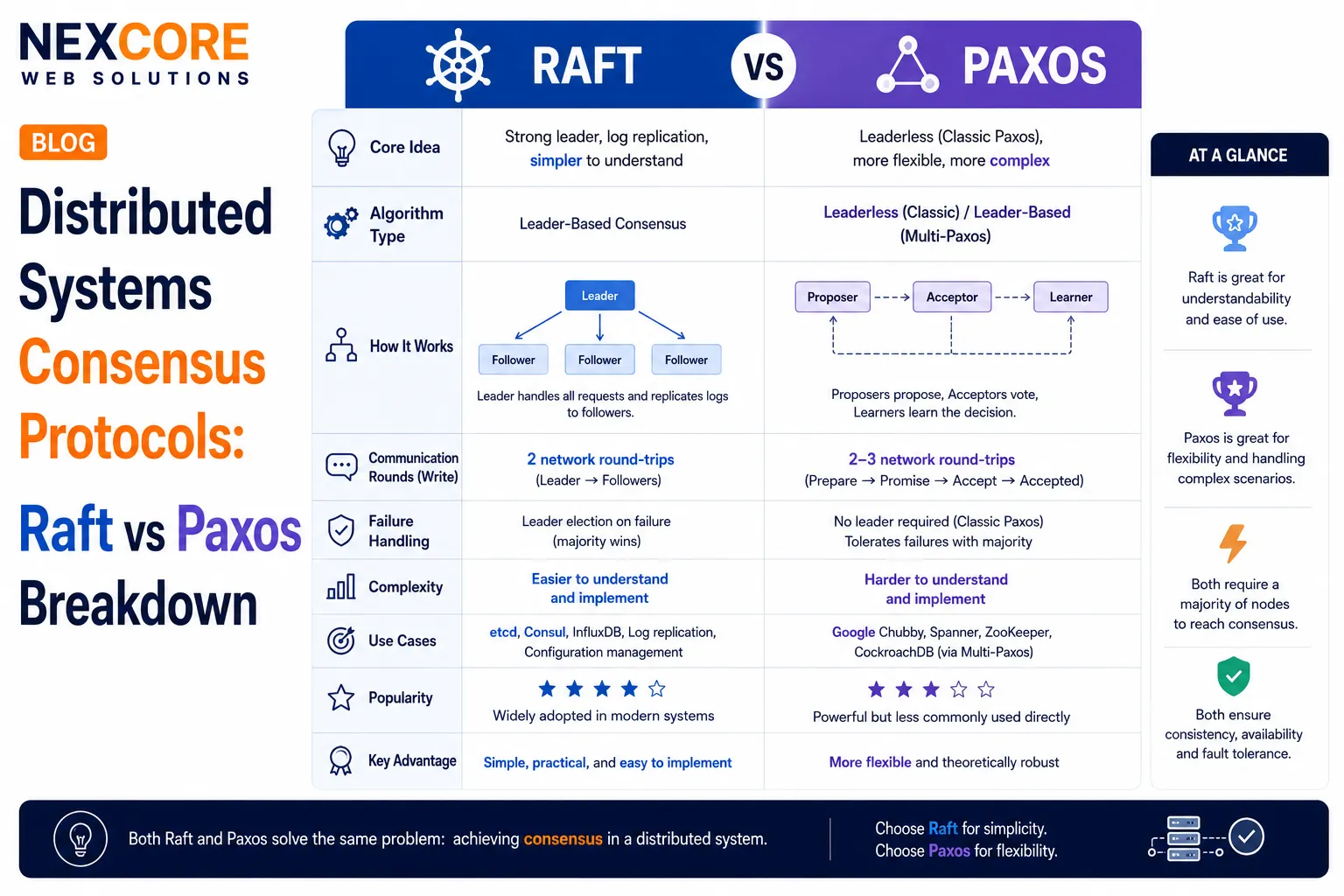
Distributed systems often need multiple machines to agree on the same piece of information even when some machines fail. This agreement problem is known as distributed consensus, and it is fundamental to replicated databases, configuration services, coordination systems, and fault-tolerant infrastructure. Two of the best-known consensus protocols are Paxos and Raft. Both are designed to help a cluster maintain consistent state despite crashes and network failures, but they differ significantly in presentation, implementation approach, and developer accessibility. Understanding their architecture is useful for engineers designing reliable distributed services because consensus is not simply about choosing a leader. It involves defining how proposals are accepted, how replicas remain consistent, and how the system behaves when communication becomes unreliable.
What Is Distributed Consensus?
Consensus allows a group of nodes to agree on an ordered sequence of operations or a chosen value. A typical cluster contains several replicas, and clients submit commands that must eventually be reflected consistently across those replicas. The protocol must continue operating when some nodes crash or messages are delayed. At the same time, it must avoid allowing conflicting decisions to become committed.
Why Consensus Is Difficult
Distributed nodes do not share a perfectly synchronized clock or communication channel. A server can stop responding, a network connection can temporarily fail, or messages can arrive later than expected. A node may therefore be unable to distinguish a crashed server from one that is simply slow. Consensus protocols use carefully defined rules, elections, majorities, and replicated state to make safe decisions despite these uncertainties.
Paxos Explained
Paxos is a family of consensus algorithms traditionally described using roles such as proposer, acceptor, and learner. Its core objective is to ensure that once a value has been safely chosen, conflicting values cannot also be chosen. In practical systems, Paxos is often adapted into replicated state-machine designs rather than being implemented exactly as the original academic presentation describes. The protocol is powerful, but its terminology and variants can make implementations difficult to understand.
Paxos and Majority Quorums
Paxos relies heavily on quorums, usually meaning a majority of participating nodes. For example, a five-node cluster can tolerate two node failures while still having a three-node majority. Decisions are structured so that overlapping majorities preserve information about previously accepted proposals. This quorum intersection is one of the fundamental mechanisms that allows Paxos to maintain safety during failures.
Raft Explained
Raft was designed with understandability as an important goal. It divides consensus responsibilities into leader election, log replication, and safety mechanisms. A Raft cluster normally has one elected leader that receives client commands and coordinates replication with follower nodes. If the leader fails, the remaining nodes can elect a new leader using a voting process.
Raft Leader Election
Raft divides time into terms, and each election occurs within a term. Followers that stop receiving valid leader communication can become candidates and request votes. A candidate needs a majority to become leader. The voting rules also consider the candidate’s log so that a node with outdated state cannot simply become leader and overwrite more recent committed information.
Log Replication
Both approaches can be used to maintain a replicated log, where each entry represents an operation that should be applied to a state machine. In Raft, the leader appends client commands to its log and sends entries to followers. Once an entry has been replicated to a majority and the appropriate safety conditions are satisfied, it can become committed. Followers then apply committed entries in order to their local state machines.
Paxos-based replicated logs use a different conceptual structure and may involve multiple rounds or leadership optimizations depending on the implementation. Multi-Paxos commonly introduces a stable leader to reduce the coordination cost of repeatedly establishing agreement. Consequently, real-world Paxos systems may look considerably different from simplified descriptions of basic Paxos.
Raft vs Paxos Architecture
The key difference is often the mental model used to organize the protocol.
| Feature | Raft | Paxos |
|---|---|---|
| Primary design goal | Understandability | Consensus safety |
| Leadership model | Explicit leader | Often optimized with stable leadership |
| Log structure | Central to protocol | Implemented through protocol variants |
| Learning curve | Generally easier | Generally harder |
| Formal foundations | Strong | Strong |
| Common use | Replicated state machines | Distributed coordination and storage systems |
This comparison simplifies two broad families of implementations. Production systems may add snapshots, membership changes, batching, pipelining, persistence, and other optimizations that significantly affect implementation details.
Fault Tolerance
Both protocols are designed to tolerate failures when a majority of nodes remains available. In a three-node cluster, one node can fail while the remaining two maintain a majority. In a five-node cluster, two failures can generally be tolerated. However, losing a majority prevents new consensus decisions even though surviving nodes may still contain valid state.
Network Partitions
Network partitions are particularly important because different groups of nodes may temporarily become unable to communicate. Consensus protocols prevent isolated minority partitions from safely committing conflicting changes. When connectivity is restored, the protocol reconciles state according to its safety rules. This behavior is essential for preventing split-brain conditions.
Performance Considerations
Consensus introduces communication overhead because operations generally need confirmation from multiple nodes before they can be considered committed. Network latency between replicas therefore influences write latency. Batching, pipelining, efficient serialization, and stable leadership can reduce overhead. Storage performance also matters because durable logs often require disk or equivalent persistent storage.
Raft’s explicit leader model can make the normal write path easier to reason about. A client sends a command to the leader, which replicates it to followers and commits it after obtaining the necessary acknowledgments. Paxos implementations can achieve comparable performance when optimized, particularly when a stable leader or equivalent optimization avoids unnecessary proposal rounds.
Membership Changes and Recovery
Production consensus systems must handle more than node crashes. Nodes may need to be added, removed, replaced, or restored from snapshots. Safe membership changes require careful coordination because changing cluster membership while simultaneously losing nodes can create dangerous quorum conditions. Both Raft-based and Paxos-based systems therefore use specialized mechanisms for configuration changes and recovery.
Choosing Raft or Paxos
For engineers learning consensus or building a replicated state machine, Raft is often easier to understand and implement correctly. Its separation between elections, log replication, and safety provides a clear conceptual structure. Paxos remains highly important because it established influential foundations for consensus and has inspired numerous production systems. The choice should ultimately depend on the existing ecosystem, implementation maturity, operational requirements, and the availability of well-tested libraries.
Conclusion
Raft and Paxos solve the same fundamental problem: helping distributed nodes reach safe agreement despite failures and unreliable communication. Paxos provides a powerful and formally grounded consensus model, while Raft emphasizes a more approachable architecture centered on leadership and replicated logs. Neither protocol eliminates the challenges of distributed systems, and production implementations require careful handling of persistence, elections, quorum behavior, snapshots, membership changes, and network partitions. For many engineers building a replicated state machine from scratch, Raft’s structure can be easier to reason about. Paxos, however, remains a foundational concept that is valuable for understanding the theory behind modern fault-tolerant distributed systems.
FAQs
1. What is the main difference between Raft and Paxos?
Raft and Paxos are both consensus protocols, but they organize the problem differently. Raft explicitly separates leader election, log replication, and safety, making its design easier for many developers to understand. Paxos focuses more directly on reaching safe agreement through proposal and quorum mechanisms. Production implementations can add optimizations and abstractions, so the practical difference depends on the specific system being used.
2. How many node failures can Raft tolerate?
A Raft cluster can generally tolerate failures as long as a majority of nodes remains available. A three-node cluster can tolerate one failure, while a five-node cluster can tolerate two failures. Once a majority is unavailable, the cluster cannot safely commit new entries. This majority requirement protects consistency because committed decisions depend on overlapping quorums rather than relying on a single machine.
3. Is Raft faster than Paxos?
Neither protocol is universally faster. Performance depends on network latency, storage speed, batching, implementation quality, message patterns, and leadership optimizations. A well-engineered Paxos implementation can achieve excellent performance, while Raft can provide an efficient write path through its stable leader model. Benchmarking the actual implementation under representative workloads is more meaningful than comparing the protocol names alone.
4. Why does distributed consensus require a majority?
A majority provides quorum intersection, meaning two different majorities must share at least one node in the same cluster configuration. This overlap helps preserve information about decisions that have already been accepted or committed. Without quorum requirements, separate network partitions could independently make conflicting decisions. Majority-based consensus therefore provides an important foundation for maintaining consistency during failures and communication problems.
5. Should beginners learn Raft or Paxos first?
Raft is often a more approachable starting point because its architecture clearly separates leader election, log replication, and safety. It provides a practical way to understand concepts such as terms, voting, replicated logs, commitment, and quorum behavior. Paxos is still worth learning afterward because it provides important theoretical foundations for distributed consensus. Studying both gives engineers a stronger understanding of fault-tolerant distributed architecture.




