
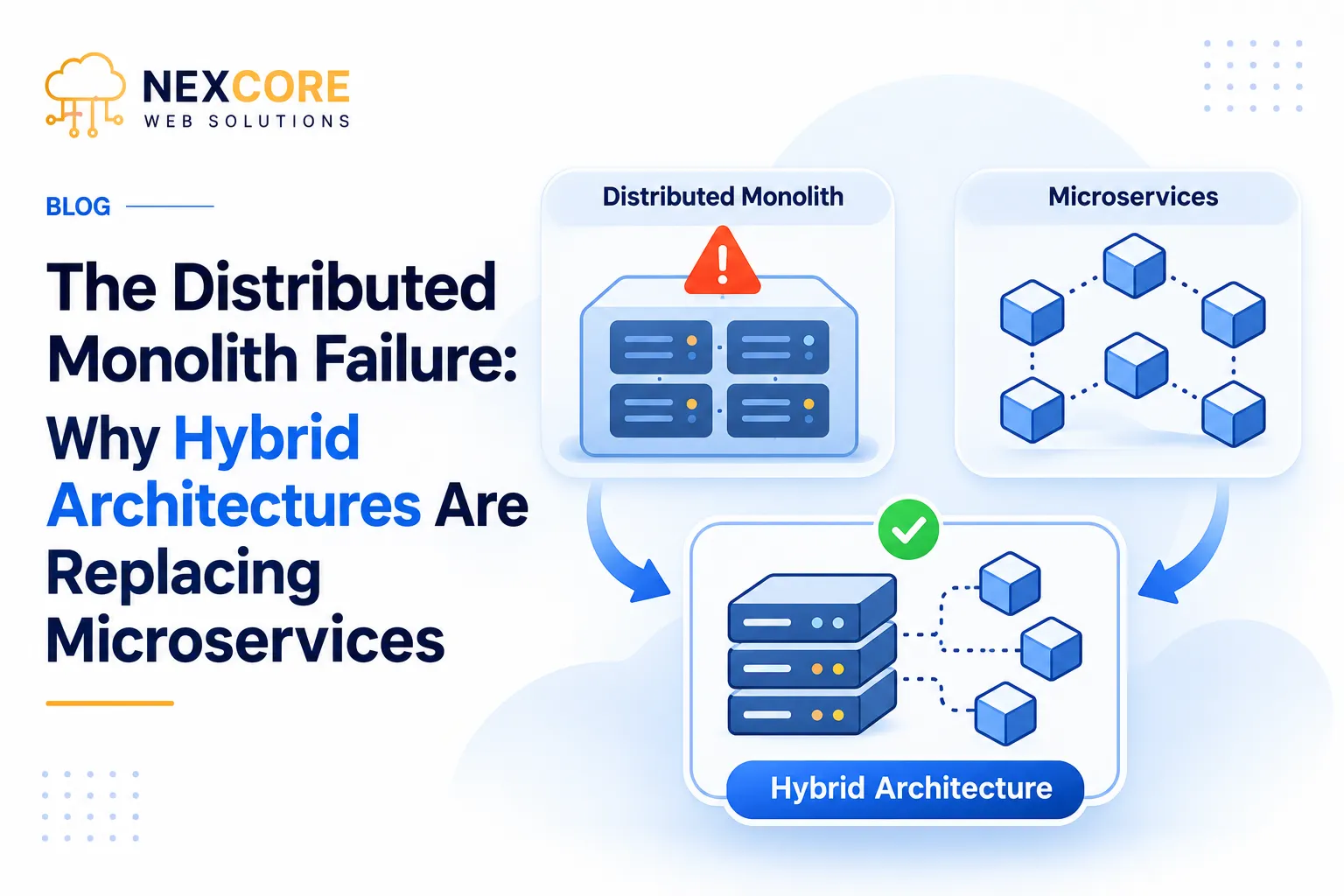
Modern software architecture has gone through several major shifts, and microservices have been one of the most influential. By breaking large applications into smaller, independently deployable services, organizations hoped to improve scalability, team autonomy, and development speed. However, many companies have discovered that simply splitting a monolith into dozens of networked services can create a different problem: the distributed monolith. In this architecture, services appear independent but remain tightly connected through synchronous calls, shared data, and coordinated deployments. The result is greater operational complexity without the expected flexibility. As teams learn from these challenges, hybrid architectures are emerging as a practical alternative that combines modular design with carefully chosen service boundaries.
Understanding the Distributed Monolith
A distributed monolith occurs when an application is divided into multiple services that cannot operate independently. A small change in one service may require updates, testing, or deployment across several others. Although the system uses containers, APIs, and separate repositories, its components remain tightly coupled at the business or operational level.
Consider an e-commerce platform with separate services for orders, inventory, payments, and shipping. If placing an order requires synchronous communication with all four services, a failure or delay in one dependency can affect the entire transaction. The architecture has gained network calls, monitoring requirements, and deployment complexity without truly isolating failures.
This problem often develops when teams adopt microservices before understanding their domain boundaries. Technical separation alone does not create independence. If services constantly share internal knowledge and must change together, the organization has effectively rebuilt a monolith across a network.
Why Microservice Complexity Grows Quickly
Microservices introduce costs that are easy to underestimate during early development. Every service requires deployment automation, logging, security controls, monitoring, configuration management, and reliable communication with other systems. A platform with fifty services does not simply have fifty small applications; it has a large network of dependencies that must be understood and maintained.
Distributed communication also makes failures harder to diagnose. A user may experience a slow response because of a database query, an overloaded downstream service, a network timeout, or a retry loop. Engineers need tracing and observability across the entire request path rather than relying on logs from a single application.
Data consistency presents another challenge. A traditional monolith can often use a single database transaction to keep related information synchronized. In a distributed environment, teams may need asynchronous events, compensating actions, and eventually consistent data, which require careful design and operational discipline.
The Case for Hybrid Architectures
Hybrid architecture does not mean abandoning microservices and returning to one massive codebase. Instead, it recognizes that different parts of an application have different scaling, reliability, and ownership requirements. Closely related functionality can remain inside a modular monolith, while components with clear boundaries can operate as independent services.
This approach reduces unnecessary network communication while preserving the ability to scale important workloads independently. For example, an application may keep customer accounts, orders, and product management within a well-structured core application. A high-volume recommendation engine, payment integration, or media processing system can then run as separate services because those workloads have distinct technical requirements.
The key principle is intentional distribution. Teams should introduce service boundaries when independence creates measurable value rather than treating microservices as the default architecture for every feature.
Modular Monoliths as a Strong Foundation
A modular monolith organizes a single deployable application into clearly separated business modules. Each module has defined responsibilities and internal interfaces, limiting unnecessary dependencies between different areas of the codebase. Unlike an unstructured monolith, developers can understand ownership boundaries without managing network communication for every interaction.
This structure also provides a useful path for future evolution. If one module eventually needs independent scaling or a separate release cycle, the existing boundaries make extraction easier. Teams can validate whether a business capability truly needs to become a service before paying the operational cost.
A modular monolith is particularly effective for products with small or medium-sized engineering teams. Developers can move quickly because local development, testing, and debugging remain relatively simple. At the same time, good internal boundaries prevent the codebase from becoming an uncontrolled collection of tightly connected features.
Choosing What Should Become a Service
Not every application component benefits from independent deployment. The strongest candidates usually have distinct scaling requirements, clear ownership, or specialized infrastructure needs. A real-time analytics pipeline, for example, may require different storage and processing technology from a transactional web application.
Services are also useful when a component has a stable interface and can tolerate communication over a network. If two modules change together every week and require immediate synchronous access to the same data, separating them may create more problems than benefits. Architecture decisions should reflect actual business and technical patterns.
Teams should examine several questions before extracting a service:
- Does this component need to scale independently?
- Can it be owned and deployed by a separate team?
- Does it have clear data boundaries?
- Will independent operation reduce risk or improve delivery speed?
These questions help organizations avoid creating services simply because the technology stack supports them.
Improving Reliability Through Simpler Boundaries
Hybrid architectures can improve reliability by reducing the number of synchronous dependencies in common application flows. A core business process that runs inside one application avoids several network hops and potential points of failure. External services can be reserved for capabilities where isolation provides meaningful resilience.
Asynchronous messaging can further separate workloads that do not require an immediate response. For example, an order system may complete a transaction first and publish an event for analytics, notifications, or reporting. A temporary failure in the reporting system does not need to prevent the customer from completing a purchase.
However, asynchronous architecture is not automatically simpler. Event schemas, duplicate delivery, ordering, and failure recovery still require careful engineering. The goal is not to replace every API call with a message queue but to select communication patterns based on business requirements.
Organizational Benefits of a Hybrid Model
Architecture affects the way engineering teams collaborate. A large microservices environment can create coordination overhead when developers must understand many repositories, deployment pipelines, and service contracts. Smaller teams may spend more time operating infrastructure than improving the product.
A hybrid model allows organizations to match architecture with team maturity. The core platform can remain easier to manage while specialized teams operate independent services where their expertise creates value. This prevents unnecessary platform complexity from becoming a barrier to product development.
It also supports gradual change. Companies can modernize legacy systems by improving internal module boundaries first instead of attempting a risky, large-scale migration to microservices. Services can then be extracted based on proven bottlenecks and business needs.
Avoiding Another Architectural Extreme
The growing interest in modular monoliths and hybrid systems should not be interpreted as proof that microservices have failed. Large organizations with complex products, independent teams, and diverse workloads can gain substantial benefits from a well-designed service architecture. The problem is usually uncontrolled distribution rather than microservices themselves.
Similarly, keeping everything inside one application does not guarantee simplicity. An unstructured monolith can become difficult to test, understand, and modify. Strong boundaries, clear ownership, and disciplined engineering practices remain important regardless of deployment style.
The most effective architecture is often the one that introduces the least complexity required to solve a real problem. Teams should measure deployment friction, system reliability, scaling needs, and organizational coordination before making major structural changes.
Conclusion
The distributed monolith demonstrates that splitting an application into many services does not automatically create flexibility or scalability. When services remain tightly coupled, organizations inherit the operational costs of distributed systems while losing the simplicity of a unified application. Hybrid architectures offer a more balanced path by keeping closely related functionality together and distributing only the components that benefit from true independence. A modular monolith can provide a strong foundation, while specialized services handle workloads with unique scaling or technical requirements. Instead of choosing between monoliths and microservices as opposing philosophies, engineering teams should focus on meaningful boundaries. The future of enterprise architecture is increasingly defined by practical decisions that prioritize maintainability, reliability, and sustainable product velocity.
FAQs
What is a distributed monolith?
A distributed monolith is a system made up of multiple services that appear independent but remain tightly coupled. Changes often require coordinated updates, deployments, or communication across several services. This architecture combines the operational complexity of distributed systems with many of the limitations of a traditional monolith, making development and troubleshooting more difficult.
What is a hybrid software architecture?
A hybrid architecture combines different architectural approaches based on actual requirements. A company might use a modular monolith for closely related business functions while operating separate services for high-scale analytics or specialized processing. This approach helps teams avoid unnecessary distribution while retaining the flexibility to scale and isolate components that genuinely need independence.
Are microservices still useful for enterprise applications?
Yes, microservices remain useful when applications have clear domain boundaries, independent teams, and different scaling requirements. They work best when services can operate with genuine autonomy and stable interfaces. Problems usually occur when organizations divide applications into services without addressing data ownership, dependency management, or the operational responsibilities of distributed systems.
Why are modular monoliths becoming more popular?
Modular monoliths provide clear internal boundaries without the networking and infrastructure overhead of multiple services. They simplify local development, testing, and deployments while keeping related functionality organized. They also offer a practical migration path because well-defined modules can be extracted into independent services later when scaling or organizational needs justify the change.
How should a team decide between a monolith and microservices?
Teams should evaluate their product complexity, team structure, scaling requirements, and operational maturity before choosing an architecture. Starting with a well-designed modular monolith is often effective when requirements are still evolving. Independent services should be introduced when they solve specific problems, such as separate scaling, stronger fault isolation, or clear ownership by dedicated engineering teams.




