
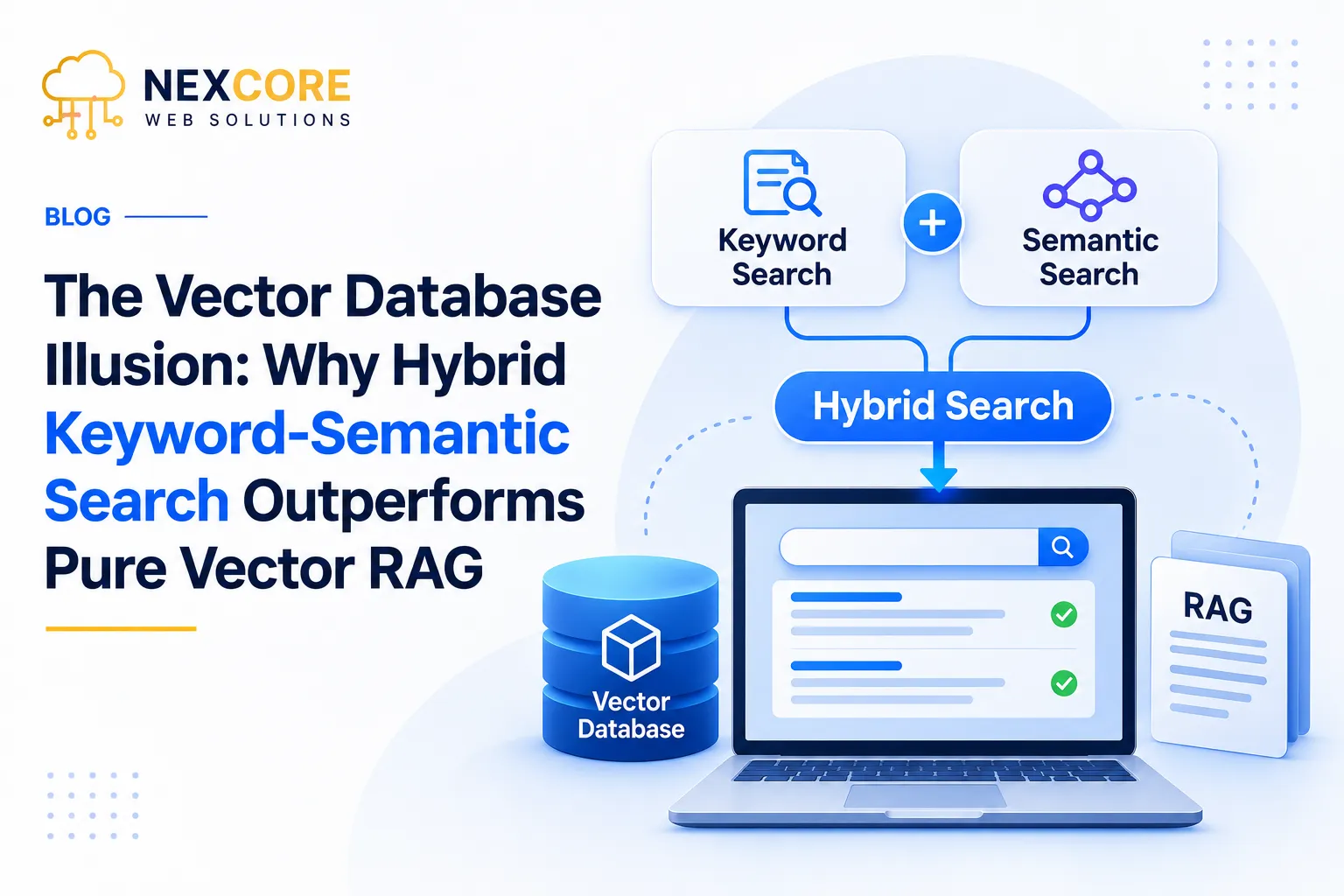
Retrieval-augmented generation, or RAG, has become a popular way to connect large language models with private documents and enterprise knowledge. Many implementations begin with a simple formula: convert documents into vectors, store them in a vector database, and retrieve the most semantically similar chunks for every question. This approach can work well, but it creates an illusion that vector similarity alone is enough for reliable search. Enterprise information is rarely purely semantic. Product codes, error messages, names, dates, policy numbers, and exact technical terms often matter just as much as conceptual meaning. Hybrid search combines traditional keyword retrieval with semantic vector search, giving RAG systems a broader and more accurate view of user intent.
Why Pure Vector Search Can Miss Important Results
Vector search converts text into numerical representations called embeddings. Documents with similar meanings are placed close together in a mathematical space, allowing a system to retrieve related content even when the query uses different wording. This makes semantic search valuable for natural language questions, broad concepts, and documents containing varied terminology.
However, semantic similarity is not the same as factual precision. A user searching for a specific error code or contract number may need an exact match rather than a conceptually related document. Embeddings can retrieve passages that discuss a similar problem while ranking the precise document lower than expected.
This issue becomes more visible in enterprise environments where language contains specialized vocabulary. Internal product names, abbreviations, version numbers, and customer identifiers may have little semantic meaning outside their exact context. A vector model may not understand that one character in a configuration value can completely change the answer.
The Strength of Traditional Keyword Search
Keyword search remains extremely effective when users need exact information. Technologies based on inverted indexes can quickly locate documents containing a particular term, phrase, or identifier. Ranking methods such as BM25 also consider term frequency and document relevance, making keyword retrieval a dependable foundation for structured and technical content.
For example, an engineer investigating an error such as “AUTH-1042” expects documentation containing that exact code. A semantic system might return general authentication troubleshooting guides because their overall meaning appears related. Keyword search can immediately identify the documents where the exact error code appears.
Traditional search also provides predictable behavior for specific queries. When a user searches for a unique product name or legal clause, exact matching can be easier to validate and debug. This does not make keyword search superior in every situation, but it explains why removing it entirely can weaken a production RAG system.
How Hybrid Search Combines Both Approaches
Hybrid search retrieves information using both keyword and semantic methods, then combines the results into a unified ranking. The keyword component captures exact terms and lexical relationships, while the vector component identifies documents that express similar ideas using different language. Together, they reduce the weaknesses that appear when either method operates alone.
A customer might ask, “How do I fix the login timeout after version 4.2?” Keyword retrieval can recognize the exact version number and technical phrase. Semantic retrieval can find documentation describing session expiration, authentication delays, or related configuration changes. A ranking layer can then determine which passages best satisfy the complete question.
The final ranking is an important part of the architecture. Systems may use weighted scoring, reciprocal rank fusion, or a dedicated reranking model to compare retrieved results. The best choice depends on the data, query patterns, latency requirements, and available computing resources.
Understanding the Retrieval Pipeline
A reliable hybrid RAG pipeline requires more than placing two search engines behind one API. Document preparation has a major effect on retrieval quality. Content should be cleaned, divided into meaningful chunks, and enriched with metadata that helps filtering and ranking.
A practical pipeline often includes several stages:
- Document parsing and structured chunking based on headings or content boundaries.
- Keyword indexing for exact terms, phrases, and identifiers.
- Embedding generation for semantic retrieval.
- Metadata filtering based on permissions, document type, or date.
- Result fusion and reranking before sending context to the language model.
Each stage addresses a different retrieval problem. Treating the vector database as the complete knowledge layer can hide weaknesses in document quality or access control. A strong pipeline evaluates retrieval as a system rather than focusing only on embedding similarity scores.
Why Reranking Matters for RAG Quality
Initial retrieval usually prioritizes speed over perfect accuracy. A hybrid system might retrieve dozens of potentially useful passages from both keyword and vector indexes. Reranking then evaluates those candidates more carefully against the complete user query.
This process can improve relevance because the reranker sees the relationship between the query and each candidate in greater detail. For example, several documents may mention a software version, but only one explains the specific problem described by the user. A reranker can help move that passage closer to the top.
Reranking should also be measured against real user questions. Teams sometimes optimize benchmarks while overlooking the terminology and search behavior of actual employees or customers. Building a representative evaluation set provides a clearer picture of whether retrieval improvements are meaningful in production.
The Risks of Over-Relying on Vector Databases
Vector databases are useful infrastructure, but they are not a replacement for search design. A high-quality embedding model cannot compensate for poorly structured documents, missing metadata, or chunks that separate important facts from their context. Retrieval failures often begin before the query reaches the database.
Another risk is assuming that the highest similarity score represents the correct answer. Vector scores measure relationships within an embedding space, not factual correctness or business relevance. A passage can be semantically close to a question while containing outdated, incomplete, or unauthorized information.
Enterprise systems must also consider security and permissions. Search results should be filtered according to what a user is authorized to access before sensitive information reaches the language model. Hybrid retrieval can work with these controls, but access filtering must be designed as a core requirement rather than an afterthought.
Choosing the Right Strategy for Your Data
The best retrieval strategy depends heavily on the information being searched. A knowledge base containing conversational support articles may benefit strongly from semantic search. A repository filled with technical specifications, part numbers, and exact identifiers will usually require robust keyword capabilities.
Organizations should begin by analyzing real queries rather than choosing a database based on current trends. Teams can identify how often users search for exact terms, broad concepts, recent information, or combinations of these needs. This evidence makes it easier to configure ranking weights and evaluate trade-offs.
Hybrid search is not necessarily more complicated for users. The complexity belongs inside the retrieval layer, while the user receives a more reliable answer. When implemented carefully, combining search methods improves recall and precision without requiring people to understand how the underlying system works.
Measuring Retrieval Beyond Similarity Scores
RAG performance should be evaluated using more than model output quality. If the correct source document is never retrieved, even an advanced language model cannot reliably provide the right answer. Teams should measure retrieval recall, ranking quality, response latency, and the usefulness of the final generated response.
Human evaluation remains valuable, especially for high-impact enterprise workflows. Reviewers can identify cases where an answer sounds convincing but relies on incomplete or irrelevant context. These findings can reveal weaknesses that automated similarity metrics fail to capture.
Regular evaluation is particularly important when documents change. New policies, products, and technical documentation can alter search behavior over time. Monitoring real queries and updating indexes ensures that the retrieval layer continues to reflect the organization’s current knowledge.
Conclusion
The popularity of vector databases has encouraged many RAG projects to treat semantic similarity as the complete solution to information retrieval. In reality, enterprise search requires both conceptual understanding and exact matching. Hybrid keyword-semantic search provides a practical balance by combining the strengths of traditional retrieval with the flexibility of embeddings. Keyword search handles identifiers and precise terminology, while semantic search helps users find information when their wording differs from the original documents. Reranking, metadata, access controls, and continuous evaluation further improve reliability. The goal is not to replace vector search but to place it within a broader retrieval strategy. For production RAG systems, better answers usually begin with better search rather than a larger vector database.
FAQs
What is hybrid search in a RAG system?
Hybrid search combines traditional keyword retrieval with semantic vector search. Keyword search identifies exact words, phrases, and identifiers, while vector search finds content with similar meaning even when different wording is used. The results are combined and ranked to provide more relevant context to the language model before it generates a response.
Why is pure vector search not always accurate?
Pure vector search focuses on semantic similarity rather than exact matches. This can cause problems when a query contains error codes, product numbers, names, dates, or specialized terminology. The system may retrieve conceptually related content instead of the precise document required, which can reduce the factual accuracy of the final RAG response.
Does hybrid search require both a vector database and a keyword index?
In many implementations, yes, although some modern search platforms provide both capabilities in one system. The important requirement is access to both lexical and semantic retrieval methods. Organizations should select infrastructure based on data volume, latency needs, security requirements, and existing technology rather than assuming that separate databases are always necessary.
What is reranking in a hybrid RAG pipeline?
Reranking is a process that evaluates the initially retrieved documents or passages more carefully against the user’s complete query. After keyword and semantic search produce a candidate set, a ranking model or scoring method places the most relevant results at the top. This helps the language model receive more accurate and focused context.
How can companies evaluate hybrid search performance?
Companies should test hybrid search using realistic questions collected from actual users and business workflows. Useful measurements include whether the correct documents are retrieved, where they appear in rankings, response latency, and the quality of generated answers. Human review is also important because automated metrics may miss factual errors or misleading responses.




