
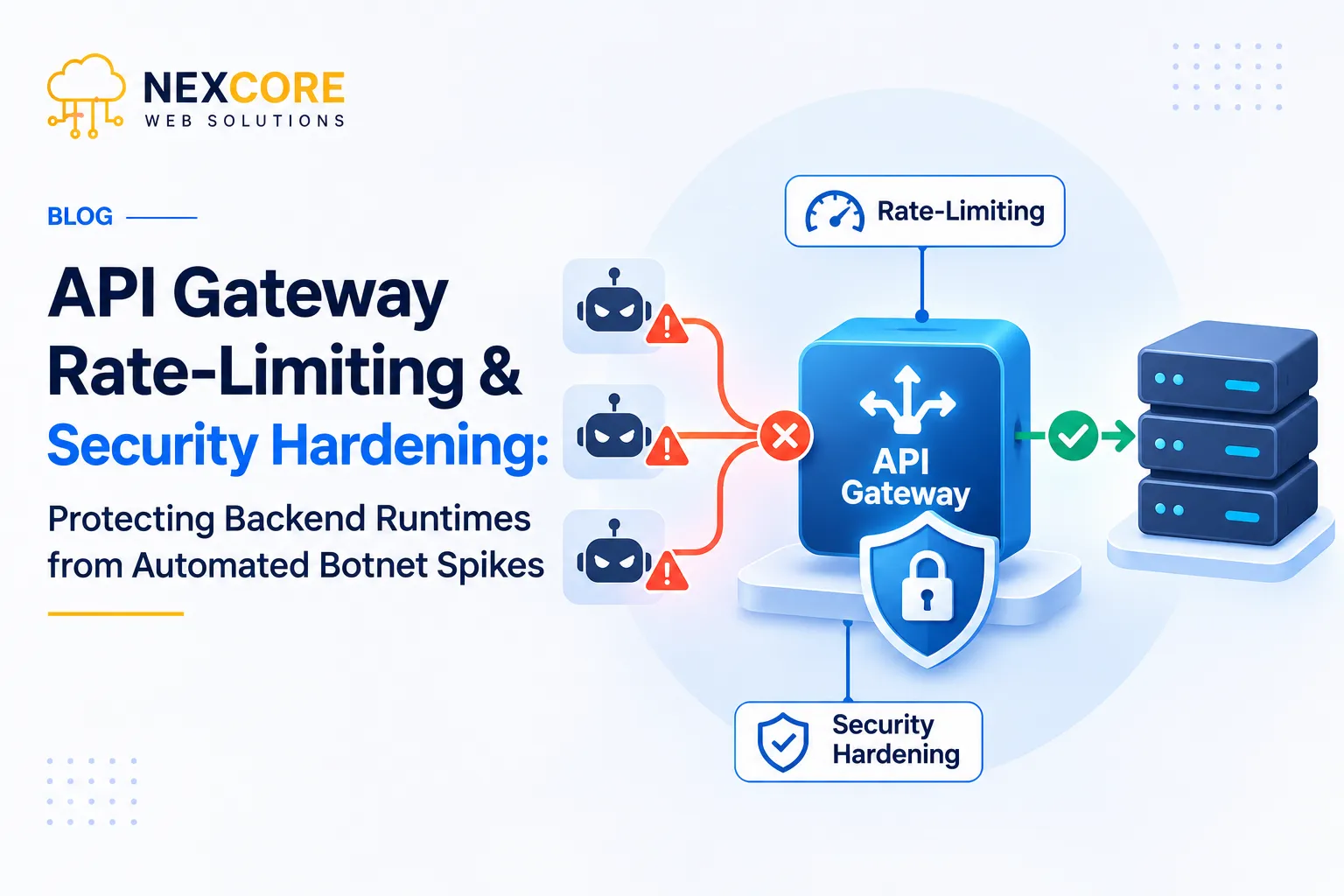
APIs are the front door to many modern applications, connecting websites, mobile apps, third-party services, and internal systems to critical backend resources. This accessibility also makes APIs attractive targets for automated traffic, credential abuse, scraping, and large-scale botnet spikes. A sudden increase in requests can exhaust application servers, overload databases, and create service outages even when the attack does not exploit a traditional software vulnerability. An API gateway provides a strategic control point for managing this risk before harmful traffic reaches backend runtimes. Effective rate limiting and security hardening help organizations control request volume, identify suspicious patterns, and preserve resources for legitimate users. The strongest approach combines several layers of protection rather than relying on a single request limit.
Why Automated Traffic Threatens Backend Systems
Automated traffic can arrive much faster and at a larger scale than normal user activity. Botnets distribute requests across many devices and IP addresses, making simple IP-based blocking less effective. Attackers may repeatedly target login endpoints, search APIs, checkout processes, or expensive database queries. Even legitimate-looking requests can become dangerous when their volume overwhelms available infrastructure.
Backend systems are particularly vulnerable when each API request triggers significant processing. For example, an endpoint that generates reports or performs complex database searches may consume far more resources than a simple static request. A botnet can exploit this difference by repeatedly calling expensive endpoints. The result may be increased latency, higher infrastructure costs, and failures for genuine customers.
The API gateway acts as a protective layer between incoming traffic and application services. It can evaluate requests and reject or slow suspicious traffic before backend resources are consumed. This reduces the impact of traffic spikes and gives security teams a central location for enforcing consistent controls.
Understanding Rate-Limiting Strategies
Rate limiting controls how many requests a client can make during a defined period. The goal is not simply to block traffic but to establish reasonable boundaries based on application behavior. A public endpoint may allow a higher volume than a login or password-reset endpoint. Effective policies consider the sensitivity and resource cost of each API operation.
Fixed Windows and Token Buckets
A fixed-window limit counts requests within a specific time interval. For example, an API may permit a certain number of requests every minute before rejecting additional traffic. This approach is straightforward, but traffic bursts at the boundary between two windows can temporarily exceed the intended rate. It works best for simple applications where precise traffic smoothing is not essential.
Token bucket algorithms provide greater flexibility for modern APIs. Clients receive tokens at a controlled rate and consume a token for each request. Short bursts are allowed when tokens are available, while sustained excessive traffic is restricted. This model can protect backend services without unnecessarily blocking legitimate users who occasionally make several requests quickly.
Limits Based on More Than IP Addresses
IP-based limits remain useful, but they should rarely be the only control. Large organizations, mobile networks, and users behind shared networks may generate traffic from the same address. At the same time, distributed botnets can use thousands of different IP addresses. Relying exclusively on IP limits can therefore block legitimate users while failing to stop coordinated abuse.
A stronger policy can combine multiple signals, such as authenticated user identity, API key, device characteristics, and endpoint behavior. For authenticated APIs, limits per account or API credential can provide more meaningful protection. Different thresholds can also be applied to high-risk operations. This layered approach makes automated abuse more difficult while supporting normal application usage.
Hardening the API Gateway
Rate limiting is only one part of API gateway security. The gateway should enforce authentication and authorization before forwarding sensitive requests to backend services. Invalid, expired, or malformed credentials should be rejected at the edge whenever possible. This prevents unnecessary processing and reduces the opportunity for attackers to reach internal application logic.
Input validation is another important defensive measure. Requests with unexpected methods, oversized payloads, or invalid content types can be blocked according to clearly defined rules. APIs should expose only the methods and routes required by the application. Removing unused endpoints and limiting unnecessary features reduces the attack surface.
Security headers and encrypted connections should also be configured consistently. Internal services should not assume that a request is trustworthy simply because it passed through the gateway. Backend applications still need authorization checks and secure coding practices. The gateway provides an important security layer, but it should support a broader defense-in-depth strategy.
Detecting Botnet Spikes and Abnormal Behavior
Static rate limits cannot identify every type of automated attack. Attackers may keep individual request rates below configured thresholds while coordinating activity across thousands of compromised devices. Behavioral monitoring helps detect patterns that traditional limits may miss. Sudden changes in request volume, unusual endpoint combinations, and repeated failures can all indicate automated abuse.
Observability data from the API gateway should include request rates, response codes, latency, and authentication failures. Teams can establish a baseline for normal traffic and create alerts when behavior changes significantly. Monitoring should focus on trends rather than individual events because distributed attacks may appear harmless when each source is viewed separately.
Automated responses can also help reduce reaction time during a spike. Temporary restrictions may be applied to unusually expensive endpoints or suspicious traffic patterns. However, automated blocking should be tested carefully to avoid disrupting legitimate customers during popular events or unexpected traffic growth. Human review remains valuable when security signals are uncertain.
Protecting Backend Resources Beyond the Gateway
A secure gateway cannot compensate for an unlimited backend. Applications should enforce resource limits, connection controls, and timeouts to prevent individual requests from consuming excessive capacity. Databases should also be protected against uncontrolled query volume and expensive operations. These internal safeguards ensure that a gateway failure or misconfiguration does not create a single point of exposure.
Caching can reduce the cost of repeated requests for data that does not change frequently. Queue-based processing can move time-consuming tasks away from synchronous API responses. Circuit breakers and load-shedding mechanisms can prevent overloaded services from causing failures across the entire application. Together, these patterns improve resilience during both malicious and legitimate traffic spikes.
Regular security testing is essential because API behavior changes over time. New endpoints, integrations, and application features can introduce unexpected resource-intensive operations. Teams should review gateway policies whenever major services change. Testing realistic traffic scenarios helps reveal whether rate limits and backend protections remain appropriate.
Balancing Security With Legitimate User Experience
Overly aggressive rate limits can create problems for genuine users. Mobile applications may retry failed requests, enterprise customers may operate from shared networks, and legitimate automated integrations may require higher throughput. Security policies should therefore reflect real application behavior instead of using arbitrary limits. Clear API documentation can also help customers understand usage boundaries.
Different service tiers may require different limits when an application supports authenticated partners or trusted integrations. Temporary increases can be managed through controlled API credentials rather than weakening global security settings. When a request is rejected, a clear response helps developers understand when and how to retry. Good security controls should protect availability without making the API unnecessarily difficult to use.
Conclusion
API gateways play a critical role in protecting modern backend systems from automated botnet spikes and abusive traffic. Rate limiting reduces the number of harmful requests that reach expensive application resources, while authentication, validation, and behavioral monitoring provide additional security layers. The most effective strategy uses multiple signals instead of relying only on IP addresses or a single fixed request limit. Backend services must also enforce their own resource controls because resilient security requires defense at several levels. By regularly monitoring traffic patterns, testing gateway policies, and adjusting limits to match real usage, organizations can maintain reliable APIs while reducing the risk of automated attacks and unexpected infrastructure overload.
FAQs
What is API rate limiting?
API rate limiting controls how many requests a user, application, or other client can send within a defined period. It protects backend resources from excessive traffic and helps maintain reliable service for legitimate users. Limits can be based on IP addresses, API keys, authenticated accounts, or other signals, depending on the application’s security and performance requirements.
Can rate limiting stop a botnet attack?
Rate limiting can reduce the impact of a botnet attack, but it may not stop every distributed attack by itself. Botnets can use many different IP addresses and keep individual request rates relatively low. Combining rate limits with authentication controls, behavioral monitoring, traffic filtering, and backend resource protections provides stronger defense against coordinated automated traffic.
Which API endpoints need stricter rate limits?
Authentication, password recovery, payment, search, report generation, and other resource-intensive endpoints often need stricter limits. These operations can be attractive targets for automated abuse or may consume significant backend capacity. Organizations should evaluate the security sensitivity and processing cost of each endpoint rather than applying identical limits across the entire API.
Should rate limits be based only on IP addresses?
No, IP-based limits should usually be combined with other signals. Legitimate users may share an IP address through corporate or mobile networks, while botnets can distribute requests across many addresses. Authenticated user IDs, API keys, endpoint behavior, and device-related signals can provide more accurate controls and reduce unnecessary blocking of genuine traffic.
How often should API gateway security policies be reviewed?
API gateway security policies should be reviewed whenever significant endpoints, integrations, or application workloads change. Regular reviews also help identify limits that no longer match normal traffic patterns. Security teams should analyze monitoring data and test realistic traffic spikes to ensure policies protect backend resources without unnecessarily disrupting legitimate users or trusted integrations.




