
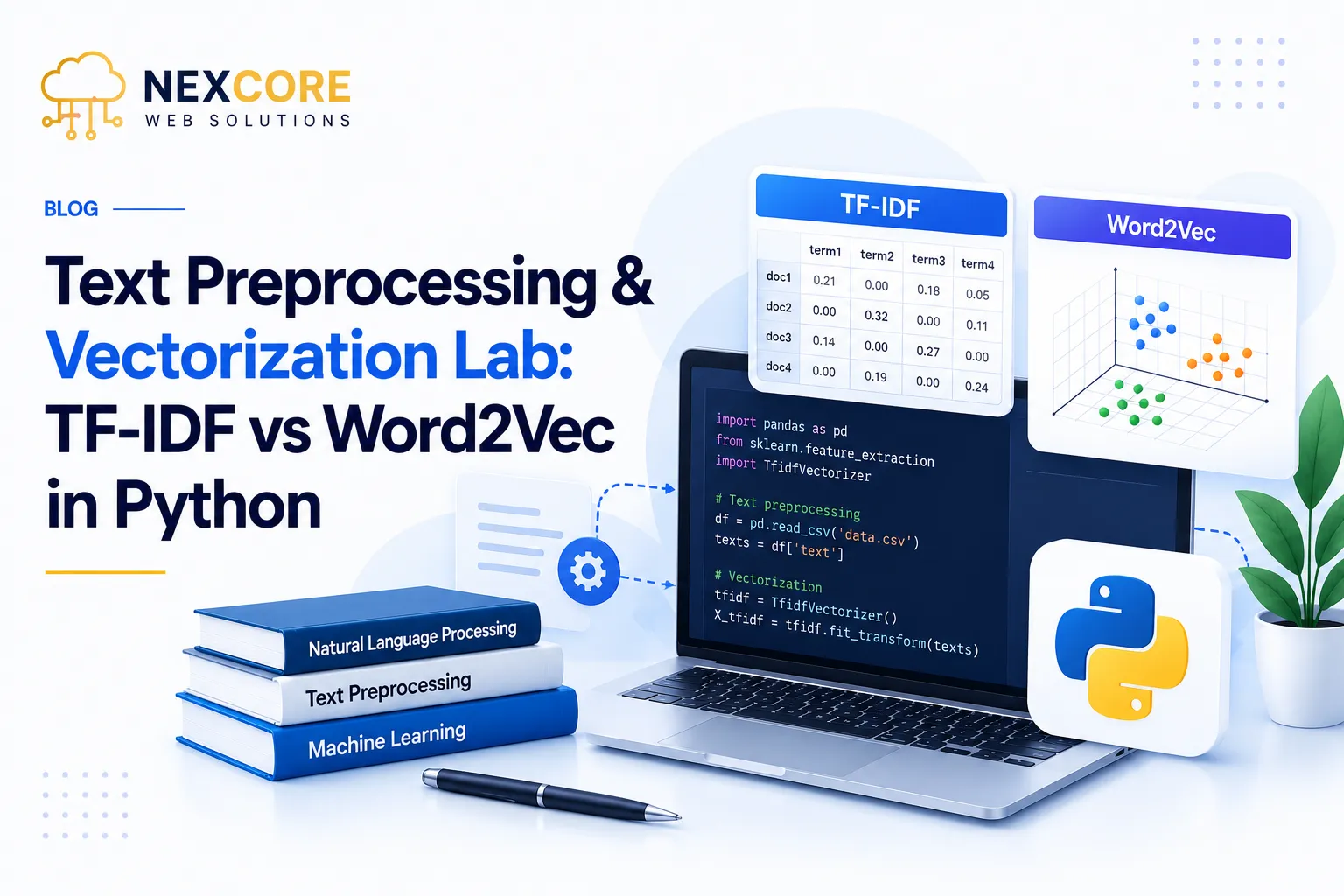
Natural language processing systems cannot work directly with raw sentences in the same way humans understand them. Before a machine learning model can classify, compare, or predict text, developers usually need to clean the data and convert words into numerical representations. Text preprocessing removes inconsistencies such as unnecessary punctuation, unwanted spaces, and irrelevant tokens, while vectorization transforms language into mathematical features. Two widely used approaches are Term Frequency-Inverse Document Frequency (TF-IDF) and Word2Vec. TF-IDF represents words according to their importance within documents, whereas Word2Vec learns dense numerical representations based on surrounding words. Understanding the difference between these methods is useful for students, developers, and data scientists building sentiment analysis, document classification, search, recommendation, and other NLP applications in Python.
Why Text Preprocessing Matters
Raw text often contains inconsistent capitalization, punctuation, HTML fragments, repeated spaces, emojis, URLs, and other elements that may not contribute useful information to a particular machine learning task. Preprocessing creates a more consistent representation before feature extraction begins. Common operations include lowercasing, tokenization, punctuation handling, stop-word filtering, and optional stemming or lemmatization. The exact preprocessing pipeline should depend on the dataset and objective because aggressively removing information can sometimes reduce model quality.
Tokenization and Normalization
Tokenization divides text into smaller units, usually words or subwords, that can be processed individually. For example, a sentence such as “Python makes NLP practical” can be separated into meaningful tokens before vectorization. Lowercasing can ensure that “Python” and “python” are treated consistently when capitalization is not meaningful. Developers should also inspect the dataset before removing stop words because words that appear unimportant in one task may carry useful information in another.
TF-IDF Vectorization in Python
TF-IDF converts documents into numerical vectors based on how frequently terms appear and how uncommon they are across the document collection. Term Frequency measures how often a word appears in a particular document, while Inverse Document Frequency reduces the importance of words that occur in many documents. As a result, a term appearing frequently in one document but rarely across the dataset can receive a stronger weight. This makes TF-IDF useful for identifying distinctive vocabulary.
Implementing TF-IDF
Python’s scikit-learn library provides TfidfVectorizer, which can handle tokenization and feature construction in a convenient pipeline. A developer can provide a collection of documents, fit the vectorizer on training data, and transform the text into a sparse numerical matrix. The resulting features can then be passed to algorithms such as logistic regression, support vector machines, or naive Bayes. Developers should fit the vectorizer only on training data when evaluating a model to avoid leaking information from validation or test sets.
TF-IDF is relatively easy to interpret because each feature corresponds to a vocabulary term with an associated numerical weight. It also produces sparse matrices, which can be efficient when documents contain many possible terms but each individual document uses only a small subset. However, TF-IDF does not inherently understand word meaning or relationships between similar terms. For example, “excellent” and “great” may receive completely independent features even though they can have similar meanings.
Word2Vec and Distributed Word Representations
Word2Vec takes a different approach by learning dense vector representations from word context. Instead of assigning importance based only on document frequency, it learns relationships between words by examining which terms tend to appear near each other. Two common Word2Vec training approaches are Continuous Bag of Words (CBOW) and Skip-Gram. The resulting vectors can capture useful semantic and syntactic relationships when the training corpus is sufficiently representative.
Training Word2Vec in Python
The Gensim library is commonly used for Word2Vec experiments in Python. Developers provide tokenized sentences and configure parameters such as vector size, context window, minimum word frequency, and training epochs. The trained model can then return a dense vector for words included in its vocabulary. Similarity operations can also identify words whose learned representations are close in vector space.
Word2Vec requires more consideration than a basic TF-IDF pipeline because the quality of its representations depends heavily on the training corpus. A small or highly specialized dataset may not contain enough contextual information to learn reliable relationships. Pretrained embeddings can provide a practical alternative when a suitable model is available. Even then, developers should consider whether the vocabulary and domain match the application being developed.
TF-IDF vs Word2Vec
The two approaches differ mainly in what information they capture. TF-IDF focuses on the importance of terms within documents, making it useful for traditional document classification, keyword analysis, and information retrieval. Word2Vec focuses on contextual relationships and produces dense representations that can capture similarities between words. Therefore, neither method is universally superior; the better choice depends on the task, dataset size, computational resources, and required representation.
For a simple sentiment classification project with a moderate dataset, TF-IDF combined with a linear classifier may provide a strong and easy-to-understand baseline. For applications where semantic similarity is important, Word2Vec can provide richer representations. Developers can also experiment with combining different feature types when the architecture and model benefit from both lexical importance and semantic information.
Building a Practical NLP Lab
A useful Python lab should compare both methods using the same dataset and evaluation procedure. Students can begin by cleaning the text, splitting it into training and testing sets, and applying TF-IDF to create a baseline. They can then train or load Word2Vec embeddings and construct document-level representations, such as averaging word vectors. Accuracy, precision, recall, F1-score, training time, and memory usage can then be compared across the experiments.
The experiment should also include qualitative inspection rather than relying only on numerical scores. Examine important TF-IDF terms and test Word2Vec similarity relationships to understand what each representation has learned. Record preprocessing choices, vectorizer settings, embedding dimensions, and model parameters so the experiment remains reproducible. This makes the lab more valuable because students learn not only how to execute code but also how feature representation affects machine learning results.
Conclusion
Text preprocessing and vectorization are essential stages in practical NLP workflows. Cleaning and tokenizing text creates a consistent foundation, while TF-IDF and Word2Vec provide different ways to convert language into numerical features. TF-IDF is simple, efficient, interpretable, and effective for many document-level tasks, while Word2Vec captures contextual relationships through dense word embeddings. The right choice depends on the problem rather than popularity alone. A strong Python lab should evaluate both approaches using identical data splits, suitable metrics, and carefully documented preprocessing steps. By comparing their strengths and limitations, developers can better understand how feature representation influences NLP performance and make more informed decisions when designing real-world text processing pipelines.
FAQs
1. What is the main difference between TF-IDF and Word2Vec?
TF-IDF represents words according to their importance within individual documents and the overall document collection. Word2Vec learns dense word vectors based on contextual relationships between words. TF-IDF is generally easier to interpret and works well with traditional machine learning algorithms, while Word2Vec can capture semantic similarities. The appropriate method depends on the NLP task, dataset, computational resources, and desired representation.
2. Is TF-IDF better than Word2Vec for text classification?
TF-IDF can be an excellent choice for text classification, particularly when datasets are moderate in size and the vocabulary itself contains strong predictive signals. It is computationally efficient and produces interpretable features. However, Word2Vec may capture semantic relationships that TF-IDF misses. Developers should compare both methods using the same evaluation dataset rather than assuming one will always produce better classification results.
3. Why is preprocessing important before vectorization?
Preprocessing reduces inconsistencies and removes text elements that may interfere with feature extraction. Operations such as tokenization, normalization, punctuation handling, and selective stop-word removal can create cleaner input. However, preprocessing should not become unnecessarily aggressive because removing meaningful words or linguistic signals can hurt performance. The best pipeline depends on the language, dataset, domain, and machine learning objective.
4. Can Word2Vec represent an entire document?
Word2Vec normally produces vectors for individual words rather than complete documents. To represent a document, developers can combine its word vectors using methods such as averaging or weighted averaging. More advanced approaches can use document-level models or neural architectures that process sequences directly. The quality of a document representation depends on both the word embeddings and the method used to combine them.
5. Which Python libraries are commonly used for TF-IDF and Word2Vec?
Scikit-learn provides TfidfVectorizer for convenient TF-IDF feature extraction and integration with traditional machine learning workflows. Gensim is commonly used for training and working with Word2Vec embeddings. Python’s broader NLP ecosystem also includes libraries for tokenization and linguistic preprocessing. Choosing libraries should depend on the experiment’s requirements, dataset size, model architecture, and desired level of control.




