
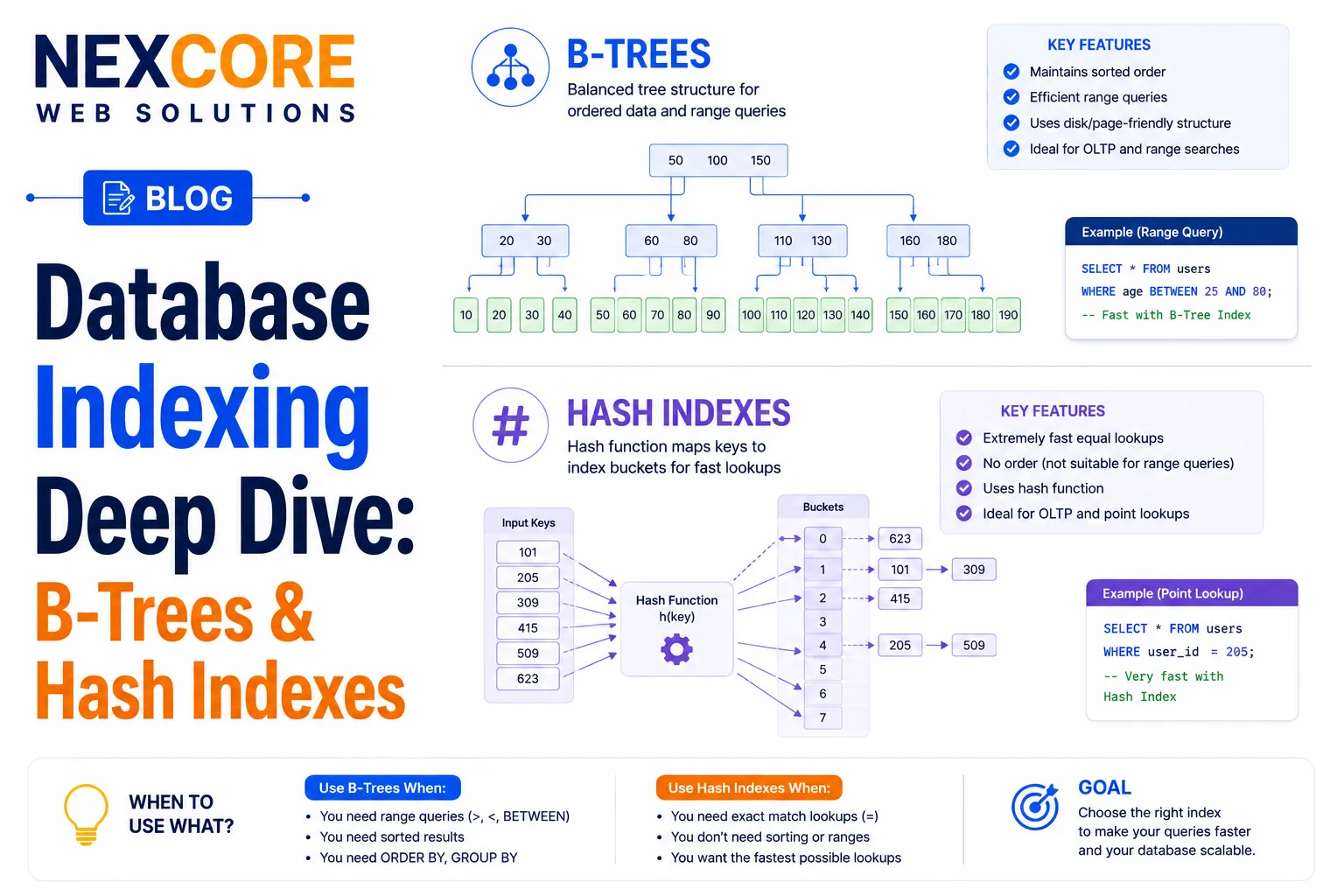
Database indexing is one of the most important techniques for improving query performance. Without an appropriate index, a database may need to examine a large portion of a table before finding the requested records, which becomes increasingly expensive as data grows. An index creates an additional data structure that helps the database locate rows more efficiently, similar to how an index in a book helps readers find a topic without scanning every page. Different index structures are designed for different types of queries, and two important examples are B-tree and hash indexes. Understanding how these structures work helps developers and database administrators choose indexes intelligently, avoid unnecessary overhead, and design applications that remain responsive as their datasets become larger.
What Is a Database Index?
A database index is a separate structure containing information that helps the database locate records efficiently. Instead of reading every row in a table, the database can use an index to narrow the search to relevant entries. The index usually stores indexed values along with references or information that helps identify the corresponding table records. However, indexes are not free because they consume storage and must be maintained when data is inserted, updated, or deleted.
Why Indexes Improve Performance
Consider a customer table containing several million records with an email column. A query searching for one specific email could require a full table scan if no suitable index exists. With an index on that column, the database can navigate the index and locate the matching record much more efficiently. The exact performance improvement depends on the database engine, data distribution, query structure, hardware, and index design.
Understanding B-Tree Indexes
B-tree indexes are widely used in relational database systems because they support efficient searching, sorting, and range queries. A B-tree organizes indexed values into a balanced tree structure with multiple levels of nodes. The database can navigate from the root toward the appropriate leaf rather than examining every indexed value. Because the tree remains balanced as records change, search performance remains predictable as the index grows.
How B-Trees Work
A B-tree node can contain multiple keys and pointers to lower-level nodes. The root provides the first navigation step, while intermediate nodes narrow the search and leaf nodes contain the indexed values or references to records. When values are inserted, the database can split nodes when necessary to maintain the tree’s structure. This balancing process helps keep the number of levels relatively small even when an index contains a large number of entries.
B-Trees and Range Queries
One major advantage of B-tree indexes is their support for range conditions. Queries such as finding products priced between two values or retrieving orders created within a particular date range can benefit from this structure. B-trees also support ordered operations, making them useful for queries involving sorting and comparisons. For example, an index on created_at can help retrieve recent orders efficiently and may also reduce the work required for an ORDER BY operation.
CREATE INDEX idx_orders_createdON orders(created_at);
This index can help queries that filter or organize records based on the indexed date column. Whether the optimizer actually chooses the index depends on factors such as selectivity, query structure, table size, and database statistics.
Understanding Hash Indexes
Hash indexes use a different strategy by applying a hash function to indexed values. The resulting hash determines where the value is stored within the index structure. This approach can provide efficient equality lookups because the database can calculate the hash for a searched value and identify the corresponding location. Hash indexes are therefore particularly suited to queries that ask whether a value exactly matches a given value.
Equality Searches
A query such as the following represents a typical hash-index use case:
SELECT*FROM usersWHERE user_id =58291;
If a suitable hash index exists and the database engine supports using it for the query, the system can quickly locate the matching entry. Hash indexes are less naturally suited to ordered operations because the hash function does not preserve the original ordering of values. Consequently, queries involving ranges or sorting generally favor structures such as B-trees.
B-Tree vs Hash Indexes
The most important difference is the type of query each structure handles effectively. B-trees support equality comparisons, range searches, ordering, and many prefix-oriented access patterns, depending on the database and query. Hash indexes are primarily optimized for exact equality comparisons. This makes B-trees the more general-purpose choice in many relational database workloads, while hash indexes can be useful for specific access patterns where ordering is unnecessary.
| Feature | B-Tree | Hash |
|---|---|---|
| Equality lookup | Excellent | Excellent |
| Range queries | Excellent | Poor or unsupported |
| Sorting | Useful | Not suitable |
| Ordered traversal | Supported | Not supported |
| General-purpose use | High | More specialized |
Choosing the Right Index
Index selection should begin with the application’s actual query patterns rather than assumptions about which structure is theoretically faster. Developers should examine frequently executed queries, filtering conditions, joins, sorting operations, and data distribution. An index that looks useful may provide little benefit if most rows share the same indexed value. Query execution plans and database monitoring tools are valuable for confirming whether an index is actually being used.
Indexing Costs and Trade-Offs
Every additional index creates maintenance work. Inserts, updates, and deletes may need to modify one or more index structures, increasing write overhead. Indexes also consume memory and disk space, and excessive indexing can make database maintenance more complicated. A balanced indexing strategy focuses on queries that matter while avoiding indexes that provide little measurable value.
Composite Index Considerations
Real applications often need indexes containing multiple columns. A composite B-tree index can support queries that filter using several related fields, but column order matters. For example, an index beginning with customer_id may be particularly useful for queries filtering by customer and then date. Developers should design composite indexes according to actual query patterns rather than simply adding every commonly used column.
Testing Index Performance
Adding an index should be followed by measurement. Database systems commonly provide execution-plan tools that reveal whether a query performs a table scan, index scan, index lookup, or another access strategy. Developers can compare query execution before and after adding an index and monitor performance under realistic data volumes. Testing is important because an index that improves one query can sometimes have little effect or even introduce additional overhead elsewhere.
Conclusion
B-tree and hash indexes provide different approaches to accelerating database lookups. B-trees are versatile structures that support equality searches, range conditions, and ordered operations, making them a common choice for general-purpose relational workloads. Hash indexes specialize in exact equality lookups and can be useful when ordered access is unnecessary. However, selecting an index should never be based solely on theoretical characteristics. Developers should examine real query patterns, data distribution, execution plans, and write workloads before making changes. Good database indexing is ultimately a balance between faster reads, acceptable write overhead, storage consumption, and maintainability. With careful measurement and thoughtful design, indexes can significantly improve application performance as databases grow.
FAQs
1. What is a B-tree index?
A B-tree index is a balanced tree-based data structure used by databases to locate indexed values efficiently. It organizes keys across multiple levels and keeps the structure balanced as data changes. B-tree indexes support equality searches as well as range queries and ordered operations. They are widely used because they provide flexible performance for many common database query patterns.
2. What is a hash index used for?
A hash index is primarily designed for efficient equality lookups. It applies a hash function to indexed values and uses the resulting hash to locate entries in the index. This makes hash indexes useful for queries that search for an exact value. However, because hashing does not preserve value ordering, hash indexes are generally unsuitable for range searches and ordered retrieval.
3. Which is better, B-tree or hash indexing?
Neither index type is universally better. B-trees are more versatile because they support equality searches, range queries, and ordering, while hash indexes specialize in exact equality lookups. In many relational database applications, B-trees are the default general-purpose choice. A hash index can make sense when the workload is heavily focused on exact matches and does not require ordered or range-based access.
4. Do indexes always make database queries faster?
No. An index can improve a query substantially, but it does not guarantee better performance in every situation. If an indexed column has very low selectivity, the database may determine that scanning the table is more efficient. Indexes also introduce storage and write-maintenance costs. Execution plans, realistic datasets, and performance measurements should be used to determine whether a particular index provides meaningful value.
5. Can a table have multiple indexes?
Yes, a table can have multiple indexes, and real applications commonly use several indexes for different query patterns. However, adding too many indexes can increase storage usage and slow inserts, updates, and deletes because each relevant index must be maintained. Indexes should therefore be based on actual application queries and workload requirements. Regular monitoring can help identify indexes that are useful, redundant, or rarely used.




