
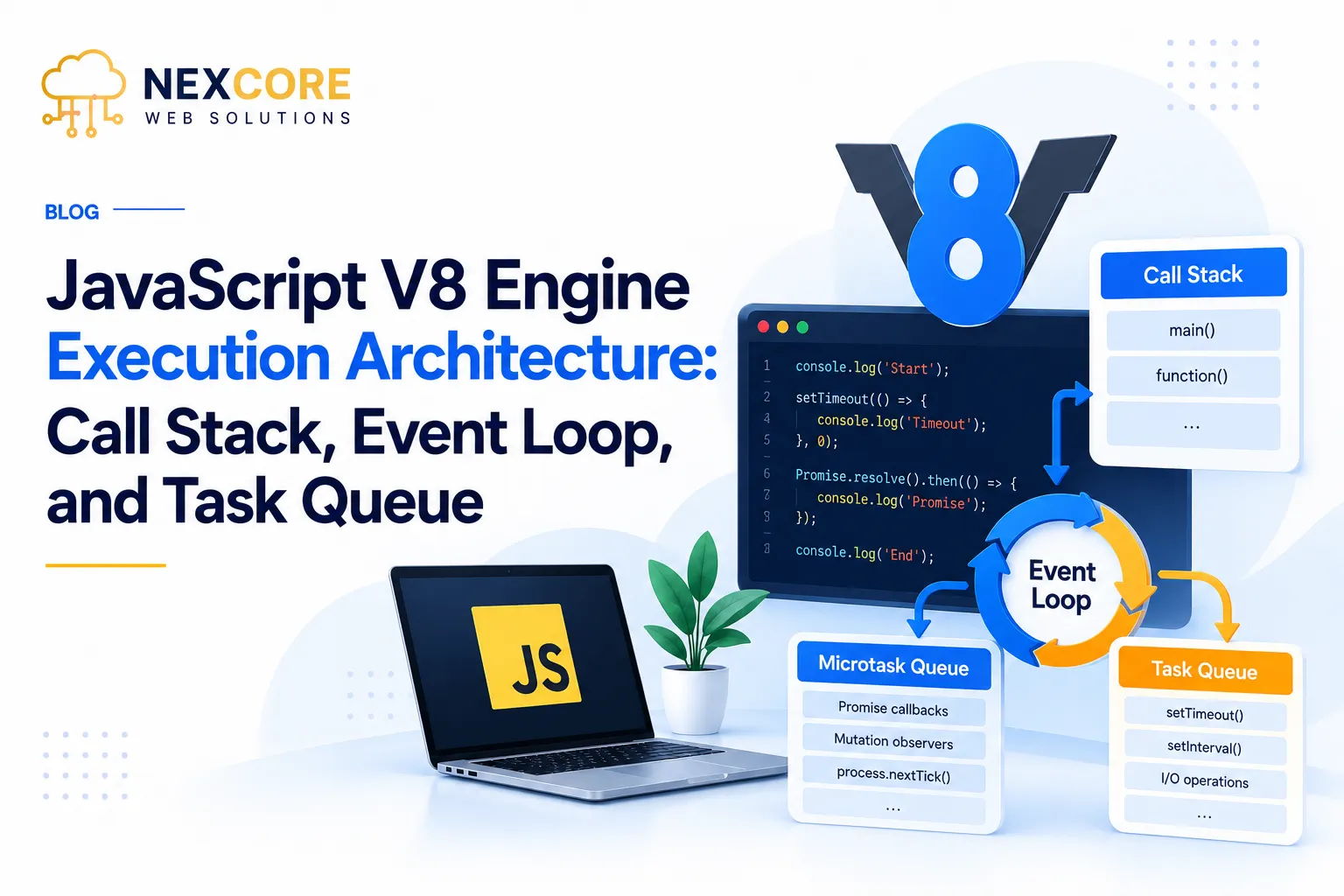
JavaScript is often described as a single-threaded language, yet modern web applications handle timers, network requests, user interactions, animations, and other asynchronous operations without freezing the interface. This behavior becomes easier to understand when you examine the architecture behind JavaScript execution. The V8 engine, developed by Google and used by Chrome and Node.js, compiles and executes JavaScript while working with runtime components that coordinate asynchronous tasks. The call stack manages currently executing functions, while the event loop and task queues coordinate work that must happen later. Understanding how these components interact helps developers write faster, more predictable applications and troubleshoot problems such as blocked interfaces, delayed callbacks, and unexpected execution order.
Understanding the V8 Engine
What V8 Actually Does
V8 is a JavaScript engine responsible for parsing, compiling, optimizing, and executing JavaScript code. When a script reaches the engine, V8 converts source code into internal representations and eventually machine-level instructions that the processor can execute efficiently. Modern V8 uses techniques such as just-in-time compilation and runtime optimization to improve performance while programs are running. However, V8 itself does not provide every asynchronous feature developers commonly associate with JavaScript. Browser or server runtimes provide additional APIs that work alongside the engine.
For example, functions such as setTimeout() are not implemented as ordinary JavaScript functions inside the V8 execution model. In a browser, the runtime provides timer, networking, DOM, and other Web APIs that interact with JavaScript. Node.js similarly provides runtime capabilities around V8 for filesystem operations, networking, timers, and streams. This distinction is important because developers often attribute the entire asynchronous architecture to V8, even though the runtime environment plays a major role.
The Call Stack
How Functions Execute
The call stack is a last-in, first-out structure that tracks function execution. When JavaScript starts executing a function, that function is placed on the stack as a stack frame containing information required for its execution. If that function calls another function, the new function is pushed above it and executes first. Once the function finishes, its frame is removed, allowing execution to return to the previous function.
Consider a simple sequence where main() calls calculate(), and calculate() calls formatResult(). The stack first contains main(), then calculate() is added, followed by formatResult(). When formatResult() completes, it is removed, followed by calculate(), and finally main(). This predictable structure explains why deeply nested synchronous operations can consume stack space. Excessive recursion can eventually cause a stack overflow because the engine cannot continue adding frames indefinitely.
Why Blocking Matters
JavaScript’s main execution thread can process only one JavaScript operation at a time through the call stack. If a function performs an expensive calculation for several seconds, other JavaScript work must wait until that function completes. In a browser, this can make buttons appear unresponsive, delay rendering, and create a poor user experience. Developers therefore need to avoid unnecessarily long synchronous operations and consider techniques such as chunking work, asynchronous processing, or worker threads for demanding workloads.
Event Loop and Asynchronous Execution
The Role of the Event Loop
The event loop coordinates when queued asynchronous callbacks can enter JavaScript execution. When the call stack becomes empty, the runtime can select eligible work from its queues and place callbacks onto the stack. This process allows JavaScript to continue handling other operations while external activities such as timers or network requests are being processed. The event loop therefore acts as a coordinator between completed asynchronous work and the JavaScript execution context.
Suppose an application starts a network request and immediately executes another calculation. The request does not normally block the JavaScript call stack while the underlying runtime handles the operation. Once the relevant operation completes, its callback or continuation becomes eligible for processing. The event loop eventually schedules that work when the execution environment is ready, allowing the application to remain responsive while waiting for external operations.
Task Queues and Execution Order
Macrotasks and Tasks
Task queues contain callbacks that are ready to be executed by the JavaScript runtime. Common examples include timer callbacks, certain event handlers, and other runtime-scheduled operations. A task is generally considered for execution when the call stack is empty, although the precise scheduling behavior depends on the host environment and specification rules. This means placing a callback in a queue does not guarantee that it will execute immediately.
For example, setTimeout(() => console.log("Done"), 0) does not mean the callback executes instantly. The timer establishes a minimum scheduling condition, after which the callback becomes eligible for execution. If the call stack is busy or higher-priority queued work exists, the callback waits. Understanding this distinction prevents developers from incorrectly treating zero-delay timers as immediate operations.
Microtasks and Promises
Promises introduce another important queue known as the microtask queue. Promise reactions created through .then(), .catch(), and .finally(), along with other microtask-based operations, are processed with priority relative to ordinary tasks. After the current JavaScript execution completes, the runtime processes pending microtasks before moving to the next task. This behavior can produce surprising output when promises and timers are mixed.
Consider code that schedules both Promise.resolve().then(...) and setTimeout(..., 0). Even though both operations are asynchronous from the developer’s perspective, the promise callback is generally processed before the timer callback after the current stack finishes. This ordering is useful for understanding modern JavaScript applications, especially code involving promises, async and await, and framework scheduling mechanisms. Developers should also avoid creating endless chains of microtasks because they can delay other queued work.
Practical Execution Example
A useful way to visualize the architecture is to imagine code that logs a message, schedules a timer, resolves a promise, and logs another message synchronously. The synchronous statements execute first because they enter the call stack immediately. Once the stack becomes empty, pending microtasks such as the promise reaction are processed. The timer callback then becomes eligible according to the runtime’s task scheduling rules.
This execution model explains why console output may differ from the order in which statements appear visually in source code. The important factor is not simply where a callback appears but how the runtime classifies and schedules the operation. When debugging asynchronous code, developers should identify synchronous stack execution, microtasks, tasks, and external runtime operations separately. This approach makes complex execution sequences much easier to reason about.
Conclusion
JavaScript execution becomes much less mysterious when the responsibilities of the V8 engine, call stack, runtime APIs, event loop, and task queues are understood separately. V8 handles the core process of executing and optimizing JavaScript, while the host environment provides many asynchronous capabilities. The call stack controls synchronous execution, and the event loop coordinates when queued callbacks can run. Microtasks, including promise reactions, receive priority during the appropriate scheduling phase, while ordinary tasks such as timer callbacks wait for their turn. Developers who understand these mechanics can diagnose blocking code, predict asynchronous behavior, and design applications that remain responsive under real-world workloads.
FAQs
What is the JavaScript call stack?
The JavaScript call stack is a data structure that tracks currently executing functions. When a function starts, it is added to the stack, and when it finishes, it is removed. Nested function calls create additional stack frames. Because JavaScript executes stack operations sequentially, a long-running synchronous function can prevent other JavaScript work from executing until the stack becomes available.
Is the event loop part of the V8 engine?
The event loop should not be treated as a feature provided exclusively by V8. V8 handles JavaScript parsing, compilation, optimization, and execution, while the host environment provides APIs and scheduling mechanisms for asynchronous operations. Browsers and Node.js have their own runtime infrastructure surrounding V8. The event loop coordinates these runtime activities with JavaScript execution.
Why does setTimeout with zero delay not run immediately?
A zero-delay timer does not execute immediately because it schedules a callback to become eligible for execution after the required timer conditions are met. The callback must still wait for the current call stack to finish and for the runtime’s scheduling process to select it. Other eligible work, including microtasks, may be processed before the timer callback gets its turn.
What is the difference between tasks and microtasks?
Tasks and microtasks are different categories of scheduled JavaScript work. Timer callbacks and many event-related operations are handled as tasks, while promise reactions are typically processed as microtasks. After the current synchronous execution finishes, pending microtasks are processed before the runtime proceeds to another task. This distinction explains many unexpected execution-order results.
Why is understanding V8 execution important for developers?
Understanding V8 execution helps developers reason about performance, asynchronous behavior, and application responsiveness. It explains why expensive synchronous code can block interactions and why promise callbacks can execute before timer callbacks. These concepts are especially valuable when debugging Node.js services, browser applications, APIs, and frontend frameworks. A solid execution model also makes asynchronous JavaScript code easier to design and maintain.




