
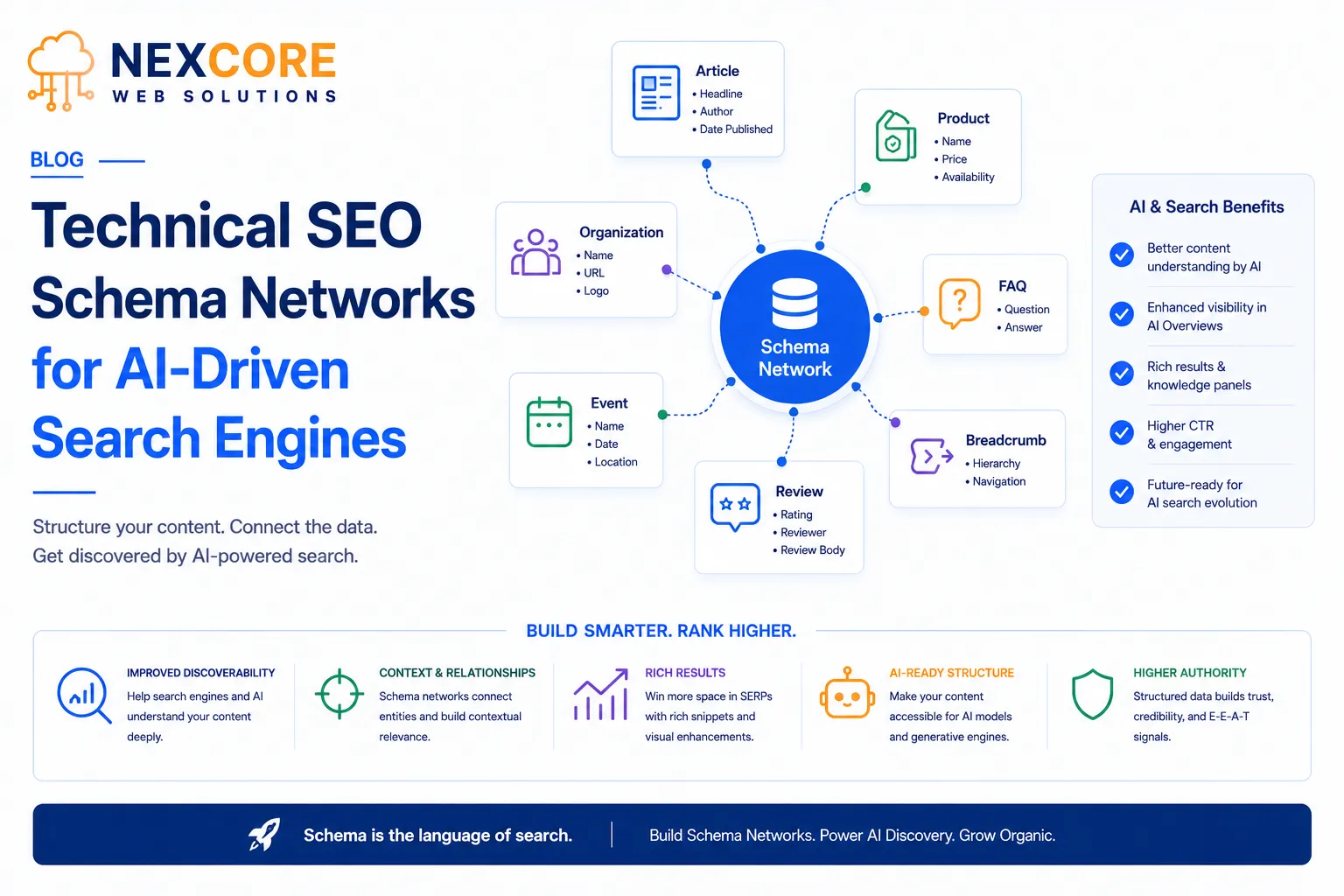
Search engines increasingly rely on structured information to understand what websites, organizations, products, services, and people represent. As AI-driven search experiences become more sophisticated, traditional keyword optimization alone is no longer enough to communicate the relationships between entities and content. Technical SEO schema networks provide a structured way to describe those relationships using machine-readable data. Instead of adding isolated schema types to individual pages, a schema network connects related entities across an entire website through consistent identifiers, properties, and references. This approach can help search systems interpret website architecture more accurately and distinguish important entities from supporting information. For businesses with large websites, complex services, multiple locations, or extensive content libraries, a well-planned schema network can strengthen semantic clarity and support more reliable machine understanding.
Understanding Schema Networks
What Is a Schema Network?
A schema network is a connected collection of structured data entities that describe a website’s important relationships. An organization can be connected to its website, services, authors, locations, products, articles, and other relevant entities through Schema.org properties and stable identifiers. Each page contributes information to the broader semantic structure instead of operating as an isolated markup implementation. This creates a more coherent representation of the business for machines.
Why Entity Relationships Matter
AI-driven search systems need to understand context rather than simply identify matching words. For example, a page mentioning a company, its founder, a service, and an office location becomes more meaningful when those entities are explicitly connected. Properties such as about, provider, author, location, and sameAs can establish these relationships. Accurate connections reduce ambiguity and improve semantic consistency across the site.
Building the Core Entity Layer
Organization and Website Entities
Most business websites should begin by defining their primary organization and website entities. The organization entity can include the official name, logo, URL, contact information, and relevant social profiles, while the WebSite entity represents the digital property itself. Stable @id values allow these entities to be referenced consistently across different pages. This creates a foundation for additional schema relationships.
WebPage Relationships
Individual pages should identify their relationship with the broader website and relevant entities. A service page, for example, can describe the service while connecting it to the organization that provides it. Article pages can identify their author, publisher, topic, and publication details. These relationships help machines understand not only what a page contains but also how it fits within the site’s information architecture.
Connecting Content and Entities
Articles and Authors
Content-heavy websites benefit from consistent relationships between articles, authors, organizations, and topics. Author entities should use stable identifiers so multiple articles written by the same person do not create disconnected representations of that individual. Where appropriate, author profiles can connect to professional information and relevant external identity references. Consistency is more valuable than adding unnecessary properties.
Services and Products
Service and product entities should clearly identify what a business actually offers. A service page can connect the service to its provider, relevant industry, geographic availability, and supporting content. Product pages can similarly connect products with brands, categories, offers, and reviews when those relationships genuinely exist. Structured data should reflect visible, verifiable information rather than assumptions.
Technical Implementation
Use Stable @id Values
Stable identifiers are one of the most important elements of a schema network. An entity should have a consistent @id that can be referenced from other structured data blocks. For example, the organization’s identifier can be reused across service pages, articles, and contact information. Changing identifiers unnecessarily can fragment the semantic graph.
Use JSON-LD Consistently
JSON-LD is generally practical for implementing structured data because it separates machine-readable information from visible page markup. Developers can generate schema dynamically from a content management system while maintaining consistent entity identifiers. However, automation should be controlled carefully because incorrect generated data can spread errors across hundreds or thousands of pages. Templates should be tested before large-scale deployment.
Avoiding Schema Errors
Mark Up What Users Can Verify
Structured data should accurately represent information visible or reasonably supported on the corresponding page. Adding unsupported claims, fictional ratings, irrelevant entities, or misleading relationships can reduce trust in the markup. Schema should describe genuine business information rather than attempt to manipulate search results. Accuracy is more important than maximizing the number of properties.
Prevent Duplicate Entities
Large websites sometimes create multiple versions of the same organization, person, or service because different templates use different identifiers. This fragments the schema network and makes entity relationships harder to interpret. Centralized schema definitions and reusable IDs can prevent unnecessary duplication. Regular audits should identify conflicting or redundant entities.
Schema Networks and AI Search
Supporting Machine Understanding
AI-driven search systems need reliable signals when interpreting websites and generating answers. A connected schema structure can provide explicit context about entities and their relationships, complementing visible content and other technical signals. However, schema does not guarantee inclusion in AI-generated answers or special search features. Its primary value is improving structured machine understanding of legitimate website information.
Combine Schema With Strong Content
Schema cannot compensate for thin, inaccurate, or poorly organized content. AI search systems still depend heavily on the quality, usefulness, accessibility, and credibility of the underlying information. Businesses should therefore combine structured data with clear content, strong internal linking, authoritative sources, fast performance, and consistent entity information. Technical SEO works best when these elements reinforce one another.
Auditing a Schema Network
A useful audit should examine entity consistency, identifier reuse, property accuracy, validation errors, page relationships, and alignment between structured data and visible content. Teams should also review whether important entities are missing from the network or unnecessarily duplicated. Search Console reports and structured-data testing tools can help identify technical issues, but manual review remains important for semantic accuracy. Regular audits become especially valuable after major site migrations or content architecture changes.
Conclusion
Technical SEO schema networks provide a structured framework for helping search engines and AI-driven systems understand complex websites as connected collections of entities rather than isolated pages. The strongest implementations establish stable organization, website, page, author, service, product, and location relationships while maintaining accurate identifiers and meaningful properties. Schema should always reflect genuine information and work alongside high-quality content, internal linking, performance, and trustworthy entity signals. Businesses should avoid treating structured data as a shortcut to rankings or AI visibility. Instead, a carefully maintained schema network should be viewed as part of a broader technical SEO architecture designed to make important information clearer, more consistent, and easier for modern search systems to interpret.
FAQs
1. What is a technical SEO schema network?
A technical SEO schema network is a connected set of structured data entities that describes relationships between an organization’s website, pages, services, products, authors, locations, and other relevant entities. Instead of treating every schema implementation separately, it uses consistent identifiers and relationships to create a clearer machine-readable representation of the website.
2. How does schema help AI-driven search engines?
Schema provides structured context about entities and their relationships, which can complement the information search systems extract from page content. It may help clarify who provides a service, who authored an article, or how a page relates to an organization. However, schema does not guarantee rankings, citations, or inclusion in AI-generated search results.
3. Why are stable @id values important?
Stable @id values allow different schema blocks and pages to refer to the same entity consistently. Without stable identifiers, a large website may accidentally create multiple representations of the same organization, person, or service. Consistent IDs help maintain a coherent entity graph and reduce ambiguity across structured data implementations.
4. Can schema markup improve visibility in AI search results?
Schema can support clearer machine understanding, but it cannot guarantee visibility in AI search results. AI-driven search considers many signals, including content quality, relevance, authority, technical accessibility, and user intent. Structured data works best as part of a broader SEO strategy that accurately represents useful and trustworthy information.
5. How often should a schema network be audited?
A schema network should be reviewed regularly and whenever major changes are made to website architecture, templates, content, services, or organizational information. Audits should check identifier consistency, entity duplication, validation errors, property accuracy, and alignment with visible content. Ongoing monitoring helps prevent technical mistakes from spreading across large numbers of pages.




