
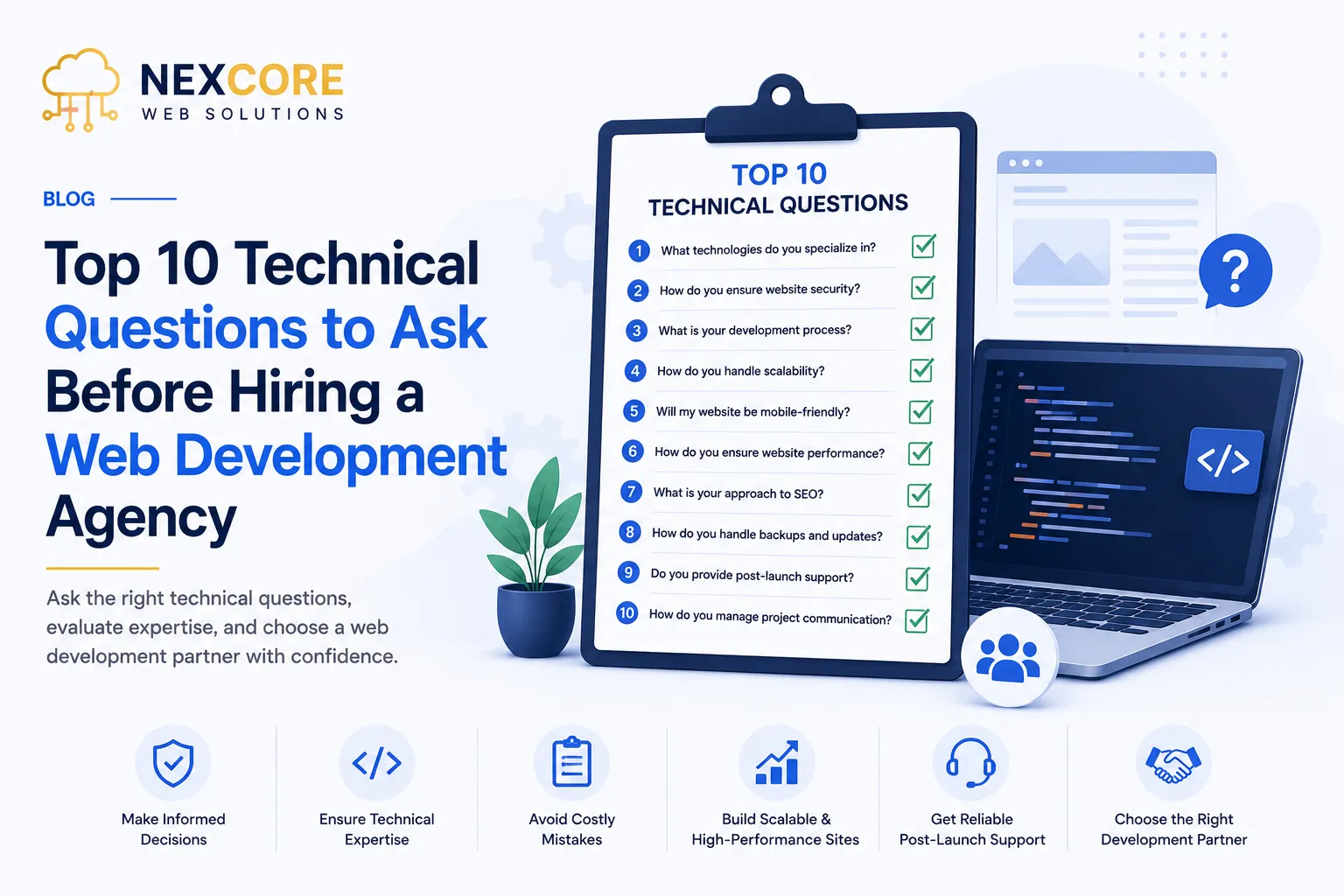
Hiring a web development agency is a significant investment that can influence your company’s online growth for years. While attractive portfolios and competitive pricing may grab your attention, they rarely reveal how technically capable an agency truly is. A visually appealing website means little if it loads slowly, has security flaws, or becomes difficult to maintain over time. Asking the right technical questions before signing a contract helps you understand how the agency approaches development, performance, security, and long-term support. It also reduces the risk of unexpected costs, missed deadlines, and poor-quality work. Whether you are building a business website, an eCommerce platform, or a custom web application, these technical questions will help you choose a development partner with confidence.
Why Technical Questions Matter
Many businesses focus on pricing and design while overlooking the technical foundation of a website. A professionally built website should be secure, scalable, search-engine friendly, and easy to maintain. Without discussing these aspects early, you may end up with a website that requires expensive fixes shortly after launch. Understanding an agency’s technical processes allows you to evaluate its expertise beyond marketing promises and polished sales presentations.
Top 10 Technical Questions to Ask
1. Which Technologies and Frameworks Do You Use?
The first question should focus on the agency’s preferred technology stack. Experienced agencies should clearly explain why they recommend specific programming languages, frameworks, or content management systems for your project. Their recommendation should align with your business goals rather than simply promoting the tools they already use. Understanding the technology stack also helps you estimate future maintenance, scalability, and compatibility with other business systems.
2. How Will You Optimize Website Performance?
Website speed directly affects user experience, search rankings, and conversion rates. Ask how the agency plans to optimize images, minimize code, implement caching, and improve Core Web Vitals. A technically skilled agency should discuss server optimization, lazy loading, content delivery networks, and database performance. These practices ensure your website remains fast as traffic grows.
3. What Security Measures Will Be Implemented?
Cybersecurity should never become an afterthought during development. A reliable agency should explain how it protects websites through secure coding practices, SSL implementation, regular software updates, input validation, and firewall integration. They should also discuss backup strategies and vulnerability monitoring. Understanding their security approach reduces the risk of future attacks and data breaches.
4. Will the Website Be Fully Mobile Responsive?
Most users now browse websites using smartphones and tablets instead of desktop computers. Ask how the agency tests responsiveness across multiple devices, browsers, and screen sizes. Responsive development should extend beyond adjusting layouts to include touch-friendly navigation, optimized images, and fast mobile performance. A positive mobile experience benefits both visitors and search visibility.
5. How Do You Handle SEO During Development?
Search engine optimization begins during website development rather than after launch. Agencies should explain how they structure URLs, optimize page speed, implement schema markup, create XML sitemaps, manage canonical tags, and improve accessibility. Technical SEO decisions made during development often have long-term effects on search performance. Building SEO into the project from the beginning saves significant effort later.
6. Can the Website Scale as My Business Grows?
Business requirements evolve over time, making scalability an essential consideration. Ask whether the website architecture can support additional pages, new features, increased traffic, or third-party integrations without requiring a complete rebuild. A scalable solution protects your investment and reduces future development costs. Agencies should demonstrate experience building flexible systems that accommodate business growth.
7. Who Owns the Website and Source Code?
Ownership is frequently overlooked until problems arise after project completion. Confirm that you will receive complete ownership of the website, source code, design assets, databases, and domain-related configurations upon project delivery. Clarify whether the agency uses proprietary platforms or open technologies. Full ownership provides flexibility if you decide to change development partners in the future.
8. What Testing Process Do You Follow?
Comprehensive testing ensures a stable website before launch. Ask whether the agency performs functional testing, browser compatibility testing, mobile testing, security assessments, performance testing, and user acceptance testing. A structured quality assurance process identifies issues before customers encounter them. Well-tested websites reduce downtime, support requests, and post-launch corrections.
9. What Maintenance and Support Do You Provide?
Launching a website is only the beginning of its lifecycle. Ask whether the agency provides ongoing maintenance, security updates, plugin management, performance monitoring, and technical support after deployment. Reliable post-launch support ensures issues are resolved quickly and keeps the website compatible with changing technologies. Understanding maintenance terms also helps you estimate long-term operating costs.
10. How Will You Manage Integrations and Future Features?
Modern websites often connect with payment gateways, customer relationship management systems, analytics platforms, marketing tools, and APIs. Ask how the agency handles third-party integrations and future feature development. A modular development approach simplifies upgrades without affecting existing functionality. Planning for future integrations early prevents technical limitations as your business expands.
Evaluating the Answers
The quality of an agency’s answers is often more important than the answers themselves. Experienced developers explain technical concepts in simple language without relying on unnecessary jargon. They should provide practical examples, discuss potential challenges honestly, and explain how their solutions address your business objectives. Transparency and clear communication usually indicate a well-organized development process and a reliable long-term partnership.
Conclusion
Choosing a web development agency requires more than comparing prices or reviewing attractive portfolios. Technical expertise determines whether your website remains secure, fast, scalable, and easy to maintain throughout its lifecycle. Asking these ten questions allows you to evaluate an agency’s development standards, communication style, and commitment to long-term quality. Instead of making decisions based solely on appearance or cost, focus on understanding how the agency builds and supports websites behind the scenes. A technically strong development partner creates a reliable digital foundation that supports business growth, improves user experience, and reduces future maintenance challenges. Investing time in the selection process today can prevent expensive problems tomorrow.
FAQs
1. Why should I ask technical questions before hiring a web development agency?
Technical questions help you evaluate an agency’s real expertise beyond its portfolio or marketing materials. They reveal how the agency approaches security, performance, SEO, testing, scalability, and long-term maintenance. Understanding these areas reduces project risks and helps ensure your website performs reliably after launch.
2. What is the most important technical factor when choosing a web development agency?
There is no single most important factor because successful websites depend on multiple technical elements working together. However, security, performance optimization, scalability, clean coding practices, and ongoing maintenance are among the most critical considerations. An experienced agency should demonstrate strength across all of these areas instead of focusing on only one.
3. Should I ask about website ownership before signing a contract?
Yes. You should clearly confirm ownership of the website, source code, design files, databases, and hosting-related assets before development begins. Full ownership ensures you can maintain, modify, or transfer the website to another developer without legal or technical complications in the future.
4. How important is technical SEO during website development?
Technical SEO is essential because many optimization decisions are made while building the website. Proper URL structures, schema markup, XML sitemaps, canonical tags, mobile responsiveness, and page speed improvements all contribute to better search engine visibility. Addressing these factors during development is far more effective than correcting them after launch.
5. Should every web development agency provide ongoing maintenance?
While not every agency offers maintenance services, ongoing support is highly recommended. Websites require regular software updates, security patches, performance monitoring, backups, and compatibility testing. Choosing an agency that provides reliable maintenance helps protect your investment and ensures the website continues operating efficiently as technology evolves.




